Results by title
237 books match the query 'Race & Ethnic Relations' and 4 start with g
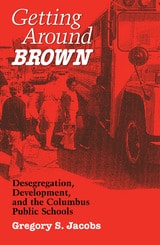
Getting around Brown
Desegregation, Development, and the Columbus Public SchoolsGregory S. Jacobs
The Ohio State University Press, 1998
Getting Around Brown is both the first history of school desegregation in Columbus, Ohio, and the first case study to explore the interplay of desegregation, business, and urban development in America.
Drawing on a broad range of sources, including over sixty interviews, the book details the causes and consequences of Penick v. Columbus Board of Education (1977). Gregory S. Jacobs argues that school desegregation in Columbus failed to produce equal educational opportunity, not because it was inherently detrimental to learning, but because it was incompatible with urban development. As a consequence, the long-term health of the city school district was sacrificed to preserve the growth of the city itself. The resulting middle-class abandonment of urban education in Columbus produced an increasingly poor, African-American city school system and a powerful form of defensive activism within the overwhelmingly white suburban systems.
The title of the book refers not only to the elaborate tools used to circumvent the spirit of the Supreme Court’s landmark 1954 Brown v. Board of Education decision but also to the need to move beyond the flawed dichotomies and failed policies that have come to define desegregation. The book calls for a reconsideration of the complicated relationship race, class, and housing patterns have with city school reform efforts, a relationship obscured by this country’s vitriolic and occasionally violent battle over busing. Jacobs concludes his study with a “modest proposal,” in which he recommends the abolition of the Columbus Public School District, the dispersal of its students throughout surrounding suburban systems, and the creation of a choice-based “experimental education zone” within the old city school district boundaries.
Readable and relevant, Getting around Brownis essential reading for scholars of recent American history, urban studies, civil rights and race relations, and educational policy, as well as anyone interested in public education and politics.
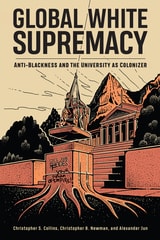
Global White Supremacy
Anti-Blackness and the University as ColonizerChristopher S. Collins
Rutgers University Press, 2023
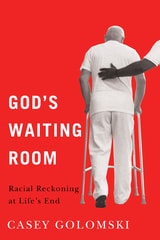
God's Waiting Room
Racial Reckoning at Life's EndCasey Golomski
Rutgers University Press, 2025
Winner of the Elliott P. Skinner Award from the Association of Africanist Anthropology, part of the American Anthropological Association
Third Place in the Victor Turner Prize in Ethnographic Writing from the American Anthropological Association's Society for Humanistic Anthropology
Can older racists change their tune, or will they haunt us further once they're gone? Rich in mystery and life's lessons, God's Waiting Room considers what matters in the end for older white adults and the younger Black nurses who care for them. An innovation in creative nonfiction, Casey Golomski's story of his years of immersive research at a nursing home in South Africa, thirty years after the end of apartheid, is narrated as a one-day, room-by-room tour. The story is told in breathtakingly intimate and witty conversations with the home's residents and nurses, including the untold story of Nelson Mandela's Robben Island prison nurse, and readers learn how ageism, sexism, and racism intersect and impact health care both in South Africa and in the United States, as well as create conditions in which people primed to be enemies find grace despite the odds.
Course or Book Club Reading and Discussion Guide (https://dhjhkxawhe8q4.cloudfront.net/rup-wp-v2/wp-content/uploads/2025/02/04135941/gods-waiting-room_reading-questions.pdf)
For copyright reasons, this edition is not available in the South African Development Community and Kenya.
Good Boys, Bad Hombres
The Racial Politics of Mentoring Latino Boys in SchoolsMichael V Singh
University of Minnesota Press, 2024
The unintended consequences of youth empowerment programs for Latino boys
Educational research has long documented the politics of punishment for boys and young men of color in schools—but what about the politics of empowerment and inclusion? In Good Boys, Bad Hombres, Michael V. Singh focuses on this aspect of youth control in schools, asking on whose terms a positive Latino manhood gets to be envisioned.
Based on two years of ethnographic research in an urban school district in California, Good Boys, Bad Hombres examines Latino Male Success, a school-based mentorship program for Latino boys. Instead of attempting to shape these boys’ lives through the threat of punishment, the program aims to provide an “invitation to a respectable and productive masculinity” framed as being rooted in traditional Latinx signifiers of manhood. Singh argues, however, that the promotion of this aspirational form of Latino masculinity is rooted in neoliberal multiculturalism, heteropatriarchy, and anti-Blackness, and that even such empowerment programs can unintentionally reproduce attitudes that paint Latino boys as problematic and in need of control and containment.
An insightful gender analysis, Good Boys, Bad Hombres sheds light on how mentorship is a reaction to the alleged crisis of Latino boys and is governed by the perceived remedies of the neoliberal state. Documenting the ways Latino men and boys resist the politics of neoliberal empowerment for new visions of justice, Singh works to deconstruct male empowerment, arguing that new narratives and practices—beyond patriarchal redemption—are necessary for a reimagining of Latino manhood in schools and beyond.