97 books match the query 'Race discrimination' and 3 start with g

cover of Germany and Its Gypsies: A Post-Auschwitz Ordeal

Germany and Its Gypsies

A Post-Auschwitz Ordeal

Gilad Margalit

University of Wisconsin Press, 2002

    Historian Gilad Margalit eloquently fills a tragic gap in the historical record with this sweeping examination of the plight of Gypsies in Germany before, during, and since the era of the Third Reich.
    Germany and Its Gypsies reveals the painful record of the official treatment of the German Gypsies, a people whose future, in the shadow of Auschwitz, remains uncertain. Margalit follows the story from the heightened racism of the nineteenth century to the National Socialist genocidal policies that resulted in the murder of most German Gypsies, from the shifting attitudes in the two Germanys in 1945 through reunification and up to the present day.
    Drawing upon a rich variety of sources, Margalit considers the pivotal historic events, legal arguments, debates, and changing attitudes toward the status of the German Gypsies and shines a vitally important light upon the issue of ethnic groups and their victimization in society. The result is a powerful and unforgettable testament.
[more]
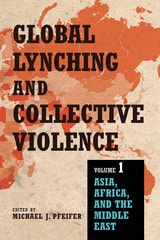
cover of Global Lynching and Collective Violence: Volume 1: Asia, Africa, and the Middle East

Global Lynching and Collective Violence

Volume 1: Asia, Africa, and the Middle East

Edited by Michael J. Pfeifer

University of Illinois Press, 2017
Often considered peculiarly American, lynching in fact takes place around the world. In the first book of a two-volume study, Michael J. Pfeifer collects essays that look at lynching and related forms of collective violence in Africa, Asia, and the Middle East. Understanding lynching as a transnational phenomenon rooted in political and cultural flux, the writers probe important issues from Indonesia--where a long history of public violence now twines with the Internet--to South Africa, with its notorious history of necklacing. Other scholars examine lynching in medieval Nepal, the epidemic of summary executions in late Qing-era China, the merging of state-sponsored and local collective violence during the Nanking Massacre, and the ways public anger and lynching in India relate to identity, autonomy, and territory. Contributors: Laurens Bakker, Shaiel Ben-Ephraim, Nandana Dutta, Weiting Guo, Or Honig, Frank Jacob, Michael J. Pfeifer, Yogesh Raj, and Nicholas Rush Smith.
[more]
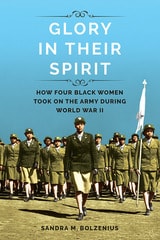
cover of Glory in Their Spirit: How Four Black Women Took On the Army during World War II

Glory in Their Spirit

How Four Black Women Took On the Army during World War II

Sandra M Bolzenius

University of Illinois Press, 2018

Before Rosa Parks and the March on Washington, four African American women risked their careers and freedom to defy the United States Army over segregation. Women Army Corps (WAC) privates Mary Green, Anna Morrison, Johnnie Murphy, and Alice Young enlisted to serve their country, improve their lives, and claim the privileges of citizenship long denied them. Promised a chance at training and skilled positions, they saw white WACs assigned to those better jobs and found themselves relegated to work as orderlies. In 1945, their strike alongside fifty other WACs captured the nation's attention and ignited passionate debates on racism, women in the military, and patriotism. Glory in Their Spirit presents the powerful story of their persistence and the public uproar that ensued. Newspapers chose sides. Civil rights activists coalesced to wield a new power. The military, meanwhile, found itself increasingly unable to justify its policies. In the end, Green, Morrison, Murphy, and Young chose court-martial over a return to menial duties. But their courage pushed the segregated military to the breaking point ”and helped steer one of American's most powerful institutions onto a new road toward progress and justice.
[more]