Results by title
72 books match the query 'Railroads' and 5 start with g

GENERATION OF BOOMERS
Shelton Stromquist
University of Illinois Press, 2000
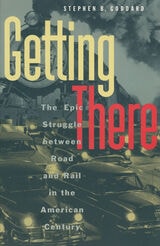
Getting There
The Epic Struggle between Road and Rail in the American CenturyStephen B. Goddard
University of Chicago Press, 1996
"This is a riveting story: of mighty railroads hamstrung almost overnight by government bureaucrats; of road interests led by General Motors Corp. conspiring in city after city to destroy efficient trolley systems . . . and of freeways that are far from free."—Bill Laitner, Detroit Free Press
"The combination of forces and fates that turned America into a giant parking lot from sea to shining sea is the subject of Stephen B. Goddard's lively pop history. . . . As Mr. Goddard ably points out, road-building and the creation of car-dependent suburbs have become ends in themselves."—James Howard Kunstler, Wall Street Journal
"The strength of Goddard's book is that he understands the complexities of manipulating public opinion to influence legislatures."—David Young, Chicago Tribune
"[Goddard's] book is a deft and easily read history of how transportation has shaped the nation and its economy, and ultimately, how a federation of truck and car interests drastically tilted national policies. . . . For many reasons this is an exceptionally important work."—Jim Dwyer, New York Newsday
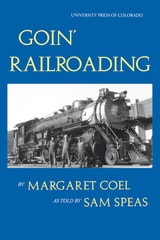
Goin' Railroading
Two Generations of Colorado StoriesMargaret Coel
University Press of Colorado, 1998
Goin' Railroading is the story of two generations of such men, four members of the Speas family who, from the open cabs of narrow-gauge steam engines, watched Colorado grow.
Sam Speas tells the story of his father, Sam Speas Sr., who left Missouri in 1883 to become an engineer in Colorado, and recounts his own experiences and those of his brothers and fellow railroaders on the Colorado and Southern Railway, from the golden era of the narrow-gauge lines in South Park to the final days of steam power on the Front Range and the coming of the diesel engine.
His stories are a profound document of a vanished way of life, a testament to the courage and tenacity of the early citizens of Colorado, and a tribute to the rough-hewn, often gallant men who took the trains through incredible, almost unbelievable, hazards. Funny, tragic, bittersweet, and poignant, Goin' Railroading is a remarkable book that brings a portion of the history and people of an earlier Colorado to vibrant life.
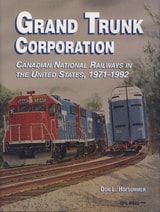
Grand Trunk Corporation
Canadian National Railways in the United States, 1971-1992Don L. Hofsommer
Michigan State University Press, 1995
The Detroit, Michigan-based Grand Trunk Corporation was established more than two decades ago by Canadian National to oversee and maximize the potential of its railroad holdings in the United States. By making use of corporate records, oral histories, and archival material, Hofsommer uncovers the interesting and complex history of Grand Trunk from its inception in 1971 through 1992.
Gulf To Rockies
The Heritage of the Fort Worth and Denver–Colorado and Southern Railways, 1861–1898By Richard C. Overton
University of Texas Press, 1953
Gulf to Rockies is a chapter in the business and economic history of the American West and the story of two of the most colorful railroad builders of the nineteenth century.
Throughout the 1860s the mineral treasures of Colorado were virtually inaccessible for lack of railroads. Even after a hectic decade of building in the 1870s, the state faced a new sort of isolation: every railroad crossing her borders was controlled by the Union Pacific or the Santa Fe. As a result, the Rocky Mountain region could not hope to compete with the Midwest for the business of the Atlantic seaboard.
To remedy this situation, John Evans, former governor of Colorado, organized in 1881 a railroad to run southward from Denver as the first link in a cheap rail-water route via the Gulf of Mexico to the East. Meanwhile ambitious Fort Worth citizens had incorporated the Fort Worth and Denver City in 1873. Not a rail was laid on either road, however, until General Grenville M. Dodge, famed builder of the Union Pacific and the Texas Pacific, took up the Texas project and joined forces with Evans to create the Gulf-to-Rockies route.
It took seven years for these men and their associates to mobilize funds and complete the Fort Worth–Denver line, and another decade to establish the system’s independence and solve its financial problems in the face of drought, depression, and intense competition.
Gulf to Rockies was written under special agreements with Northwestern University and the Chicago, Burlington & Quincy Railroad, whereby the university relieved Mr. Overton of a part of his duties in order that he might have time for research and writing and the railroad undertook to bear the cost of the research. The Burlington also permitted him free access to all company records and granted him unrestricted freedom to publish his findings.