Results by title
1017 books match the query 'Reference' and 22 start with g
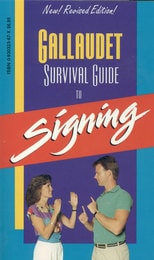
Gallaudet Survival Guide to Signing
Leonard Lane
Gallaudet University Press, 1987
Gender Equity in Education
An Annotated BibliographyBeverly Stitt
Southern Illinois University Press, 1994
Recent studies show that, either consciously or unconsciously, teachers are not practicing gender equity in the classroom. Boys are called on more in class than girls and are encouraged to pursue careers from which girls are excluded because they are thought to be less capable.
Serious questions arise for educators and counselors in this time of increasing awareness of the implications of gender bias, such as what comprises a gender-fair education and how can gender equity become part of the classroom curriculum? Guidance counselors and teachers share an important responsibility in seeking answers to these questions in order to avoid limiting students’ potential because of gender.
To achieve this end, Beverly A. Stitt has compiled an annotated bibliography of hundreds of books, articles, videos, classroom activities, and curriculum and workshop guides to help provide the tools needed for educators to become more gender conscious and to develop a gender–fair educational system.
The bibliography is divided into twenty-three categories under the headings of Agriculture and Industry, Business, Career Guidance, Communications, Computers, Discrimination, Displaced Homemakers/Reentry Women, Elementary Education, Family and Work Issues, Gender Role Stereotyping, History, Home Economics, In-service Training, Legislation, Male Focus, Math and Science, Nontraditional Careers, Pregnant and Parenting Teens, Recruitment, Special Needs, Teaching, Vocational Education, and Women’s Studies.
Each entry’s annotation provides a short description of the content, the age group to which the resource applies, and ordering information. The book concludes with an index in which entries are cross-referenced under various categories to further aid the reader’s research.
Gender, Health, and History in Modern East Asia
Edited by Angela Ki Che Leung and Izumi Nakayama
Hong Kong University Press, 2017
Georgia Civil War Manuscript Collections
An Annotated BibliographyDavid H. Slay
University of Alabama Press, 2011
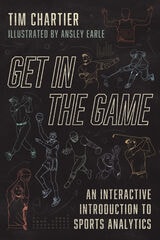
Get in the Game
An Interactive Introduction to Sports AnalyticsTim Chartier
University of Chicago Press, 2022
In 2013, NBA point guard Steph Curry wowed crowds when he sunk 11 out of 13 three-pointers for a game total of 54 points—only seven other players, including Michael Jordan and Kobe Bryant, had scored more in a game at Madison Square Garden. Four years later, the University of Connecticut women’s basketball team won its hundredth straight game, defeating South Carolina 66–55. And in 2010, one forecaster—an octopus named Paul—correctly predicted the outcome of all of Germany’s matches in the FIFA World Cup. These are surprising events—but are they truly improbable?
In Get in the Game, mathematician and sports analytics expert Tim Chartier helps us answer that question—condensing complex mathematics down to coin tosses and dice throws to give readers both an introduction to statistics and a new way to enjoy sporting events. With these accessible tools, Chartier leads us through modeling experiments that develop our intuitive sense of the improbable. For example, to see how likely you are to beat Curry’s three-pointer feat, consider his 45.3 percent three-point shooting average in 2012–13. Take a coin and assume heads is making the shot (slightly better than Curry at a fifty percent chance). Can you imagine getting heads eleven out of thirteen times? With engaging exercises and fun, comic book–style illustrations by Ansley Earle, Chartier’s book encourages all readers—including those who have never encountered formal statistics or data simulations, or even heard of sports analytics, but who enjoy watching sports—to get in the game.
Getting A Life
Everyday Uses of AutobiographySidonie Smith
University of Minnesota Press, 1996
Getting It Published, 2nd Edition
A Guide for Scholars and Anyone Else Serious about Serious BooksWilliam Germano
University of Chicago Press, 2008
But a lot has changed in the past seven years. With the publishing world both more competitive and more confusing—especially given the increased availability of electronic resources—this second edition of Germano’s best-selling guide has arrived at just the right moment. As he writes in a new chapter, the “via electronica” now touches every aspect of writing and publishing. And although scholars now research, write, and gain tenure in a digital world, they must continue to ensure that their work meets the requirements of their institutions and the needs of their readers.
Getting It Published, Third Edition
A Guide for Scholars and Anyone Else Serious about Serious BooksWilliam Germano
University of Chicago Press, 2016
Today there are more ways to publish than ever, and more challenges to traditional publishing. This ever-evolving landscape brings more confusion for authors trying to understand their options. The third edition of Getting It Published offers the clear, practicable guidance on choosing the best path to publication that has made it a trusted resource, now updated to include discussions of current best practices for submitting a proposal, of the advantages and drawbacks of digital publishing, and tips for authors publishing textbooks and in open-access environments.
Germano argues that it’s not enough for authors to write well—they also need to write with an audience in mind. He provides valuable guidance on developing a compelling book proposal, finding the right publisher, evaluating a contract, negotiating the production process, and, finally, emerging as a published author.
“This endlessly useful and expansive guide is every academic’s pocket Wikipedia: a timely, relevant, and ready resource on scholarly publishing, from the traditional monograph to the digital e-book. I regularly share it, teach it, and consult it myself, whenever I have a question on titling a chapter, securing a permission, or negotiating a contract. Professional advice simply does not get any savvier than this pitch-perfect manual on how to think like a publisher.”—Diana Fuss, Princeton University
Getting Published in Academic Journals
Navigating the Publication ProcessBrian Paltridge and Sue Starfield
University of Michigan Press, 2016
Getting Published in Academic Journals draws on the experiences of the authors as editors of peer-reviewed journals, as teachers of writing-for-publication courses and workshops, as researchers of the scholarly publication process, as reviewers of hundreds of articles, and as published authors.
The book is written to be used in courses and workshops on publishing, as a supplement to the books in the revised and updated English in Today’s Research World (Swales & Feak) series, and as a stand-alone guide for academic writers working independently.
Given Time II
Jacques Derrida
University of Chicago Press, 2026
The long-awaited conclusion to Derrida’s seminar on the gift and time.
In 1991, Jacques Derrida published the first half of a seminar delivered from 1978 to 1979 on gifts and time, but the second installment (though expected) was not completed in his lifetime. Given Time II completes the seminar with eight sessions that showcase Derrida’s most advanced work on the problematic of the gift in Heidegger, with deep dives into some of the most difficult texts in the Heideggerian corpus, including “The Origin of the Work of Art,” “The Thing,” and “On Time and Being.”
Beyond Heidegger, Derrida engages Claude Lévi-Strauss, Marcel Mauss, Maurice Blanchot, Jacques Lacan, and others on the act of giving and receiving, the sacrificial gift, and more. Throughout, Derrida identifies a paradox of gift giving: for the gift to be received as a gift, it must not appear as such, since gifts often involve a cycle of debt and repayment. Given Time II is a uniquely Derridean treatment of an important subject in the work of Heidegger and beyond.
Glossary of Hausa Music and Its Social Contexts
David W. Ames and Anthony V. King
Northwestern University Press, 1971
Glossary of Typesetting Terms
Richard Eckersley, Richard Angstadt, Charles M. Ellertson, and Richard Hendel
University of Chicago Press, 1994
Prepared by a team of leading professionals—a designer, an editor, compositors, and production managers—this glossary will be valuable to anyone who works in publishing or printing for its definitions of typographical terms and concise treatment of typographical style.
The glossary adds important details to discussions of typography that are covered more generally in editorial style guides such as The Chicago Manual of Style. It is indispensable to anyone who prepares text for a living, including those who implement their own typesetting decisions with the aid of word-processing and page-layout software.
This manual furnishes a common technical vocabulary for specialists and nonspecialists alike. More than 900 entries provide up-to-date meanings for traditional terms like kerning,bleed, and thumbnail and definitions of new phrases like global search and replace,H & J (hyphenation and justification), and idiot file that have been developed to describe the role of computer technology in typesetting.
Eight appendixes offer additional guidance. The house style sheets of a major typesetter provide a sample checklist of items that affect the way in which words are composed into professional-quality type. Other appendixes cover families of type, the parts of a book, diagrams of the parts of a letter, coding and marking a manuscript in the precise language of typesetters, writing specifications for tables, proofreaders’ marks, and special characters.
No other reference book makes the vocabulary and practices of contemporary typesetting so accessible.
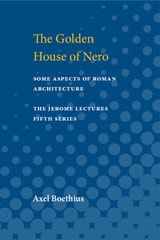
Golden House of Nero
Some Aspects of Roman ArchitectureAxel Boethius
University of Michigan Press, 1960
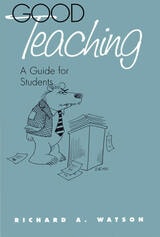
Good Teaching
A Guide for StudentsRichard A. Watson
Southern Illinois University Press, 1997
From junior college to Ivy League university, the level of teaching ranges from "great to awful," according to Richard A. Watson, who explains not only how to survive but how to profit from and enjoy your college experience.
To help students make important personal choices—what school? what major? what classes?—Watson explains such broad areas as administrative structure, institutional goals, and faculty aspirations.
Charging the student with the ultimate responsibility for learning, Watson presents certain academic facts of life: teaching is not the primary concern of either the faculty or the administration in most institutions; few professors on the university level have had any training in teaching, and even fewer started out with teaching as their goal; senior professors do not teach much (the higher the rank and salary, the less time in the classroom), and those seeking tenure must emphasize research to survive; and almost certainly, the bad teacher who is a good researcher will get paid more than the good teacher who does not publish.
This is a book about good teaching and how to find it. Rejecting the conventional wisdom that a professor devoted to research will not be effective in the classroom, Watson advises that you take classes from the professor you may have been cautioned to avoid.
Grammar Crammer
How to Write Perfect SentencesJudi Kesselman-Turkel and Franklynn Peterson
University of Wisconsin Press, 2003
The Grammar Crammer is a concise, sensible grammar handbook that explains lucidly how to remember correct word forms and sentence structures. Useful as a reference tool for high school and beyond, it packs an entire grammar encyclopedia into just over a hundred pages.

Greek Grammar of the New Testament and Other Early Christian Literature
Edited by Robert W. Funk
University of Chicago Press, 1961
This work was created by Friedrich Blass, professor of classical philology at the University of Halle-Wittenberg, and was continued after his death by Albert Debrunner, professor of Indo-European and classical philology at the University of Bern until his retirement in 1954. The grammar has passed through ten editions from 1896 to 1960.
Robert W. Funk, in translating this long-established classic, has also revised it and, in doing so, has incorporated the notes which Professor Debrunner had prepared for a new German edition on which he was working at the time of his death in 1958. Dr. Funk has also had the co-operation of leading British, Continental, and American scholars. The translation places in the hands of English-speaking students a book that belongs in their libraries and in the libraries of every theologian, philologist and pastor alongside the Gingrich-Danker Greek-English Lexicon.
This grammar sets the Greek of the New Testament in the context of Hellenistic Greek and compares and contrasts it with the classical norms. It relates to the New Testament language to its Semitic background, to Greek dialects, and to Latin and has been kept fully abreast of latest developments and manuscript discoveries. It is at no point exclusively dependent on modern editions of the Greek New Testament text but considers variant readings wherever they are significant. It is designed to compress the greatest amount of information into the smallest amount of space consistent with clarity. There are subsections discussing difficult or disputed points and copious citations of primary texts in addition to generous bibliographies for those who wish to pursue specific items further.
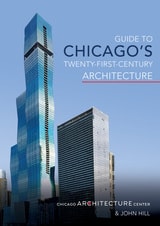
Guide to Chicago's Twenty-First-Century Architecture
Chicago Architecture Center and John Hill
University of Illinois Press, 2021
Chicago's wealth of architectural treasures makes it one of the world's majestic cityscapes. Published in collaboration with the Chicago Architecture Center, this easy-to-use guide invites you to discover the new era of twenty-first-century architecture in the Windy City via two hundred architecturally significant buildings and spaces in the city and suburbs. Features include:
- Entries organized by neighborhood
- Maps with easy-to-locate landmarks and mass transit options
- Background on each entry, including the design architect, name and address, description, and other essential information
- Sidebars on additional sites and projects
- A detailed supplemental section with a glossary, selected bibliography, and indexes by architect, building name, and building type
Up-to-date and illustrated with almost four hundred color photos, the Guide to Chicago's Twenty-First-Century Architecture takes travelers and locals on a journey into an ever-changing architectural mecca.

Guide to Reference in Business and Economics
Steven W. American Library Association
American Library Association, 2014
Guide to Reference in Essential General Reference and Library Science Sources
Jo Bell American Library Association
American Library Association, 2014
Guide to Reference in Genealogy and Biography
Mary K. American Library Association
American Library Association, 2015
Guide to Reference in Medicine and Health
Denise Beaubien Bennett
American Library Association, 2014
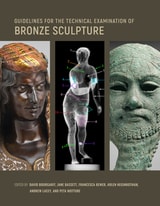
Guidelines for the Technical Examination of Bronze Sculpture
David Bourgarit
J. Paul Getty Trust, The, 2023
Since the fourth millennium BCE, bronze has been the preferred medium for some of the most prestigious and sacred works of art. But only through interdisciplinary research can the fabrication of these extraordinary objects be properly investigated, interpreted, and documented. This innovative publication bridges the expertise of myriad art-technological specialists to create a new framework for advancing the understanding of bronze sculpture.
Essential reading for curators, conservators, scientists, archaeologists, sculptors, metallurgists, founders, dealers, collectors, and anyone interested in the life cycle of a bronze, this volume explains how to identify the evidence of process steps, metals used, casting defects, and surface work and alterations before moving on to address analytical techniques ranging from visual exams to imaging, material analyses, and dating. The guidelines are accompanied by detailed illustrations, including videos, charts, and animations; a robust vocabulary, ensuring precision across English, German, French, Italian, and Chinese; a diverse selection of case studies; and a comprehensive bibliography.
The free online edition of this open-access publication is available at getty.edu/publications/bronze-guidelines/ and includes videos and zoomable illustrations. Also available are free PDF and EPUB downloads of the book.