Results by title
201 books match the query 'Regional Studies' and 11 start with g
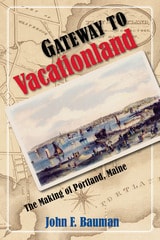
Gateway to Vacationland
The Making of Portland, MaineJohn F. Bauman
University of Massachusetts Press, 2012
Situated on a peninsula jutting into picturesque Casco Bay, Portland has long been admired for its geographical setting—the “beautiful city by the sea,” as native son Henry Wadsworth Longfellow called it. At the same time, Portland's deep, ice-free port has made it an ideal site for the development of coastal commerce and industry. Much of the city's history, John F. Bauman shows, has been defined by the effort to reconcile the competing interests generated by these attributes—to balance the imperatives of economic growth with a desire to preserve Portland's natural beauty.
Caught in the crossfire of British and French imperial ambitions throughout the colonial era, Portland emerged as a prosperous shipbuilding center and locus of trade in the decades following the American Revolution. During the nineteenth century it became a busy railroad hub and winter port for Canadian grain until a devastating fire in 1866 reduced much of the city to ruins. Civic leaders responded by reinventing Portland as a tourist destination, building new hotels, parks, and promenades, and proclaiming it the “Gateway to Vacationland.”
After losing its grain trade in the 1920s and suffering through the Great Depression, Portland withered in the years following World War II as it wrestled with the problems of deindustrialization, suburbanization, and an aging downtown. Efforts at urban renewal met with limited success until the 1980s, when a concerted plan of historic preservation and the restoration of the Old Port not only revived the tourist trade but eventually established Portland as one of America's “most livable cities.”

Germania, USA
Social Change in New Ulm, MinnesotaNoel Iverson
University of Minnesota Press, 1967
Germania, USA was first published in 1967. Minnesota Archive Editions uses digital technology to make long-unavailable books once again accessible, and are published unaltered from the original University of Minnesota Press editions.
An unusual community in southern Minnesota, New Ulm, a town of about 12,000 inhabitants, is the subject of this sociological study. New Ulm was founded in 1856 by a group of German immigrants who came to the United States as refugees from the revolution of 1848 in Germany. They were members of the Turnverein, a society of liberal thinkers who were a political minority in Germany. In founding New Ulm they established a "utopian" ethnic community, became the town's status elite, and for a long time monopolized its economic, political, and cultural life.
Professor Iverson analyzes four aspects of sociological change in the community—class, status, power, and assimilation. Each aspect is viewed according to the differences found between two generations of the upper status group, the Turners, and two corresponding generations of non-Turners.
In addition to its substantive contribution to our knowledge of ethnic settlements, the study demonstrates a gain in methodological precision over many earlier studies of ethnic communities. Its chief methodological innovation is in the use of scales to verify and measure the changing structure of class, status, and power, and to gauge the extent of assimilation.
The book is of interest not only to sociologists, especially those concerned with the study of community change, but also to political scientists interested in the study of community power structures. Also, the methodology will be instructive to those interested in the design of community studies.
Germans in Illinois
Miranda E. Wilkerson and Heather Richmond
Southern Illinois University Press, 2019
The promise of cheap land and fertile soil in rural areas and emerging industries in cities attracted three major waves of German-speaking immigrants to Illinois in search of freedom and economic opportunities. Before long the state was dotted with German churches, schools, cultural institutions, and place names. German churches served not only as meeting places but also as a means of keeping language and culture alive. Names of Illinois cities and towns of German origin include New Baden, Darmstadt, Bismarck, and Hamburg. In Chicago, many streets, parks, and buildings bear German names, including Altgeld Street, Germania Place, Humboldt Park, and Goethe Elementary School. Some of the most lively and ubiquitous organizations, such as Sängerbunde, or singer societies, and the Turnverein, or Turner Society, also preserved a bit of the Fatherland.
Exploring the complex and ever-evolving German American identity in the growing diversity of Illinois’s linguistic and ethnic landscape, this book contextualizes their experiences and corrects widely held assumptions about assimilation and cultural identity. Federal census data, photographs, lively biographical sketches, and newly created maps bring the complex story of German immigration to life. The generously illustrated volume also features detailed notes, suggestions for further reading, and an annotated list of books, journal articles, and other sources of information.

Gichigami Hearts
Stories and Histories from MisaabekongLinda LeGarde Grover
University of Minnesota Press, 2021
Award-winning author Linda LeGarde Grover interweaves family and Ojibwe history with stories from Misaabekong (the place of the giants) on Lake Superior
Long before there was a Duluth, Minnesota, the massive outcropping that divides the city emerged from the ridge of gabbro rock running along the westward shore of Lake Superior. A great westward migration carried the Ojibwe people to this place, the Point of Rocks. Against this backdrop—Misaabekong, the place of the giants—the lives chronicled in Linda LeGarde Grover’s book unfold, some in myth, some in long-ago times, some in an imagined present, and some in the author’s family history, all with a deep and tenacious bond to the land, one another, and the Ojibwe culture.
Within the larger history, Grover tells the story of her ancestors’ arrival at the American Fur Post in far western Duluth more than two hundred years ago. Their fortunes and the family’s future are inextricably entwined with tales of marriages to voyageurs, relocations to reservation lands, encounters with the spirits of the lake and wood creatures, the renewal of life—in myth and in art, the search for meaning in the transformations of our day is always vital. Finally, in one man’s struggles, age-old tribulations, the intergenerational traumas of extended families and communities, and a uniquely Ojibwe appreciation for the natural and spiritual worlds converge, forging the Ojibwe worldview and will to survive as his legacy to his descendants.
Blending the seen and unseen, the old and the new, the amusing and the tragic and the hauntingly familiar, this lyrical work encapsulates a way of life forever vibrant at the Point of Rocks.

Global Politics of Regionalism
Theory and PracticeEdited by Mary Farrell, Bjorn Hettne, and Luk Van Langenhove
Pluto Press, 2005
The book reviews the major theoretical approaches to regional cooperation including perspectives from international relations, political economy, economics and sociology. It is divided into three main sections: theoretical approaches to regionalism; issues of regional cooperation (such as security, monetary issues, identity and integration); and an exploration of specific case studies including the Middle East, Africa, the Americas, China, Europe, Asia and the Pacific.
With an international range of contributors, including Bjorn Hettne, Louise Fawcett and Andrew Hurrell, this in-depth and multi-disciplinary guide will be of interest to students across the social sciences and to the wider policy community.

Going Wild
Hunting, Animal Rights, and the Contested Meaning of NatureJan E. Dizard
University of Massachusetts Press, 1999
A probing study of the way diverse conceptions of nature shape our responses to specific environmental issues, this book examines the recent clash over a proposed deer hunt on the largest public watershed in Massachusetts, the Quabbin reservoir. In analyzing this public dispute, Jan E. Dizard draws on a wide range of sources, including interviews with resource managers, animal rights advocates, hunters, and environmentalists. He shows how each faction, while sharing some common ground with the others, projects different meanings onto nature.
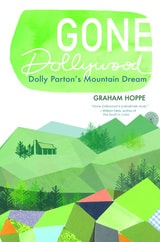
Gone Dollywood
Dolly Parton’s Mountain DreamGraham Hoppe
Ohio University Press, 2018
Dolly Parton isn’t just a country music superstar. She has built an empire. At the heart of that empire is Dollywood, a 150-acre fantasy land that hosts three million people a year. Parton’s prodigious talent and incredible celebrity have allowed her to turn her hometown into one of the most popular tourist destinations in America. The crux of Dollywood’s allure is its precisely calibrated Appalachian image, itself drawn from Parton’s very real hardscrabble childhood in the mountains of east Tennessee.
What does Dollywood have to offer besides entertainment? What do we find if we take this remarkable place seriously? How does it both confirm and subvert outsiders’ expectations of Appalachia? What does it tell us about the modern South, and in turn what does that tell us about America at large? How is regional identity molded in service of commerce, and what is the interplay of race, gender, and class when that happens?
In Gone Dollywood, Graham Hoppe blends tourism studies, celebrity studies, cultural analysis, folklore, and the acute observations and personal reflections of longform journalism into an unforgettable interrogation of Southern and American identity.
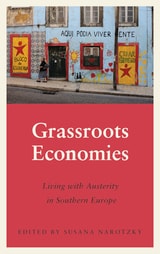
Grassroots Economies
Living with Austerity in Southern EuropeSusana Narotzky
Pluto Press, 2020
Grassroots Economies interrogates the effects of the economic crisis on the livelihood of working people, providing insight into their anxieties. Drawing on a rich seam of ethnographic material, it is a distinctive comparative analysis that explores the contradictions of their coping mechanisms and support structures.
With a focus on gender, the book explores values and ideologies, including dispossession and accumulation. Ultimately it demonstrates that everyday interactions on the local scale provide a significant sense of the global.
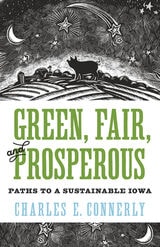
Green, Fair, and Prosperous
Paths to Sustainable IowaCharles Connerly
University of Iowa Press, 2020
At the center of what was once the tallgrass prairie, Iowa has stood out for clearing the land and becoming one of the most productive agricultural states in the nation. But its success is challenged by multiple issues including but not limited to a decline in union representation of meatpacking workers; lack of demographic diversity; the advent of job-replacing mechanization; growing income inequality; negative contributions to and effects of climate change and environmental hazards.
To become green, fair, and prosperous, Connerly argues that Iowa must reckon with its past and the fact that its farm economy continues to pollute waterways, while remaining utterly unprepared for climate change. Iowa must recognize ways in which it can bolster its residents’ standard of living and move away from its demographic tradition of whiteness. For development to be sustainable, society must balance it with environmental protection and social justice. Connerly provides a crucial roadmap for how Iowans can move forward and achieve this balance.
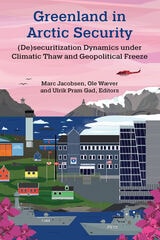
Greenland in Arctic Security
(De)securitization Dynamics under Climatic Thaw and Geopolitical FreezeMarc Jacobsen, Ole Wæver, and Ulrik Pram Gad, Editors
University of Michigan Press, 2024
By combining these different analyses, Greenland in Arctic Security provides new, theoretically informed discussions on how security politics can manifest across different scales and territorial borders. At times, these politics can have consequences beyond their original intent. With Greenland geopolitics and securitization theory of current interest to political and academic debates, this book offers timely insights for readers.
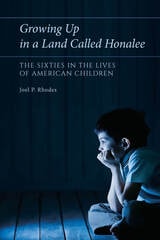
Growing Up in a Land Called Honalee
The Sixties in the Lives of American ChildrenJoel P. Rhodes
University of Missouri Press, 2017
Because the preadolescent years are, according to the child development researchers, the most formative, Joel P. Rhodes focuses on the cohort born between 1956 and 1970 who have never been quantitatively defined as a generation, but whose preadolescent world was nonetheless quite distinct from that of the “baby boomers.” Rhodes examines how this group understood the historical forces of the 1960s as children, and how they made meaning of these forces based on their developmental age. He is concerned not only with the immediate imprint of the 1960s on their young lives, but with how their perspective on the era influenced them as adults.