Results by title
164 books match the query 'Revolution' and 5 start with g
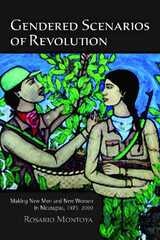
Gendered Scenarios of Revolution
Making New Men and New Women in Nicaragua, 1975–2000Rosario Montoya
University of Arizona Press, 2012
In 1979, toward the end of the Cold War era, Nicaragua's Sandinista movement emerged on the world stage claiming to represent a new form of socialism. Gendered Scenarios of Revolution is a historical ethnography of Sandinista state formation from the perspective of El Tule-a peasant village that was itself thrust onto a national and international stage as a "model" Sandinista community. This book follows the villagers´ story as they joined the Sandinista movement, performed revolution before a world audience, and grappled with the lessons of this experience in the neoliberal aftermath.
Employing an approach that combines political economy and cultural analysis, Montoya argues that the Sandinistas collapsed gender contradictions into class ones, and that as the Contra War exacerbated political and economic crises in the country, the Sandinistas increasingly ruled by mandate as vanguard party instead of creating the participatory democracy that they professed to work toward. In El Tule this meant that even though the Sandinistas created new roles and possibilities for women and men, over time they upheld pre-revolutionary patriarchal social structures. Yet in showing how the revolution created opportunities for Tuleños to assert their agency and advance their interests, even against the Sandinistas´ own interests, this book offers a reinterpretation of the revolution´s supposed failure.
Examining this community’s experience in the Sandinista and post-Sandinista periods offers perspective on both processes of revolutionary transformation and their legacies in the neoliberal era. Gendered Scenarios of Revolution will engage graduate and undergraduate students and scholars in anthropology, sociology, history, and women’s and gender studies, and appeal to anyone interested in modern revolution and its aftermath.
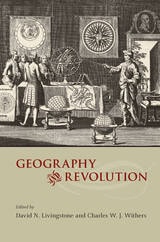
Geography and Revolution
Edited by David N. Livingstone and Charles W. J. Withers
University of Chicago Press, 2005
David N. Livingstone and Charles W. J. Withers assemble a set of essays that are themselves revolutionary in uncovering not only the geography of revolutions but the role of geography in revolutions. Here, scientific revolutions—Copernican, Newtonian, and Darwinian—ordinarily thought of as placeless, are revealed to be rooted in specific sites and spaces. Technical revolutions—the advent of print, time-keeping, and photography—emerge as inventions that transformed the world's order without homogenizing it. Political revolutions—in France, England, Germany, and the United States—are notable for their debates on the nature of political institutions and national identity.
Gathering insight from geographers, historians, and historians of science, Geography and Revolution is an invitation to take the where as seriously as the who and the when in examining the nature, shape, and location of revolutions.
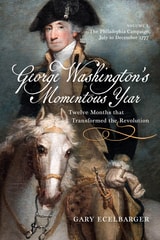
George Washington's Momentous Year
Twelve Months that Transformed the Revolution, Vol. I: The Philadelphia Campaign, July to December 1777Gary Ecelbarger
Westholme Publishing, 2027
WINNER OF THE 2025 FRAUNCES TAVERN MUSEUM BOOK AWARD
On July 4, 1777, George Washington was so consumed with where the British would strike that he ignored the nation’s first birthday. One year later, Washington created an independence celebration so spectacular that soldiers proudly recalled it in their old age. As historian Gary Ecelbarger explains in George Washington’s Momentous Year: Twelve Months that Transformed the Revolution, it was between these two antithetical anniversaries where the fight for independence under Washington’s leadership changed from a precarious regional struggle to a global conflict. In August 1777, the British landed at Head of Elk, Maryland, and defeated the Continentals at Brandywine, White Horse Tavern, and Paoli, before occupying Philadelphia. Over the next several months, the forces clashed at Germantown, Red Bank, and White Marsh, and in December, Washington and his troops fell back to Valley Forge. Despite the immediacy of the Philadelphia campaign, Washington remained in charge of the entire Continental effort, and welcomed the American victory at Saratoga that secured an alliance with France. In the new year, British forces were ordered back to New York, and as they set out across New Jersey, a newly invigorated American army engaged them at Monmouth Courthouse. This was Washington’s final time leading troops in battle and ended with his Continentals masters of the field.
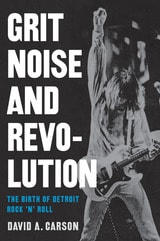
Grit, Noise, and Revolution
The Birth of Detroit Rock 'n' RollDavid A. Carson
University of Michigan Press, 2011
---Marshall Crenshaw
From the early days of John Lee Hooker to the heyday of Motown and beyond, Detroit has enjoyed a long reputation as one of the crucibles of American pop music. In Grit, Noise, and Revolution, David Carson turns the spotlight on those hard-rocking, long-haired musicians-influenced by Detroit's R&B heritage-who ultimately helped change the face of rock 'n' roll.
Carson tells the story of some of the great garage-inspired, blue-collar Motor City rock 'n' roll bands that exemplified the Detroit rock sound: The MC5, Iggy Pop and the Stooges, Mitch Ryder and the Detroit Wheels, SRC, the Bob Seger System, Ted Nugent and the Amboy Dukes, and Grand Funk Railroad.
An indispensable guide for rock aficionados, Grit, Noise, and Revolution features stories of these groundbreaking groups and is the first book to survey Detroit music of the 1960s and 70s-a pivotal era in rock music history.
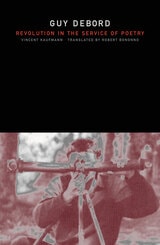
Guy Debord
Revolution in the Service of PoetryVincent Kaufmann
University of Minnesota Press, 2010
Instead of providing a conventional day-to-day account of Debord's life, Kaufmann deftly locates his subject within the historical and intellectual context of the radical social, political, and artistic movements in which he participated. He traces Debord's development as an intellectual: his involvement with the lettrist movement in the early 1950s, his central role in the Situationist International from 1957 to 1971 and in the events of May 1968, and the productive and frequently misunderstood period between the dissolution of the situationists and his suicide, during which time Debord clarified the rules of his war against inauthenticity.
As Kaufmann makes clear, for Debord political thought and action were inseparable from aesthetics and poetic expression. Whether envisioning the recovery of a lost, protocommunist age of authenticity and transparency in The Society of the Spectacle or critically assessing the possibility of revolution against postmodern capitalism two decades later, Debord advocated and practiced an art of defiance, a concurrently martial and melancholic poetics. Avoiding the mythologies about Debord that both admirers and critics have cultivated, Kaufmann provides a groundbreaking and generous assessment of Debord and his uncompromising struggle against a corrupt civilization.