Results by title
82 books match the query 'Revolution, 1775-1783' and 3 start with g
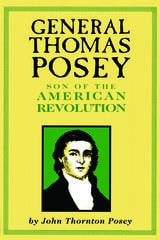
General Thomas Posey
Son of the American RevolutionJohn Thornton Posey
Michigan State University Press, 1992
Revolutionary War general Thomas Posey (1750-1818) lived his life against the backdrop of one of the most dramatic periods in American history. Posey, who played a minor role in the actual War for Independence, went on to participate in the development and foundation of several states in the transappalachian West. His experiences on the late 18th- and early 19th-century American frontier were varied and in a certain sense extraordinary; he served as Indian agent in Illinois Territory; as Lieutenant Governor of Kentucky, as U.S. Senator from Louisiana, and as Governor of Indiana during its transition from territorial status to statehood.
His biographer speculates on the contrasting influences of Thomas's ne'er-do-well father, Captain John Posey, and the family's close friend, General George Washington. Posey's progress is then followed as he raises his own family in the newly formed nation. Of particular interest is an appendix containing a detailed analysis of evidence available to support popular 29th-century speculation that Thomas Posey was, in fact, George Washington's illicit son.
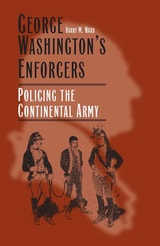
George Washington's Enforcers
Policing the Continental ArmyHarry M. Ward
Southern Illinois University Press, 2006
A well-disciplined army was vital to win American independence, but policing soldiers during the Revolution presented challenges. George Washington’s Enforcers: Policing the Continental Army examines how justice was left to the overlapping duties of special army personnel and how an improvised police force imposed rules and regulations on the common soldier. Historian Harry M. Ward describes these methods of police enforcement, emphasizing the brutality experienced by the enlisted men who were punished severely for even light transgressions. This volume explores the influences that shaped army practice and the quality of the soldiery, the enforcement of military justice, the use of guards as military police, and the application of punishment.
Washington’s army, which adopted the organization and justice code of the British army, labored under the direction of ill-trained and arrogant officers. Ward relates how the enlisted men, who had a propensity for troublemaking and desertion, not only were victims of the double standard that existed between officers and regular troops but also lacked legal protection in the army. The enforcement of military justice afforded the accused with little due process support.
Ward discusses the duties of the various personnel responsible for training and enforcing the standards of behavior, including duty officers, adjutants, brigade majors, inspectors, and sergeant majors. He includes the roles of life guards, camp guards, quarter guards, picket men, and safe guards, whose responsibilities ranged from escorting the commander in chief, intercepting spies and stragglers, and protecting farmers from marauding soldiers to searching for deserters, rounding up unauthorized personnel, and looking for delinquents in local towns and taverns.
George Washington’s Enforcers, which includes sixteen illustrations, also addresses the executions of the period, as both ritual and spectacle, and the deterrent value of capital punishment. Ward explains how Washington himself mixed clemency with severity and examines how army policies tested the mettle of this chief disciplinarian, who operated by the dictates of military necessity as perceived at the time.
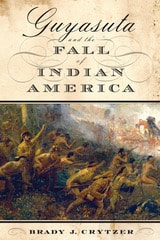
Guyasuta and the Fall of Indian America
Brady J. Crytzer
Westholme Publishing, 2013
Nearly a century before the United States declared the end of the Indian Wars, the fate of Native Americans was revealed in the battle of Fallen Timbers. In 1794, General Anthony Wayne led the first American army— the Legion of the United States—against a unified Indian force in the Ohio country. The Indians were routed and forced to vacate their lands. It was the last of a series of Indian attempts in the East to retain their sovereignty and foreshadowed what would occur across the rest of the continent. In Guyasuta and the Fall of Indian America, historian Brady J. Crytzer traces how American Indians were affected by the wars leading to American Independence through the life of one of the period’s most influential figures. Born in 1724, Guyasuta is perfectly positioned to understand the emerging political landscape of America in the tumultuous eighteenth century. As a sachem of the vaunted Iroquois Confederacy, for nearly fifty years Guyasuta dedicated his life to the preservation and survival of Indian order in a rapidly changing world, whether it was on the battlefield, in the face of powerful imperial armies, or around a campfire negotiating with his French, British, and American counterparts. Guyasuta was present at many significant events in the century, including George Washington’s expedition to Fort Le Boeuf, the Braddock disaster of 1755, Pontiac’s Rebellion and the Battle of Bushy Run in 1763, and the Battle of Oriskany during the American Revolution. Guyasuta’s involvement in the French and British wars and the American War for Independence were all motivated by a desire to retain relevance for Indian society. It was only upon the birth of the United States of America that Guyasuta finally laid his rifle down and watched as his Indian world crumbled beneath his feet. A broken man, debilitated by alcoholism, he died near Pittsburgh in 1794.
Supported by extensive research and full of compelling drama, Guyasuta and the Fall of Indian America unravels the tangled web of alliances, both white and native, and explains how the world of the American Indians could not survive alongside the emergent United States.