Results by title
397 books match the query 'Rome' and 7 start with g

Garden of Egypt
Irrigation, Society, and the State in the Premodern FayyumBrendan Haug
University of Michigan Press, 2024
2025 American Society of Papyrologists Book Prize Winner
Garden of Egypt: Irrigation, Society, and the State in the Premodern Fayyūm is the first environmental history of Egypt’s Fayyūm depression. The volume studies human relationships with flowing water, from the third century BCE to the thirteenth century CE. Until the arrival of modern perennial irrigation in the nineteenth century, the Fayyūm was the only region of premodern Egypt to be irrigated by a network of artificial canals. By linking large numbers of rural communities together in shared dependence on this public irrigation infrastructure, canalization introduced to Egypt a radically new way of interacting both with the water of the Nile and with fellow farmers. Drawing upon ancient Greek papyri, medieval Arabic literature, and modern comparative evidence, this book explores the ways in which the Nile’s water, local farmers, and state power together continually reshaped this irrigated landscape over more than thirteen centuries. Following human/water relationships through both space and time further helps to erode disciplinary boundaries and bring multiple periods of Egyptian history into contact with one another.
Gardens and Neighbors
Private Water Rights in Roman ItalyCynthia Jordan Bannon
University of Michigan Press, 2010
"Gardens and Neighbors will provide an important building block in the growing body of literature on the ways that Roman law, Roman society, and the economic concerns of the Romans jointly functioned in the real world."
---Michael Peachin, New York University
As is increasingly true today, fresh water in ancient Italy was a limited resource, made all the more precious by the Roman world's reliance on agriculture as its primary source of wealth. From estate to estate, the availability of water varied, in many cases forcing farmers in need of access to resort to the law. In Gardens and Neighbors: Private Water Rights in Roman Italy, Cynthia Bannon explores the uses of the law in controlling local water supplies. She investigates numerous issues critical to rural communities and the Roman economy. Her examination of the relationship between farmers and the land helps draw out an understanding of Roman attitudes toward the exploitation and conservation of natural resources and builds an understanding of law in daily Roman life.
An editor of the series Law and Society in the Ancient World, Cynthia Jordan Bannon is also Associate Professor of Classical Studies at Indiana University, Bloomington. Her previous book was The Brothers of Romulus: Fraternal Pietas in Roman Law, Literature, and Society (1997). Visit the author's website: http://www.iub.edu/~classics/faculty/bannon.shtml.
Gladius
The World of the Roman SoldierGuy de la Bédoyère
University of Chicago Press, 2020
Empire.
The Roman army was the greatest fighting machine in the ancient world. More than that, it was the single largest organization in Western antiquity, taking in members from all classes, from senators to freed slaves. The Roman Empire depended on its army not just to win its wars, defend its frontiers, and control the seas, but to act as the very engine of the state.
In Gladius, Guy de la Bédoyère takes us straight to the heart of what it meant to be a part of the Roman army. Rather than a history of the army itself, or a guide to military organization and fighting methods, this book is a ground-level recreation of what it was like to be a soldier in the army that made the empire. Surveying numerous aspects of life in the Roman army between 264 BCE and 337 CE, Gladius—the Latin word for sword—draws not only on the words of famed Roman historians, but also those of the soldiers themselves, as recorded in their religious dedications, tombstones, and even private letters and graffiti. Gladius reveals the everyday life of these soldiers and their families, whether stationed in a bleak frontier garrison in Britain or North Africa, tasked with guarding the emperor in Rome, fighting on foreign battlefields, mutinying over pay, marching in triumph, throwing their weight around on city streets, or enjoying esteem in honorable retirement.
By illuminating the history of one organization that reflected all corners of the Roman world, Gladius gives us a portrait of an ancient society that is unprecedented in both its broad sweep and gritty intimacy.
Golden Cynthia
Essays on PropertiusSharon L. James, Editor
University of Michigan Press, 2022
The elegiac poet Propertius responds in his verse to the complex changes that Rome underwent in his period, taking on numerous topics including poetic and sexual rivalry, visual art, violence, inability to control the elusive mistress, imperialism, colonialism, civil war, the radical new shape of the Roman state under the new monarch Augustus, and more. These essays, by well-known scholars of Roman elegy, offer new ways of reading Propertius’ topics, attitudes, and poetics.
This book begins with two distinguished essays by the late Barbara Flaschenriem, whose work on Propertius remains influential. The other contributions, offered in honor of her, are by Diane Rayor, Andrew Feldherr, Ellen Greene, Lowell Bowditch, Alison Keith, and volume editor Sharon L. James. These essays explore topics including Propertian didacticism, dream interpretation, visual art and formalism, sex and violence, Roman imperialism and its connection to the elegiac puella, and Propertius’ engagement, in Book 4, with Vergil’s poetry.

Greater than Emperor
Cola di Rienzo (ca. 1313-54) and the World of Fourteenth-Century RomeAmanda Collins
University of Michigan Press, 2002
Greater than Emperor charts the remarkable process by which Rome tried to forge a new civic identity, similar in constitution to contemporary city-republics but conceptually much greater. At the forefront of the process stood the idiosyncratic and astonishing young notary Cola di Rienzo. On May 21, 1347, Cola staged a bloodless coup. Rome entered a new age that would witness both the resurrection of the ancient power of the Empire and Rome's apotheosis as God's chosen city. Yet within seven months, the theatricality and violence of Cola's regime led to exile. Cola's triumphal return some years later ended in his assassination.
Cola was eventually resurrected as a hero of nineteenth-century nationalism, leaving the realities of Trecento Rome far behind. Yet it is only in terms of the very real models and methods that Cola welded together that his revolution can be understood.
Greater than Emperor describes Cola's reliance on the past of rhetoric, pageantry, and Roman law. It then discusses the future, tracing the dynamic contemporary influences of apocalyptic fervor, prophetic literature, and radical Franciscan imagery of Cola's world. Amanda Collins assesses Cola's legal and political career within both the complex mechanics of municipal administration and the multiple hierarchies of Roman society.
Amanda Collins offers a new assessment of the dramatic events of 1347 and an analysis of Cola within his late medieval Roman context. Bringing depth and substance to Cola's backdrop, Trecento Rome and the economic and spiritual ambitions of its citizen body, Collins provides information crucial to understanding the longer-term economic and political drive to civic autonomy in Rome before 1400.
Historians and generalists alike will relish the story of a remarkable individual, set within the cultural climate of a famous and fascinating city, during an often-overlooked period. This book sheds new light on a crucial political figure that brought a dazzling civil independence to Rome.
Amanda Collins held the Junior Research Fellowship in Intellectual History at Wolfson College, Oxford from 1997-2000, and has more recently been employed at the University of Sussex.
Greek Prostitutes in the Ancient Mediterranean, 800 BCE–200 CE
Allison Glazebrook
University of Wisconsin Press, 2011
Greek Prostitutes in the Ancient Mediterranean, 800 BCE–200 CE challenges the often-romanticized view of the prostitute as an urbane and liberated courtesan by examining the social and economic realities of the sex industry in Greco-Roman culture. Departing from the conventional focus on elite society, these essays consider the Greek prostitute as displaced foreigner, slave, and member of an urban underclass.
The contributors draw on a wide range of material and textual evidence to discuss portrayals of prostitutes on painted vases and in the literary tradition, their roles at symposia (Greek drinking parties), and their place in the everyday life of the polis. Reassessing many assumptions about the people who provided and purchased sexual services, this volume yields a new look at gender, sexuality, urbanism, and economy in the ancient Mediterranean world.
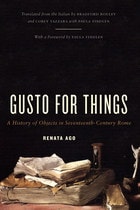
Gusto for Things
A History of Objects in Seventeenth-Century RomeRenata Ago
University of Chicago Press, 2013