Results by title
117 books match the query 'Rural conditions' and 2 start with g
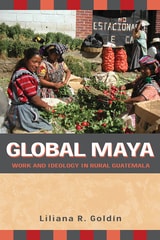
Global Maya
Work and Ideology in Rural GuatemalaLiliana R. Goldín
University of Arizona Press, 2009
In the central highland Maya communities of Guatemala, the demands of the global economy have become a way of life. This book explores how rural peoples experience economic and cultural change as their country joins the global market, focusing on their thoughts about work and sustenance as a way of learning about Guatemala’s changing economy.
For more than a decade, Liliana Goldín observed in highland towns both the intensification of various forms of production and their growing links to wider markets. In this first book to compare economic ideology across a range of production systems, she examines how people make a living and how they think about their options, practices, and constraints. Drawing on interviews and surveys—even retellings of traditional narratives—she reveals how contemporary Maya respond to the increasingly globalized yet locally circumscribed conditions in which they work.
Goldín presents four case studies: cottage industries devoted to garment production, vegetable growing for internal and border markets reached through direct commerce, crops grown for export, and wage labor in garment assembly factories. By comparing generational and gendered differences among workers, she reveals not only complexities of change but also how these complexities arereflected in changing attitudes, understandings, and aspirations that characterize people’s economic ideology. Further, she shows that as rural people take on diverse economic activities, they also reinterpret their views on such matters as accumulation, cooperation, competition, division of labor, and community solidarity.
Global Maya explores global processes in local terms, revealing the interplay of traditional values, household economics, and the inescapable conditions of demographic growth, a shrinking land base, and a global economy always looking for cheap labor. It offers a wealth of new insights not only for Maya scholars but also for anyone concerned with the effects of globalization on the Third World.
[more]
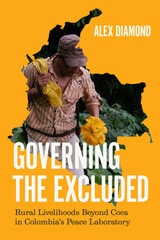
Governing the Excluded
Rural Livelihoods Beyond Coca in Colombia's Peace LaboratoryAlex Diamond
University of Chicago Press, 2026
An on-the-ground description of Colombia’s peace process as lived by the rural populations most affected by it.
The Colombian village of Briceño might, at first glimpse, look like many communities in the rural Global South. Many of the people living there rely on small-scale farming, even as a newly constructed hydroelectric dam threatens traditional livelihoods. Yet after decades where Briceño suffered from a bloody conflict, the village has more recently become central to the nation’s hopes for peace. In Governing the Excluded, sociologist Alex Diamond shares a closer look at Briceño and offers unique insight not only into the contemporary Colombian state but to how people across the Global South are struggling to maintain rural livelihoods amid economic dispossession.
Governing the Excluded describes a landmark peace process between the Colombian government and the radical FARC guerrillas from the perspective of Colombian farmers, drawing links between economic transformation, drug economies, and armed conflict. Exclusion from global markets for traditional crops like coffee first pushed farmers to grow coca, the raw material for cocaine. This ushered in an era of violent conflict for control of the illicit economy, while farmers continued to be priced out of legal markets. In exchange for peace and state protection, farmers ultimately agreed to sacrifice profitable coca. But with its disappearance, they now find themselves dependent on the state: for machinery to maintain the roads they need to get legal harvests to market, municipal jobs that are the only decent work available, and for public resources to subsidize food crops with razor-thin profit margins. Ongoing economic struggles in the legal sector make the state’s newfound authority tenuous, as some villagers replant coca, abandon the village for uncertain urban futures, or join a rearmed guerrilla group.
Informed by deep ethnographic research and firsthand stories from Briceño residents, Governing the Excluded shows that when it comes to the forces driving dispossession—be they international corporate megaprojects, global food prices, or national initiatives to replace coca cultivation—state authority goes only so far as its ability to sustain local livelihoods.
[more]