Results by title
424 books match the query 'Russian & Soviet' and 8 start with g
Genesis of The Brothers Karamazov
The Aesthetics, Ideology, and Psychology of Making a TextRobert L. Belknap
Northwestern University Press, 1990
Global Encyclopaedia of Informality, Volume 3
A Hitchhiker's Guide to Informal Problem-Solving in human lifeEdited by Alena Ledeneva
University College London, 2024
For a post-human hitchhiker, human life–with its anxiety, aging, illness, and constant need for problem-solving–may look unviable. Yet, for humans, the life struggle is softened by human touch, human emotion, and human cooperation.
The Global Encyclopaedia of Informality, Volume 3 continues the journey of the two previous volumes into the world’s open secrets, unwritten rules, and hidden practices. It focuses on issues of emotional ambivalence and pressures of the digital age. The informal practices presented in this volume demonstrate the urgency of alleviating tensions between continuity and all-too-rapid change and the need to tackle the central problem of modern societies—uncertainty.
The volume takes the reader on a biographical journey through elusive, taken-for-granted, or banal ways of getting things done from over seventy countries and world regions. It offers an innovative understanding of the significance of fringes and challenges the assumption that informality is associated exclusively with poverty, underdevelopment, the Global South, oppressive regimes, or the former socialist countries of Eastern Europe and Central Asia. It also maps the patterns of informality around the globe, identifies specific informal practices in a context-sensitive way, and documents their ambivalent impact on people engaged in problem-solving, on societies in which these problems arise, and on humanity overall.
Global Russian Cultures
Edited by Kevin M. F. Platt
University of Wisconsin Press, 2020
The volume's internationally renowned contributors treat the many different global Russian cultures not as "displaced" elements of Russian cultural life but rather as independent entities in their own right. They describe diverse forms of literature, music, film, and everyday life that transcend and defy political, geographic, and even linguistic borders. Arguing that Russian cultures today are many, this volume contends that no state or society can lay claim to be the single or authentic representative of Russianness. In so doing, it contests the conceptions of culture and identity at the root of nation-building projects in and around Russia.
Gogol's Afterlife
The Evolution of a Classic in Imperial and Soviet RussiaCaryl Emerson
Northwestern University Press, 2002
Part I charts the historical and cultural currents that shaped Gogol's reputation, devoting particular attention to the models of authorship Gogol himself devised in response to his changing audience and developing authorial mission. Part II takes a panoramic view of the social milieu in which Gogol's status evolved. Finally, Part III examines the place of the classics in Soviet culture, with a focus on Gogol's role in the cultural revolution and his peculiar relationship with state power under Stalinism.
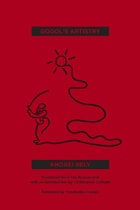
Gogol's Artistry
Andrei Bely, translated by Christopher Colbath
Northwestern University Press, 2009
When one great author engages another, as Andrei Bely so brilliantly does in Gogol’s Artistry, the result is inevitably a telling portrait of both writers. So it is in Gogol’s Artistry. Translated into English for the first time, this idiosyncratic, exhaustive critical study is as interesting for what it tells us about Bely’s thought and method as it is for its insights into the oeuvre of his literary predecessor. Bely’s argument in this book is that Gogol’s earlier writing should be given more consideration than most critics have granted. Employing what might be called a scientific perspective, Bely considers how often certain colors appear; he diagrams sentences and discusses Gogol’s prose in terms of mathematical equations. The result, as strange and engaging as Bely’s best fiction, is also an innovative, thorough, and remarkably revealing work of criticism.
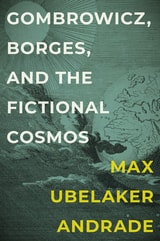
Gombrowicz, Borges, and the Fictional Cosmos
Max Ubelaker Andrade
Bucknell University Press, 2027
Polish author Witold Gombrowicz’s famously chaotic masterpiece, Cosmos, was profoundly influenced by Jorge Luis Borges—particularly by three key stories from Ficciones. Drawing on evidence that Gombrowicz read Ficciones in 1960, as well as handwritten marginalia in Gombrowicz’s copy of Adolfo Bioy Casares’s La invención de Morel, this groundbreaking study argues that Cosmos responded to Borges’s literary transformations of cartography, mathematical combinatorics, and Miguel de Cervantes’s Don Quijote. Along the way, it introduces the concept of “immaterial bibliography” to analyze imaginary texts appearing in literary works. Finally, it examines the tension between Borges’s explicit racism and the ethical and aesthetic vision suggested by his fiction, revealing how rumor, rebellion, and literary inheritance shaped Gombrowicz’s reading of Borges, which in turn influenced the composition of his prizewinning last novel.
Published by Bucknell University Press. Distributed worldwide by Rutgers University Press.
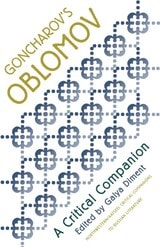
Goncharov's "Oblomov"
A Critical CompanionGayla Diment
Northwestern University Press, 1998
All the essays were written specifically for this volume and are published here for the first time. The book also includes an introduction, autobiographical materials, an annotated bibliography, and letters never before translated into English.
Contributors: Galya Diment, John Givens, Beth Holmgren, Karl D. Kramer, Ronald D. LeBlanc, Alexandar Mihailovic, and Brian Thomas Oles.
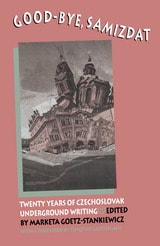
Good-Bye Samizdat
Twenty Years of Czechoslovak Underground WritingMarketa Goetz-Stankiewicz
Northwestern University Press, 1992