Results by title
105 books match the query 'Self' and 3 start with g
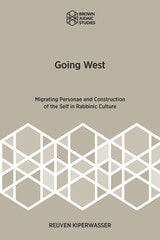
Going West
Migrating Personae and Construction of the Self in Rabbinic CultureReuven Kiperwasser
SBL Press, 2021
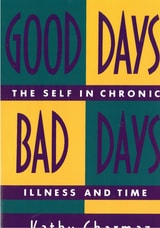
Good Days, Bad Days
The Self and Chronic Illness in TimeKathy C Charmaz
Rutgers University Press, 1993
Illness provides a mirror that allows sufferers to see themselves and to become more introspective. As they struggle for control over illness and control over time, they also struggle to control the central images of the self. For example, the chronically ill may situate their self-concepts in the past, present, or future. Charmaz examines under what conditions they situate their self-concepts in each of those timeframes. People may say they live one day at a time. They may bracket certain experiences, such as a heart attack, as timemarkers or turning points in the past. Or they may look ahead to recovering their health. Or ahead to death.
Charmaz artfully combines near jargon-free analysis with moving stories about how people have experienced illness, usually told in the sufferers' own words. She enters the world of the chronically ill, and brings us into it.
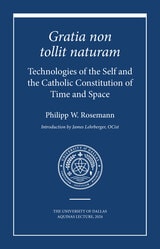
Gratia non tollit naturam
Technologies of the Self and the Catholic Constitution of Time and SpacePhilipp W. Rosemann
St. Augustine's Press, 2025
In this short volume, Philipp Rosemann sets out to articulate the structures of Catholic existence in terms adapted from contemporary philosophy. Using a concept from the last works of Michel Foucault, Rosemann focuses on the liturgy as a "technology of the self." Through language, the liturgy "makes" the world in which the believer lives. But whereas modern philosophers hold that the human mind imposes its structures upon reality, the liturgical self exists in accordance with a cosmic order that stems from the Word.
If one dialogue partner is Michel Foucault, the other is Joseph Ratzinger, the late Pope Benedict XVI. Although this pairing may seem surprising, two facts suggest its fruitfulness. First, scholars now speak of a "Christian turn" in the late Foucault, a thinker often denounced—falsely—as the epitome of philosophical decadence. Second, as one of the leading liturgists of our time, Ratzinger incorporated crucial insights from modern philosophy into his liturgical theology. In relation to Ratzinger, too, some clichés need to be corrected.
In the resulting dialogue between Foucault and Ratzinger, the reader discovers what the specific mode of existence of the "liturgical subject" is, and how Catholic time and space are constituted liturgically. In the end, the Thomistic adage gratia non tollit naturam turns out to be an excellent way of summarizing how the liturgical subject relates to the cosmos: not by destroying it, but by listening to the words of creation and perfecting them.
The University of Dallas Aquinas Lecture for 2024, Gratia non tollit naturam is published here with an introduction by Fr. James Lehrberger, OCist.