Results by title
66 books match the query 'Sex differences' and 7 start with g
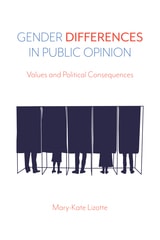
Gender Differences in Public Opinion
Values and Political ConsequencesMary-Kate Lizotte
Temple University Press, 2020
In this era in which more women are running for public office—and when there is increased activism among women—understanding gender differences on political issues has become critical. In her cogent study, Mary-Kate Lizotte argues that assessing the gender gap in public support for policies through a values lens provides insight into American politics today. There is ample evidence that men and women differ in their value endorsements—even when taking into account factors such as education, class, race, income, and party identification.
In Gender Differences in Public Opinion, Lizotte utilizes nationally representative data, mainly from the American National Election Study, to study these gender gaps, the explanatory power of values, and the political consequences of these differences. She examines the gender differences in several policy areas such as equal rights, gun control, the death penalty, and the environment, as well as social welfare issues. The result is an insightful and revealing study of how men and women vary in their policy positions and political attitudes.

Gender Differences in Science Careers
The Project Access StudyGerhard Sonnert and Gerald Holton
Rutgers University Press, 1995
What determines successful careers in the field of science? What are the early indicators of later failures. And specifically, how do women scientists' career paths differ from men's? While it is easy to theorize about these questions, those who go to the trouble of an extensive empirical study find an increasingly complex picture.
Using the largest database of its kind (699 questionnaires and 200 face-to-face conversations), the authors investigate the career paths of recipients of prestigious postdoctoral fellowships--scientists, engineers, and mathematicians. They outline a theoretical framework for understanding the causes of gender disparities among scientists, test the hypothesis of a gender- specific "glass ceiling," and provide a wealth of pertinent statistical information.
Gender Differences in Science Careers reveals that, as institutional laws changed, patterns of discrimination and exclusion become more subtle. Despite the decline of rigid gender-role socialization, many social practices persist that lead, on average and often in counterintuitive ways, to the accumulation of disadvantages for women scientists. This book is directed to scholars in the social sciences, aspiring and practicing scientists, and administrators interested in equity issues.

Gender Influences
Reading Student TextsDonnalee Rubin. Foreword by Nan Johnson
Southern Illinois University Press, 1993
Donnalee Rubin examines the responses of thirty-one freshman composition teachers to student writing and shows the negative effects of gender bias on assessment to prove that gender perceptions and expectations can influence assessment decisions that seem neutral on the surface. Arguing that certain pedagogies are more likely to minimize gender bias than others, Rubin believes that teachers are more likely to overcome the influence of gender bias on their teaching if they adopt a process-based method and work intimately with their students through nondirective, supportive conferences.
Rubin characterizes the conference/process-centered class as the type of environment in which maternal teaching can be cultivated. She stresses that maternal can describe any teacher, male or female, who exhibits the nurturing and supportive qualities that the conference/process approach embodies. With a primary focus on the student’s well-being and development as a person and a writer, the maternal teacher is in a better position to overcome gender bias that could distort the interpretation of student texts. In order for writing instructors to increase their sensitivity to gender issues in assessment, Rubin recommends that they self-consciously engage in what she calls "responsive reading." Responsive reading occurs when the teacher reads with an eye toward providing the sorts of supportive feedback and dialectic exchange that will encourage student writers to think for themselves and to revise effectively. Rubin argues that when teachers commit to a responsive-reading pedagogy, they are more likely to question their reactions to student writing along the lines of gender influence and to strive for self-conscious awareness of how their own inner male-female voices may distort their reading of student texts. She challenges all writing teachers to become more aware of the inevitable challenge gender influence presents.
Gender Roles and Faculty Lives in Rhetoric and Composition
Theresa Enos
Southern Illinois University Press, 1997
Combining anecdotal evidence (the personal stories of rhetoric and composition teachers) with hard data, Theresa Enos offers documentation for what many have long suspected to be true: lower-division writing courses in colleges and universities are staffed primarily by women who receive minimal pay, little prestige, and lessened job security in comparison to their male counterparts. Male writing faculty, however, also are affected by factors such as low salaries because of the undervaluation of a field considered feminized. As Enos notes in her preface: "The rhetoric of our institutional lives is connected especially to the negotiations of gender roles in rhetoric and composition."
Enos describes and classifies narratives gathered from surveys, interviews, and campus visits and interweaves these narratives with statistical data gathered from national surveys that show gendered experiences in the profession. Enos discusses the ways in which these experiences affect the working conditions of writing teachers and administrators in various programs at different types of institutions.
Enos points out that fields in which women excel—and are acknowledged—receive less prestige than other fields. On the university level, those genres in which women have demonstrated competence are not taken as seriously as those dominated by men. In practical terms, academia affords more glory for teaching literature than for teaching rhetoric and composition.
Within the field of rhetoric and composition, however, Enos finds it difficult to determine why the accomplishments of women receive less credit than those of men. She speculates as to whether it is part of the larger pattern in society—and in academia—to value men more than women or something in the field itself that keeps women from real power, even though women make up the majority of composition and rhetoric teachers.
Enos provides fascinating personal histories of composition and rhetoric teachers whose work has been largely disregarded. She also provides information about writing programs, teaching, administrative responsibilities, ranks among teachers, ages, salary, tenure status, distribution of research, service responsibilities, records of publication, and promotion and tenure guidelines.
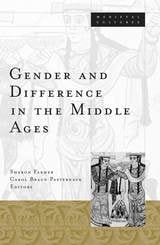
Gender and Difference in the Middle Ages
Sharon Farmer
University of Minnesota Press, 2002
Exposes complex intersections between genders and other identities in medieval cultures.
Nothing less than a rethinking of what we mean when we talk about "men" and "women" of the medieval period, this volume demonstrates how the idea of gender-in the Middle Ages no less than now-intersected in subtle and complex ways with other categories of difference. Responding to the insights of postcolonial and feminist theory, the authors show that medieval identities emerged through shifting paradigms-that fluidity, conflict, and contingency characterized not only gender, but also sexuality, social status, and religion. This view emerges through essays that delve into a wide variety of cultures and draw on a broad range of disciplinary and theoretical approaches. Scholars in the fields of history as well as literary and religious studies consider gendered hierarchies in western Christian, Jewish, Byzantine, and Islamic areas of the medieval world.
Contributors: Daniel Boyarin, U of California, Berkeley; Ruth Mazo Karras, U of Minnesota; Mathew Kuefler, San Diego State U; Martha Newman, U of Texas; Kathryn M. Ringrose, U of California, San Diego; Elizabeth Robertson, U of Colorado; Everett Rowson, U of Pennsylvania; Michael Uebel, U of Kentucky; Ulrike Wiethaus, Wake Forest U.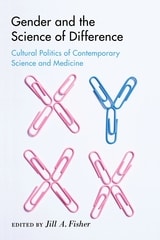
Gender and the Science of Difference
Cultural Politics of Contemporary Science and MedicineFisher, Jill A
Rutgers University Press, 2011
How does contemporary science contribute to our understanding about what it means to be women or men? What are the social implications of scientific claims about differences between "male" and "female" brains, hormones, and genes? How does culture influence scientific and medical research and its findings about human sexuality, especially so-called normal and deviant desires and behaviors? Gender and the Science of Difference examines how contemporary science shapes and is shaped by gender ideals and images.
Prior scholarship has illustrated how past cultures of science were infused with patriarchal norms and values that influenced the kinds of research that was conducted and the interpretation of findings about differences between men and women. This interdisciplinary volume presents empirical inquiries into today's science, including examples of gendered scientific inquiry and medical interventions and research. It analyzes how scientific and medical knowledge produces gender norms through an emphasis on sex differences, and includes both U.S. and non-U.S. cases and examples.

Going Stealth
Transgender Politics and U.S. Surveillance PracticesToby Beauchamp
Duke University Press, 2018