Results by title
584 books match the query 'Short Stories (single author)' and 12 start with g

Geography and Plays
Gertrude Stein; Introduction by Cyrena N. Pondrom
University of Wisconsin Press, 1993
Getaway
Glen Pourciau
Four Way Books, 2021
Although the characters in Pourciau’s stories change face, story to story they all inhabit a world dominated by interior voices revealing fragmented selves. They find difficulty making their inner worlds, with their competing narratives and emotions, fit into the world surrounding them. As they confront everyday predicaments and encounters, they are oftentimes averse to expressing their thoughts, thereby leading themselves deeper into a conflicted interior landscape.
Gettysburg
The Living and the DeadKent Gramm. Photographs by Chris Heisey
Southern Illinois University Press, 2019
Creative nonfiction, fiction, dramatic dialogue, and poetry combine with full-color photographs to convey the essential reality of the famous battlefield as a place both terrible and beautiful. The living and the dead contained here include Confederates and Yankees, soldiers and civilians, male and female, young and old. Visitors to the battlefield after 1863, both well known and obscure, provide the voices of the living. They include a female admiral in the U.S. Navy and a man from rural Virginia who visits the battlefield as a way of working through the death of his son in Iraq. The ghostly voices of the dead include actual participants in the battle, like a fiery colonel and a girl in Confederate uniform, as well as their representatives, such as a grieving widow who has come to seek her husband.
Utilizing light as a central motif and fourscore and seven voices to evoke how Gettysburg continues to draw visitors and resound throughout history, alternately wounding and stitching the lives it touches, Gramm’s words and Heisey’s photographs meld for a historical experience unlike any other. Gettysburg: The Living and the Dead offers a panoramic view wherein the battle and battlefield of Gettysburg are seen through the eyes of those who lived through it and died on it as well as those who have sought meaning at the site ever since.
Ginseng and Other Tales from Manila
Marianne Villanueva
Calyx, 1991
Giovanna's 86 Circles
And Other StoriesPaola Corso
University of Wisconsin Press, 2007
These ten magical stories are primarily set in Pittsburgh-area river towns, where Italian American women and girls draw from their culture and folklore to bring life and a sense of wonder to a seemingly barren region of the Rust Belt. Each story catapults the ordinary into something original and unpredictable.
A skeptical journalist scopes out the bar where the town mayor, in seemingly perfect health, is drinking with his buddies and celebrating what he claims is the last day of his life. A woman donates her dead mother’s clothes to a thrift shop but learns that their destiny is not what she expected. A ten-year-old girl wrestles with the facts of life as she watches her neighbor struggle to get pregnant while her teenage sister finds it all too easy. A high school girl hallucinates in a steamy hospital laundry room and discovers she can see her coworkers’ futures. A developer’s wrecking ball is no match for the legend of Giovanna’s green thumb in the title story “Giovanna’s 86 Circles.”
Quirky and profound, Corso’s magical leaps uncover the everyday poetry of these women’s lives.
Finalist for the John Gardner Fiction Book Award
Selected for “Best Short Stories of 2005” in Montserrat Review
Best Books for Regional Special Interests, selected by the American Association of School Librarians, and Best Books for General Audiences, selected by the Public Library Association
Sons of Italy National Book Club Selection
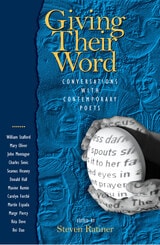
Giving Their Word
Conversations with Contemporary PoetsSteven Ratiner
University of Massachusetts Press, 2002
Based on a three-year series of interviews conducted by Steven Ratiner for the Christian Science Monitor, this book offers extended conversations with twelve of the most influential poets writing today. Their comments are wonderfully detailed, refreshingly honest, and provide the sort of intimate introduction to both poet and text that readers are rarely privileged to enjoy. Included are conversations with William Stafford, Mary Oliver, John Montague, Charles Simic, Seamus Heaney, Donald Hall, Maxine Kumin, Carolyn Forché, Martín Espada, Marge Piercy, Rita Dove, and Bei Dao. In the book's closing interview, Steven Ratiner makes a return visit to Donald Hall's New Hampshire farm shortly before the publication of Hall's collection Without, which focused on the death of his wife, poet Jane Kenyon.
Giving their word is what poets do; it is their stock-in-trade, their daily bread. In the hands of the most accomplished, a poet's words are transformed into a kind of window: looking inward toward the territory of memory, dream, personal mythology and opening out onto the landscape of the shared world where life and work are rooted. For each poet there is an intricate relationship between these two realms and poetry's third domain, the language that bridges both experiences and becomes the body of the poem. Giving Their Word shows us that the poet's fidelity to that relationship sustains his or her development over time, urges the writing toward new levels of discovery, and bestows on readers that most prized of commodities: a feeling of the authentic.
For poets, students of poetry, and that far-flung community of readers for whom the contemporary poem still provides a journey worth taking, this book will present a host of pleasures. Giving Their Word enlarges the frame through which we view the poet's text and yields significant insights into the craft and character of each of these writers.

Good-bye, Son and Other Stories
Janet Lewis
Ohio University Press, 1986
Good-bye, Son and Other Stories, Janet Lewis’s only collection of short fiction, was first published in 1946, but remains as quietly haunting today as it was then. Set in small communities of the upper Midwest and northern California in the ’30s and ’40s, these midcentury gems focus on the quiet cycles connecting youth and age, despair and hope, life and death. A mother’s encounters with her deceased son, an aging woman sitting with the new knowledge of her troubled older sister’s death, and a teenager disillusioned by her own mortality are among the characters, mostly women and girls, whom Lewis delivers. Her understated style and knack for unadorned observation embed us with them as they reckon with the disquieting forces—incomprehensible and destructive to some, enlightening to others—that move us from birth, through life, to death. In the process, Lewis has crafted a paean to the living.
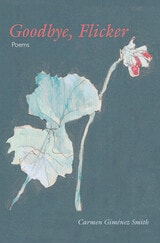
Goodbye, Flicker
PoemsCarmen Giménez Smith
University of Massachusetts Press, 2012
This distinctive collection introduces a new type of mythmaking, daring in its marriage of fairy tale tropes with American mundanities. Conspiratorial, Goodbye, Flicker describes the interior life of a girl whose prince is a deadbeat dad and whose escape into a fantasy world is also an escape into language, beauty, and the surreal.
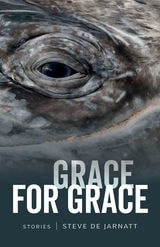
Grace for Grace
StoriesSteve De Jarnatt
Acre Books, 2020
“Rubiaux Rising” (a Best American Short Stories selection) is a tale of triumph amid calamity during Hurricane Katrina, while “Her Great Blue” a surreal interspecies love story. “Mulligan” reveals the private pain of parents traveling across the country to give away their children, and “Wraiths in a Swelter” is both a ghost story and a confessional memoir—following a deliriously exhausted EMT through a deadly Chicago heat wave.
Many of the stories in Grace for Grace are set against the backdrop of natural or manmade catastrophes. These disasters test the characters’ limits as they confront sudden changes and extremes, discovering through their unexpected resourcefulness and endurance something beyond suffering. . . something that approaches the sublime.
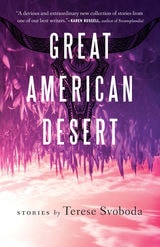
Great American Desert
StoriesTerese Svoboda
The Ohio State University Press, 2019
In her arresting and inimitable style, Svoboda’s delicate handling of the complex dynamics of family and self seeps into every sentence of these first-rate short stories about what we do to the world around us—and what it can do to us.
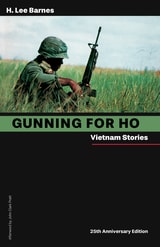
Gunning For Ho, 25th Anniversary Edition
Vietnam StoriesH. Lee Barnes
University of Nevada Press, 2026
In this rich and varied collection of short stories (six stories & one novella), former Green Beret H. Lee Barnes deals with the war itself and with its aftermath, but his stories focus more on the human aspects of men in armed conflict and families at home than on the violent drama or political aspects of that war.
Gunning For Ho
Vietnam StoriesH. Lee Barnes
University of Nevada Press, 2000