Results by title
4038 books match the query 'Social aspects' and 118 start with g

G-Strings and Sympathy
Strip Club Regulars and Male DesireKatherine Frank
Duke University Press, 2002
Frank’s ethnography draws on her work as an exotic dancer in five clubs, as well as on her interviews with over thirty regular customers—middle-class men in their late-twenties to mid-fifties. Reflecting on the customers’ dual desires for intimacy and visibility, she explores their paradoxical longings for "authentic" interactions with the dancers, the ways these aspirations are expressed within the highly controlled and regulated strip clubs, and how they relate to beliefs and fantasies about social class and gender. She considers how regular visits to strip clubs are not necessarily antithetical to marriage or long-term heterosexual relationships, but are based on particular beliefs about marriage and monogamy that make these clubs desirable venues. Looking at the relative "classiness" of the clubs where she worked—ranging from the city’s most prestigious clubs to some of its dive bars—she reveals how the clubs are differentiated by reputations, dress codes, cover charges, locations, and clientele, and describes how these distinctions become meaningful and erotic for the customers. Interspersed throughout the book are three fictional interludes that provide an intimate look at Frank’s experiences as a stripper—from the outfits to the gestures, conversations, management, coworkers, and, of course, the customers.
Focusing on the experiences of the male clients, rather than those of the female sex workers, G-Strings and Sympathy provides a nuanced, lively, and tantalizing account of the stigmatized world of strip clubs.

Gadget Consciousness
Collective Thought, Will and Action in the Age of Social MediaJoss Hands
Pluto Press, 2019
Gambling on Ore
The Nature of Metal Mining in the United States, 1860–1910Kent Curtis
University Press of Colorado, 2013
In Montana, legal issues and politics—such as unexpected consequences of federal mining law and the electrification of the United States—further complicated the mining industry’s already complex relationship to geology, while government policy, legal frameworks, dominant understandings of nature, and the exigencies of profit and production drove the industry in momentous and surprising directions. Despite its many uncertainties, mining became an important part of American culture and daily life.
Gambling on Ore unpacks the tangled relationships between mining and the natural world that gave material possibility to the age of electricity. Metal mining has had a profound influence on the human ecology and the social relationships of North America through the twentieth century and throughout the world after World War II. Understanding how we forged these relationships is central to understanding the environmental history of the United States after 1850.
Gambling
Public Policies And The Social SciencesWilliam R. Eadington
University of Nevada Press, 2002
Game Work
Language, Power, and Computer Game CultureKen S. McAllister
University of Alabama Press, 2006
Video and computer games in their cultural contexts.
As the popularity of computer games has exploded over the past decade, both scholars and game industry professionals have recognized the necessity of treating games less as frivolous entertainment and more as artifacts of culture worthy of political, social, economic, rhetorical, and aesthetic analysis. Ken McAllister notes in his introduction to Game Work that, even though games are essentially impractical, they are nevertheless important mediating agents for the broad exercise of socio-political power.
In considering how the languages, images, gestures, and sounds of video games influence those who play them, McAllister highlights the ways in which ideology is coded into games. Computer games, he argues, have transformative effects on the consciousness of players, like poetry, fiction, journalism, and film, but the implications of these transformations are not always clear. Games can work to maintain the status quo or celebrate liberation or tolerate enslavement, and they can conjure feelings of hope or despair, assent or dissent, clarity or confusion. Overall, by making and managing meanings, computer games—and the work they involve and the industry they spring from—are also negotiating power.
This book sets out a method for "recollecting" some of the diverse and copious influences on computer games and the industry they have spawned. Specifically written for use in computer game theory classes, advanced media studies, and communications courses, Game Work will also be welcome by computer gamers and designers.
Ken S. McAllister is Assistant Professor of Rhetoric, Composition, and the Teaching of English at the University of Arizona and Co-Director of the Learning Games Initiative, a research collective that studies, teaches with, and builds computer games.
Gamelan Girls
Gender, Childhood, and Politics in Balinese Music EnsemblesSonja Lynn Downing
University of Illinois Press, 2019

Gameplay Mode
War, Simulation, and TechnoculturePatrick Crogan
University of Minnesota Press, 2011
From flight simulators and first-person shooters to MMPOG and innovative strategy games like 2008’s Spore, computer games owe their development to computer simulation and imaging produced by and for the military during the Cold War. To understand their place in contemporary culture, Patrick Crogan argues, we must first understand the military logics that created and continue to inform them. Gameplay Mode situates computer games and gaming within the contemporary technocultural moment, connecting them to developments in the conceptualization of pure war since the Second World War and the evolution of simulation as both a technological achievement and a sociopolitical tool.
Crogan begins by locating the origins of computer games in the development of cybernetic weapons systems in the 1940s, the U.S. Air Force’s attempt to use computer simulation to protect the country against nuclear attack, and the U.S. military’s development of the SIMNET simulated battlefield network in the late 1980s. He then examines specific game modes and genres in detail, from the creation of virtual space in fight simulation games and the co-option of narrative forms in gameplay to the continuities between online gaming sociality and real-world communities and the potential of experimental or artgame projects like September 12th: A Toy World and Painstation, to critique conventional computer games.
Drawing on critical theoretical perspectives on computer-based technoculture, Crogan reveals the profound extent to which today’s computer games—and the wider culture they increasingly influence—are informed by the technoscientific program they inherited from the military-industrial complex. But, Crogan concludes, games can play with, as well as play out, their underlying logic, offering the potential for computer gaming to anticipate a different, more peaceful and hopeful future.
Games of Empire
Global Capitalism and Video GamesNick Dyer-Witheford
University of Minnesota Press, 2009
In the first decade of the twenty-first century, video games are an integral part of global media culture, rivaling Hollywood in revenue and influence. No longer confined to a subculture of adolescent males, video games today are played by adults around the world. At the same time, video games have become major sites of corporate exploitation and military recruitment.
In Games of Empire, Nick Dyer-Witheford and Greig de Peuter offer a radical political critique of such video games and virtual environments as Second Life, World of Warcraft, and Grand Theft Auto, analyzing them as the exemplary media of Empire, the twenty-first-century hypercapitalist complex theorized by Michael Hardt and Antonio Negri. The authors trace the ascent of virtual gaming, assess its impact on creators and players alike, and delineate the relationships between games and reality, body and avatar, screen and street.
Games of Empire forcefully connects video games to real-world concerns about globalization, militarism, and exploitation, from the horrors of African mines and Indian e-waste sites that underlie the entire industry, the role of labor in commercial game development, and the synergy between military simulation software and the battlefields of Iraq and Afghanistan exemplified by Full Spectrum Warrior to the substantial virtual economies surrounding World of Warcraft, the urban neoliberalism made playable in Grand Theft Auto, and the emergence of an alternative game culture through activist games and open-source game development.
Rejecting both moral panic and glib enthusiasm, Games of Empire demonstrates how virtual games crystallize the cultural, political, and economic forces of global capital, while also providing a means of resisting them.

Gaming Masculinity
Trolls, Fake Geeks, and the Gendered Battle for Online CultureMegan Condis
University of Iowa Press, 2018
In 2016, a female videogame programmer and a female journalist were harassed viciously by anonymous male online users in what became known as GamerGate. Male gamers threatened to rape and kill both women, and the news soon made international headlines, exposing the level of abuse that many women and minorities face when participating in the predominantly male online culture.
Gaming Masculinity explains how the term “gamer” has been constructed in the popular imagination by a core group of male online users in an attempt to shore up an embattled form of geeky masculinity. This latest form of toxicity comes at a moment of upheaval in gaming culture, as women, people of color, and LGBTQ individuals demand broader access and representation online. Paying close attention to the online practices of trolling and making memes, author Megan Condis demonstrates that, despite the supposedly disembodied nature of life online, performances of masculinity are still afforded privileged status in gamer culture. Even worse, she finds that these competing discourses are not just relegated to the gaming world but are creating rifts within the culture at large, as witnessed by the direct links between the GamerGate movement and the recent rise of the alt-right during the last presidential election.
Condis asks what this moment can teach us about the performative, collaborative, and sometimes combative ways that American culture enacts race, gender, and sexuality. She concludes by encouraging designers and those who work in the tech industry to think about how their work might have, purposefully or not, been developed in ways that are marked by gender.
Gaming Matters
Art, Science, Magic, and the Computer Game MediumJudd Ethan Ruggill and Ken S. McAllister
University of Alabama Press, 2011

Gaming at the Edge
Sexuality and Gender at the Margins of Gamer CultureAdrienne Shaw
University of Minnesota Press, 2015
Video games have long been seen as the exclusive territory of young, heterosexual white males. In a media landscape dominated by such gamers, players who do not fit this mold, including women, people of color, and LGBT people, are often brutalized in forums and in public channels in online play. Discussion of representation of such groups in games has frequently been limited and cursory. In contrast, Gaming at the Edge builds on feminist, queer, and postcolonial theories of identity and draws on qualitative audience research methods to make sense of how representation comes to matter.
In Gaming at the Edge, Adrienne Shaw argues that video game players experience race, gender, and sexuality concurrently. She asks: How do players identify with characters? How do they separate identification and interactivity? What is the role of fantasy in representation? What is the importance of understanding market logic? In addressing these questions Shaw reveals how representation comes to matter to participants and offers a perceptive consideration of the high stakes in politics of representation debates.
Putting forth a framework for talking about representation, difference, and diversity in an era in which user-generated content, individualized media consumption, and the blurring of producer/consumer roles has lessened the utility of traditional models of media representation analysis, Shaw finds new insight on the edge of media consumption with the invisible, marginalized gamers who are surprising in both their numbers and their influence in mainstream gamer culture.
Gaming the Stage
Playable Media and the Rise of English Commercial TheaterGina Bloom
University of Michigan Press, 2018
Gaming the Stage also introduces a new archive for game studies: scenes of onstage gaming, which appear at climactic moments in dramatic literature. Bloom reveals plays to be systems of information for theater spectators: games of withholding, divulging, speculating, and wagering on knowledge. Her book breaks new ground through examinations of plays such as The Tempest, Arden of Faversham, A Woman Killed with Kindness, and A Game at Chess; the histories of familiar games such as cards, backgammon, and chess; less familiar ones, like Game of the Goose; and even a mixed-reality theater videogame.

Gaming
Essays On Algorithmic CultureAlexander R. Galloway
University of Minnesota Press, 2006
In Gaming, Alexander Galloway instead considers the video game as a distinct cultural form that demands a new and unique interpretive framework. Drawing on a wide range of disciplines, particularly critical theory and media studies, he analyzes video games as something to be played rather than as texts to be read, and traces in five concise chapters how the “algorithmic culture” created by video games intersects with theories of visuality, realism, allegory, and the avant-garde. If photographs are images and films are moving images, then, Galloway asserts, video games are best defined as actions.
Using examples from more than fifty video games, Galloway constructs a classification system of action in video games, incorporating standard elements of gameplay as well as software crashes, network lags, and the use of cheats and game hacks. In subsequent chapters, he explores the overlap between the conventions of film and video games, the political and cultural implications of gaming practices, the visual environment of video games, and the status of games as an emerging cultural form.
Together, these essays offer a new conception of gaming and, more broadly, of electronic culture as a whole, one that celebrates and does not lament the qualities of the digital age.
Alexander R. Galloway is assistant professor of culture and communication at New York University and author of Protocol: How Control Exists after Decentralization.
Gandhi Meets Primetime
Globalization and Nationalism in Indian TelevisionShanti Kumar
University of Illinois Press, 2005
Kumar argues that India's hybrid national identity is manifested in the discourses found in this variety of empirical sources. He deconstructs representations of Mahatma Gandhi as the Father of the Nation on the state-sponsored network Doordarshan and those found on Rupert Murdoch's STAR TV network. The book closely analyzes print advertisements to trace the changing status of the television set as a cultural commodity in postcolonial India and examines publicity brochures, promotional materials and programming schedules of Indian-language networks to outline the role of vernacular media in the discourse of electronic capitalism. The empirical evidence is illuminated by theoretical analyses that combine diverse approaches such as cultural studies, poststructuralism and postcolonial criticism.

Garden Apartments
The History of a Low-Rent UtopiaJoshua B. Freeman
University of Chicago Press, 2026
Eminent historian Joshua Freeman rescues garden apartments—typically low-rise multifamily residences that enclose or are surrounded by landscaped gardens—from their invisibility in the American landscape. He details their outsized influence on housing policy and social policy as they helped upgrade living standards for working people. Inspired by the architectural innovations and socialist politics of British garden cities, Red Vienna, and German modernist housing in the 1920s, these large, centrally managed projects were mostly not public housing, but their capitalist developers worked with governments to keep down rents. The results were often relatively small apartments and large communal spaces, aimed at fostering actual American community.
Gardening at the Margins
Convivial Labor, Community, and ResistanceGabriel R. Valle
University of Arizona Press, 2022
Participants in La Mesa Verde home garden program engage in the practices of growing and sharing food to envision and continuously work to enact alternative food systems that connect people to their food and communities. They are building on ancestral knowledge, as well as learning new forms of farming, gardening, and healing through convivial acts of sharing.
The individuals featured in the book are imagining and building alternative worlds and futures amid the very real challenges they embody and endure. Climate change, for example, is forcing thousands of migrants to urban areas, which means recent immigrants’ traditional environmental, nutritional, and healing knowledge will continue to be threatened by the pervasiveness of modernity and the homogenization of global capitalism. Moreover, once rural people migrate to urban areas, their ability to retain traditional foodways will remain difficult without spaces of autonomy. The stories in this book reveal how people create the physical space to grow food and the political space to enact autonomy to revive and restore agroecological knowledge needed for an uncertain future.

Gas Mask Nation
Visualizing Civil Air Defense in Wartime JapanGennifer Weisenfeld
University of Chicago Press, 2023
Airplanes, gas masks, and bombs were common images in wartime Japan. Yet amid these emblems of anxiety, tasty caramels were offered to children with paper gas masks as promotional giveaways, and magazines featured everything from attractive models in the latest civil defense fashion to futuristic weapons.
Gas Mask Nation explores the multilayered construction of an anxious yet perversely pleasurable visual culture of Japanese civil air defense—or bōkū—through a diverse range of artworks, photographs, films and newsreels, magazine illustrations, postcards, cartoons, advertising, fashion, everyday goods, government posters, and state propaganda. Gennifer Weisenfeld reveals the immersive aspects of this culture, in which Japan’s imperial subjects were mobilized to regularly perform highly orchestrated civil air defense drills throughout the country.
The war years in Japan are often portrayed as a landscape of privation and suppression under the censorship of the war machine. But alongside the horrors, pleasure, desire, wonder, creativity, and humor were all still abundantly present in a period before air raids went from being a fearful specter to a deadly reality.

Gastrodiplomacy
Chinese Exclusion and the Ascent of Chinese Restaurants in New York City, 1870–1943Heather Ruth Lee
University of Chicago Press, 2027
Traces how Chinese migrants challenged racialization and disenfranchisement by establishing Chinese restaurants during the Gilded Age.
In Gastrodiplomacy, Heather Ruth Lee dives deep into not just the history of Chinese restaurants in early twentieth-century New York City but the delicate, inchoate, and constantly evolving dynamics among their owners, workers, and their predominantly white clientele. Lee argues that the stylistic and capitalist choices made by restaurateurs (“gastrodiplomats”) had outsized political effects on paternalistic white diners (“gastroliberals”) who patronized their establishments, particularly when it came to racial relations in cities that were growing and diversifying. Lee is not starry-eyed—satisfying white tongues and stomachs didn’t lead to an urban utopia of peace, harmony, and brotherhood—but she shows the great and subtle influences of Chinese migrants on American urban space, culture, and metropolitan identity in a defining time.
In Lee’s capable and compelling telling, the Chinese restaurant becomes a distinctive locus for the negotiation of political power, cultural influence, urban identity, and more. Gastrodiplomacy reveals much about burgeoning and increasingly cosmopolitan American cities, as well as about their dynamic relationships with the fluidities of the American character.

Gator!
The Making of America’s Iconic Reptile, from First Encounters to Florida ManMark V. Barrow, Jr.
University of Chicago Press, 2026
What this intriguing—and unsettling—apex predator reveals about Americans’ attempts to control and connect with the natural world.
Both a flesh-and-blood critter and the stuff of legend, the alligator inspires as much awe as it does fear. While this apex predator survives mainly on fish, birds, snakes, turtles, and small mammals, it will consume almost anything, including pets, livestock, and—in rare cases—humans. Though dreaded as a man-eater, the alligator has also been cast as a lucrative commodity, a popular roadside attraction, a prized hunting trophy, and even an unlikely household pet.
Gator! tells the riveting story of this iconic predator. Historian Mark V. Barrow, Jr.—a native of Florida, a state famous for its alligators—traces the reptile’s ancient lineage from the age of the dinosaurs to its current status as a cherished mascot and regional icon. He explores its role as a surrogate species, offering vital clues about the health of ecosystems, as well as its profound cultural weight as a totem for Indigenous communities, a mythical sewer-dweller in New York lore, and a disturbing tool of racial oppression used to dehumanize African Americans. Once over-hunted, the alligator has long been celebrated as a triumph of the federal Endangered Species Act. Barrow delves into the nuances of this comeback, one that offers both a cautionary tale of market-driven exploitation and a conservation success story.
An entertaining history of one of North America’s most charismatic animals, Gator! explores how this reptile became a Florida emblem and a national enigma, transforming humans and alligators in the process.
Gender Roles and Faculty Lives in Rhetoric and Composition
Theresa Enos
Southern Illinois University Press, 1997
Combining anecdotal evidence (the personal stories of rhetoric and composition teachers) with hard data, Theresa Enos offers documentation for what many have long suspected to be true: lower-division writing courses in colleges and universities are staffed primarily by women who receive minimal pay, little prestige, and lessened job security in comparison to their male counterparts. Male writing faculty, however, also are affected by factors such as low salaries because of the undervaluation of a field considered feminized. As Enos notes in her preface: "The rhetoric of our institutional lives is connected especially to the negotiations of gender roles in rhetoric and composition."
Enos describes and classifies narratives gathered from surveys, interviews, and campus visits and interweaves these narratives with statistical data gathered from national surveys that show gendered experiences in the profession. Enos discusses the ways in which these experiences affect the working conditions of writing teachers and administrators in various programs at different types of institutions.
Enos points out that fields in which women excel—and are acknowledged—receive less prestige than other fields. On the university level, those genres in which women have demonstrated competence are not taken as seriously as those dominated by men. In practical terms, academia affords more glory for teaching literature than for teaching rhetoric and composition.
Within the field of rhetoric and composition, however, Enos finds it difficult to determine why the accomplishments of women receive less credit than those of men. She speculates as to whether it is part of the larger pattern in society—and in academia—to value men more than women or something in the field itself that keeps women from real power, even though women make up the majority of composition and rhetoric teachers.
Enos provides fascinating personal histories of composition and rhetoric teachers whose work has been largely disregarded. She also provides information about writing programs, teaching, administrative responsibilities, ranks among teachers, ages, salary, tenure status, distribution of research, service responsibilities, records of publication, and promotion and tenure guidelines.
Gender and International Migration
KATHARINE M. DONATO is professor and chair of sociology at Vanderbilt University. DONNA GABACCIA is professor of history in the Department of Historical and Cultural Studies at the University of Toronto-Scarborough.
Russell Sage Foundation, 2015

Gender and Rhetorical Space in American Life, 1866-1910
Nan Johnson
Southern Illinois University Press, 2002
Nan Johnson demonstrates that after the Civil War, nonacademic or “parlor” traditions of rhetorical performance helped to sustain the icon of the white middle class woman as queen of her domestic sphere by promoting a code of rhetorical behavior for women that required the performance of conventional femininity. Through a lucid examination of the boundaries of that gendered rhetorical space—and the debate about who should occupy that space—Johnson explores the codes governing and challenging the American woman’s proper rhetorical sphere in the postbellum years.
While men were learning to preach, practice law, and set political policies, women were reading elocution manuals, letter-writing handbooks, and other conduct literature. These texts reinforced the conservative message that women’s words mattered, but mattered mostly in the home. Postbellum pedagogical materials were designed to educate Americans in rhetorical skills, but they also persistently directed the American woman to the domestic sphere as her proper rhetorical space. Even though these materials appeared to urge the white middle class women to become effective speakers and writers, convention dictated that a woman’s place was at the hearthside where her rhetorical talents were to be used in counseling and instructing as a mother and wife.
Aided by twenty-one illustrations, Johnson has meticulously compiled materials from historical texts no longer readily available to the general public and, in so doing, has illuminated this intersection of rhetoric and feminism in the nineteenth century. The rhetorical pedagogies designed for a postbellum popular audience represent the cultural sites where a rethinking of women’s roles becomes open controversy about how to value their words. Johnson argues this era of uneasiness about shifting gender roles and the icon of the “quiet woman” must be considered as evidence of the need for a more complete revaluing of women’s space in historical discourse.

Gender and the Science of Difference
Cultural Politics of Contemporary Science and MedicineFisher, Jill A
Rutgers University Press, 2011
How does contemporary science contribute to our understanding about what it means to be women or men? What are the social implications of scientific claims about differences between "male" and "female" brains, hormones, and genes? How does culture influence scientific and medical research and its findings about human sexuality, especially so-called normal and deviant desires and behaviors? Gender and the Science of Difference examines how contemporary science shapes and is shaped by gender ideals and images.
Prior scholarship has illustrated how past cultures of science were infused with patriarchal norms and values that influenced the kinds of research that was conducted and the interpretation of findings about differences between men and women. This interdisciplinary volume presents empirical inquiries into today's science, including examples of gendered scientific inquiry and medical interventions and research. It analyzes how scientific and medical knowledge produces gender norms through an emphasis on sex differences, and includes both U.S. and non-U.S. cases and examples.

Gender in medieval places, spaces and thresholds
Edited by Victoria Blud, Diane Heath, and Einat Klafter
University of London Press, 2019

Gender, Sexuality, and the Cold War
A Global PerspectivePhilip E. Muehlenbeck
Vanderbilt University Press, 2017
Gender, Sexuality, and the Cold War brings together a diverse group of scholars whose combined research spans fifteen countries across five continents, claiming a place as the first volume to examine how issues of gender and sexuality impacted both the domestic and foreign policies of states, far beyond the borders of the United States, during the tumult of the Cold War.
Table of Contents
Preface
Introduction: Hidden in Plain Sight: The Histories of Gender and Sexuality during the Cold War
Marko Dumančić
Part I: Sexuality
Faceless and Stateless: French Occupation Policy toward Women and Children in Postwar Germany (1945-1949)
Katherine Rossy
Patriarchy and Segregation: Policing Sexuality in US-Icelandic Military Relations
Valur Ingimundarson
Queering Subversives in Cold War Canada
Patrizia Gentile
"Nonreligious Activities": Sex, Anticommunism, and Progressive Christianity in Late Cold War Brazil
Benjamin A. Cowan
Manning the Enemy: US Perspectives on International Birthrates during the Cold War
Kathleen A. Tobin
Part II: Femininities
Indian Peasant Women's Activism in a Hot Cold War
Elisabeth Armstrong
The Medicalization of Childhood in Mexico during the Early Cold War, 1945-1960
Nichole Sanders
Africa's Kitchen Debate: Ghanaian Domestic Space in the Age of the Cold War
Jeffrey S. Ahlman
Mobilizing Women? State Feminisms in Communist Czechoslovakia and Socialist Egypt
May Hawas and Philip E. Muehlenbeck
A Vietnamese Woman Directs the War Story: Duc Hoan, 1937-2003
Karen Turner
Global Feminism and Cold War Paradigms: Women's International NGOs and the United Nations, 1970-1985
Karen Garner
Part III: Masculinities
"Men of the World" or "Uniformed Boys"? Hegemonic Masculinity and the British Army in the Era of the Korean War
Grace Huxford
Yuri Gagarin and Celebrity Masculinity in Soviet Culture
Erica L. Fraser
Gendered Defenders
Marvel's Heroines in Transmedia SpacesEdited by Bryan J. Carr and Meta G. Carstarphen
The Ohio State University Press, 2022
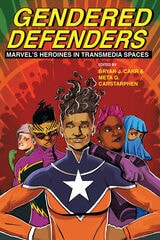
Gendered Defenders: Marvel’s Heroines in Transmedia Spaces delivers dynamic and original analyses of how women perform in super heroic spaces. Contributors from a range of disciplinary perspectives—communications, international relations, cultural and media studies, English, history, and public policy—take on Marvel’s representations of women and gender to examine how relations of power are (re)produced, understood, and challenged. Through vivid retellings of character-based scenarios, these essays examine Carol Danvers, Jessica Jones, Ms. Marvel, Shuri, Pepper Potts, Black Widow, and Squirrel Girl across media forms to characterize and critique contemporary understandings of identity, feminism, power, and gender. Collectively, Gendered Defenders challenges notions about female identity while illuminating the multidimensional portrayals that are enabled by the form of speculative fiction. Making explicit the connections between women’s lived experiences and the imagined exploits of superheroines, contributors explore how these pop culture narratives can help us understand real-world gender dynamics and prepare pedagogical, political, and social strategies for dealing with them. Contributors: Bryan J. Carr, Meta G. Carstarphen, Julie A. Davis, Rachel Grant, Annika Hagley, Amanda K. Kerhberg, Gregory P. Perreault, Mildred F. Perreault, CarrieLynn D. Reinhard, Maryanne A. Rhett, Stephanie L. Sanders, J. Richard Stevens, Anna C. Turner, Kathleen M. Turner-Ledgerwood, Robert Westerfelhaus
Gendered Infrastructures
Space, Scale, and IdentityYaffa Truelove
West Virginia University Press, 2024
The first book to take a feminist geographical approach to infrastructure, Gendered Infrastructures delves into the complex relationships between identity, social relations, and infrastructure. By drawing on feminist scholarship to enable new frameworks for critical study, this edited volume explores the gendered nature of infrastructures as diverse as Senegal’s waste disposal, Vietnam’s cement industry, and Lilongwe’s water kiosks. The chapters consider how infrastructural assemblages rework and shape gendered relations, identities, and meanings across space, while tracing the intersectionality of relations and uneven geographies that surround infrastructure. Ultimately, the contributors show how gender is always present in the quotidian building blocks that organize the socio-material world and daily life.
Edited by Yaffa Truelove and Anu Sabhlok, and the third book in Amy Trauger and Jennifer Fluri’s Gender, Feminism, and Geography series, the original essays in Gendered Infrastructures respond to and build upon a “new infrastructural turn in critical scholarship”—one that has helped enliven studies of identity across scale. The volume is relevant to geographers, anthropologists, architects, sociologists, urban researchers, and other interdisciplinary scholars interested in the gendered and social dimensions of infrastructure.
Gendered Places
The Landscape of Local Gender Norms across the United StatesWilliam J. Scarborough
Temple University Press, 2023
Every place has its quirky attributes, cultural reputation, and distinctive flair. But when we travel across America, do we also experience distinct gender norms and expectations? In his groundbreaking Gendered Places, William Scarborough examines metropolitan commuting zones to see how each region’s local culture reflects gender roles and gender equity. He uses surveys and social media data to measure multiple dimensions of gender norms, including expectations toward women in leadership, attitudes toward working mothers, as well as the division of household labor.
Gendered Places reveals that different locations, even within the same region of the country, such as Milwaukee and Madison Wisconsin, have distinct gender norms and highly influential cultural environments. Scarboroughshows how these local norms shape the attitudes and behaviors of residents with implications on patterns of inequality such as the gender wage gap. His findings offer valuable insight for community leaders and organizers making efforts to promote equality in their region.
Scarboroughrecognizes local culture as not value-neutral, but highly crucial to the gender structure that perpetuates, or challenges, gender inequality. Gendered Places questions how these gender norms are sustained and their social consequences.
Gendered Scenarios of Revolution
Making New Men and New Women in Nicaragua, 1975–2000Rosario Montoya
University of Arizona Press, 2012
In 1979, toward the end of the Cold War era, Nicaragua's Sandinista movement emerged on the world stage claiming to represent a new form of socialism. Gendered Scenarios of Revolution is a historical ethnography of Sandinista state formation from the perspective of El Tule-a peasant village that was itself thrust onto a national and international stage as a "model" Sandinista community. This book follows the villagers´ story as they joined the Sandinista movement, performed revolution before a world audience, and grappled with the lessons of this experience in the neoliberal aftermath.
Employing an approach that combines political economy and cultural analysis, Montoya argues that the Sandinistas collapsed gender contradictions into class ones, and that as the Contra War exacerbated political and economic crises in the country, the Sandinistas increasingly ruled by mandate as vanguard party instead of creating the participatory democracy that they professed to work toward. In El Tule this meant that even though the Sandinistas created new roles and possibilities for women and men, over time they upheld pre-revolutionary patriarchal social structures. Yet in showing how the revolution created opportunities for Tuleños to assert their agency and advance their interests, even against the Sandinistas´ own interests, this book offers a reinterpretation of the revolution´s supposed failure.
Examining this community’s experience in the Sandinista and post-Sandinista periods offers perspective on both processes of revolutionary transformation and their legacies in the neoliberal era. Gendered Scenarios of Revolution will engage graduate and undergraduate students and scholars in anthropology, sociology, history, and women’s and gender studies, and appeal to anyone interested in modern revolution and its aftermath.

Gendering the Fair
Histories of Women and Gender at World's FairsEdited by TJ Boisseau and Abigail M. Markwyn
University of Illinois Press, 2010

Generation Palestine
Voices from the Boycott, Divestment and Sanctions MovementEdited by Rich Wiles
Pluto Press, 2013
The unique model of apartheid, colonisation and military occupation that Israel imposes on the Palestinians, along with myriad violations of international law, have made Palestine the moral cause of a generation. Yet many people continue to ask, ‘what can we do?’
Generation Palestine helps to answer this question by bringing together Palestinian and international activists in the Boycott, Divestment and Sanctions (BDS) movement. The movement aims to pressure Israel until it complies with International Law, mirroring the model that was successfully utilised against South African apartheid.
With essays written by a wide selection of contributors, Generation Palestine follows the BDS movement’s model of inclusivity and collaboration. Contributors include Archbishop Desmond Tutu, Ken Loach, Iain Banks, Ronnie Kasrils, Professor Richard Falk, Ilan Pappe, Omar Barghouti, Ramzy Baroud and Archbishop Attallah Hannah, alongside other internationally acclaimed artists, writers, academics and grassroots activists.
Generation and Degeneration
Tropes of Reproduction in Literature and History from Antiquity through Early Modern EuropeValeria Finucci and Kevin Brownlee, eds.
Duke University Press, 2001
The discourses on reproduction, biology, degeneration, legacy, and lineage that this book broaches not only bring to the forefront concepts of sexual identity and gender politics but also show how they were culturally constructed and reconstructed through the centuries by medicine, philosophy, the visual arts, law, religion, and literature. The contributors reflect on a wide range of topics—from what makes men “manly” to the identity of Christ’s father, from what kinds of erotic practices went on among women in sixteenth-century seraglios to how men’s hemorrhoids can be variously labeled. Essays scrutinize stories of menstruating males and early writings on the presumed inferiority of female bodily functions. Others investigate a psychomorphology of the clitoris that challenges Freud’s account of lesbianism as an infantile stage of sexual development and such topics as the geographical origins of medicine and the materialization of genealogy in the presence of Renaissance theatrical ghosts.
This collection will engage those in English, comparative, Italian, Spanish, and French studies, as well as in history, history of medicine, and ancient and early modern religious studies.
Contributors. Kevin Brownlee, Marina Scordilis Brownlee, Elizabeth Clark, Valeria Finucci, Dale Martin, Gianna Pomata, Maureen Quilligan, Nancy Siraisi, Peter Stallybrass,Valerie Traub
Generations and Collective Memory
Amy Corning and Howard Schuman
University of Chicago Press, 2015
Their key finding—built on historical research and interviews in the United States and seven other countries (including China, Japan, Germany, Lithuania, Russia, Israel, and Ukraine)—is that our most powerful generational memories are of shared experiences in adolescence and early adulthood, like the 1963 Kennedy assassination for those born in the 1950s or the fall of the Berlin Wall for young people in 1989. But there are exceptions to that rule, and they're significant: Corning and Schuman find that epochal events in a country, like revolutions, override the expected effects of age, affecting citizens of all ages with a similar power and lasting intensity.
The picture Corning and Schuman paint of collective memory and its formation is fascinating on its face, but it also offers intriguing new ways to think about the rise and fall of historical reputations and attitudes toward political issues.

Genesis and Development of a Scientific Fact
Ludwik Fleck
University of Chicago Press, 1981
"To many scientists just as to many historians and philosophers of science facts are things that simply are the case: they are discovered through properly passive observation of natural reality. To such views Fleck replies that facts are invented, not discovered. Moreover, the appearance of scientific facts as discovered things is itself a social construction, a made thing. A work of transparent brilliance, one of the most significant contributions toward a thoroughly sociological account of scientific knowledge."—Steven Shapin, Science
Genetically Modified Food
A Short Guide For the ConfusedAndy Rees
Pluto Press, 2006

Genomics with Care
Minding the Double Binds of ScienceMike Fortun
Duke University Press, 2023
Genre Worlds
Popular Fiction and Twenty-First-Century Book CultureKim Wilkins, Beth Driscoll, and Lisa Fletcher
University of Massachusetts Press, 2022
Works of genre fiction are a source of enjoyment, read during cherished leisure time and in incidental moments of relaxation. This original book takes readers inside popular genres of fiction, including crime, fantasy, and romance, to reveal how personal tastes, social connections, and industry knowledge shape genre worlds. Attuned to both the pleasure and the profession of producing genre fiction, the authors investigate contemporary developments in the field—the rise of Amazon, self-publishing platforms, transmedia storytelling, and growing global publishing conglomerates—and show how these interact with older practices, from fan conventions to writers’ groups.
Sitting at the intersection of literary studies, genre studies, fan studies, and studies of the book and publishing cultures, Genre Worlds considers how contemporary genre fiction is produced and circulated on a global scale. Its authors propose an innovative theoretical framework that unfolds genre fiction’s most compelling characteristics: its connected social, industrial, and textual practices. As they demonstrate, genre fiction books are not merely texts; they are also nodes of social and industrial activity involving the production, dissemination, and reception of the texts.

Genre and the Performance of Publics
Mary Jo Reiff
Utah State University Press, 2016
In recent decades, genre studies has focused attention on how genres mediate social activities within workplace and academic settings. Genre and the Performance of Publics moves beyond institutional settings to explore public contexts that are less hierarchical, broadening the theory of how genres contribute to the interconnected and dynamic performances of public life.
Chapters examine how genres develop within publics and how genres tend to mediate performances in public domains, setting up a discussion between public sphere scholarship and rhetorical genre studies. The volume extends the understanding of genres as not only social ways of organizing texts or mediating relationships within institutions but as dynamic performances themselves.
By exploring how genres shape the formation of publics, Genre and the Performance of Publicsbrings rhetoric/composition and public sphere studies into dialogue and enhances the understanding of public genre performances in ways that contribute to research on and teaching of public discourse.
Genre, Race, and the Production of Subjectivity in German Romanticism
Stephanie Galasso
Northwestern University Press, 2024
Late Enlightenment philosophers and writers like Herder, Goethe, and Schiller broke with conventions of form and genre to prioritize an idealized, and racially coded, universality. Newly translated literatures from colonial contexts served as the basis for their evaluations of how to contribute to a distinctly “German” national literary tradition, one that valorized modernity and freedom and thus fortified crucial determinants of modern concepts of whiteness. Through close readings of both canonical and less-studied Romantic texts, Stephanie Galasso examines the intimately entwined histories of racialized subjectivity and aesthetic theory and shows how literary genre is both symptomatic and generative of the cultural violence that underpinned the colonial project.
Poetic expression and its generic conventions continue to exert pressure on the framing and reception of the stories that can be told about interpersonal and structural experiences of oppression. Genre, Race, and the Production of Subjectivity in German Romanticism explores how white subjectivity is guarded by symbolic and material forms of violence.

Genres of Listening
An Ethnography of Psychoanalysis in Buenos AiresXochitl Marsilli-Vargas
Duke University Press, 2022

Genres of the Credit Economy
Mediating Value in Eighteenth- and Nineteenth-Century BritainMary Poovey
University of Chicago Press, 2008
Chronicling the process by which some of our most important conceptual categories were naturalized, Mary Poovey explores complex relationships among forms of writing that are not usually viewed together, from bills of exchange and bank checks, to realist novels and Romantic poems, to economic theory and financial journalism. Taking up all early forms of financial and monetarywriting, Poovey argues that these genres mediated for early modern Britons the operations of a market system organized around credit and debt. By arguing that genre is a critical tool for historical and theoretical analysis and an agent in the events that formed the modern world, Poovey offers a new way to appreciate the character of the credit economy and demonstrates the contribution historians and literary scholars can make to understanding its operations.
Much more than an exploration of writing on and around money, Genres of the Credit Economy offers startling insights about the evolution of disciplines and the separation of factual and fictional genres.

Gentleman Troubadours and Andean Pop Stars
Huayno Music, Media Work, and Ethnic Imaginaries in Urban PeruJoshua Tucker
University of Chicago Press, 2013
Geoengineering, Persuasion, and the Climate Crisis
A Geologic RhetoricEhren Helmut Pflugfelder
University of Alabama Press, 2023
A rhetorical exploration of an underexamined side of climate change—the ongoing research into and development of geoengineering strategies
Geoengineering, Persuasion, and the Climate Crisis: A Geologic Rhetoric exposes the deeply worrying state of discourse over geoengineering—the intentional manipulation of the earth’s climate as means to halt or reverse global warming. These climate-altering projects, which range from cloud-whitening to carbon dioxide removal and from stratospheric aerosol injection to enhanced weathering, are all technological solutions to more complex geosocial problems.
Geoengineering represents one of the most alarming forms of deliberative discourse in the twenty-first century. Yet geoengineering could easily generate as much harm as the environmental traumas it seeks to cure. Complicating these deliberations is the scarcity of public discussion. Most deliberations transpire within policy groups, behind the closed doors of climate-oriented startups, between subject-matter experts at scientific conferences, or in the disciplinary jargon of research journals. Further, much of this conversation occurs primarily in the West.
Ehren Helmut Pflugfelder makes clear how the deliberative rhetorical strategies coming from geoengineering advocates have been largely deceptive, hegemonic, deterministic, and exploitative. In this volume, he investigates how geoengineering proponents marshal geologic actors into their arguments—and how current discourse could lead to a greater exploitation of the earth in the future.
Pflugfelder’s goal is to understand the structure, content, purpose, and effect of these discourses, raise the alarm about their deliberative directions, and help us rethink our approach to the climate. In highlighting both the inherent problems of the discourses and the ways geologic rhetoric can be made productive, he attempts to give “the geologic” a place at the table to better understand the roles that all earth systems continue to play in our lives, now and for years to come.

Geographical Identities Of Ethnic America
Race, Space, And PlaceKate A. Berry
University of Nevada Press, 2001

Geographies of Solar Energy Transitions
Conflicts, Controversies and Cognate AspectsEdited by Siddharth Sareen and Abigail Martin
University College London, 2024
Solar energy is the world’s largest growing source of power. Recently, this energy transition has produced a series of cognate challenges and conflicts in diverse geographies, yielding effects far beyond electricity generation. Geographies of Solar Energy Transitions illustrates how solar energy governance—both state-based and market-driven—is evolving to address these conflicts. Throughout the book, leading energy scholars examine relevant case studies, drawing necessary attention to the multitude of issues with solar power use, including formulating new place-specific solar energy visions and strategies, financing specific deployment scales, expanding and replacing electricity infrastructure, accessing land, resolving conflicts with competing land uses, incorporating charging technologies for transport and storage, adopting flexible energy production/consumption relationships, displacing fossil fuel energy production with renewables, enabling new energy ownership models, and addressing environmental and social injustices across the value chain of solar expansion.

Geologic Life
Inhuman Intimacies and the Geophysics of RaceKathryn Yusoff
Duke University Press, 2024

Geometry of Grief
Reflections on Mathematics, Loss, and LifeMichael Frame
University of Chicago Press, 2021
We all know the euphoria of intellectual epiphany—the thrill of sudden understanding. But coupled with that excitement is a sense of loss: a moment of epiphany can never be repeated. In Geometry of Grief, mathematician Michael Frame draws on a career’s worth of insight—including his work with a pioneer of fractal geometry Benoit Mandelbrot—and a gift for rendering the complex accessible as he delves into this twinning of understanding and loss. Grief, Frame reveals, can be a moment of possibility.
Frame investigates grief as a response to an irrevocable change in circumstance. This reframing allows us to see parallels between the loss of a loved one or a career and the loss of the elation of first understanding a tricky concept. From this foundation, Frame builds a geometric model of mental states. An object that is fractal, for example, has symmetry of magnification: magnify a picture of a mountain or a fern leaf—both fractal—and we see echoes of the original shape. Similarly, nested inside great loss are smaller losses. By manipulating this geometry, Frame shows us, we may be able to redirect our thinking in ways that help reduce our pain. Small‐scale losses, in essence, provide laboratories to learn how to meet large-scale losses.
Interweaving original illustrations, clear introductions to advanced topics in geometry, and wisdom gleaned from his own experience with illness and others’ remarkable responses to devastating loss, Frame’s poetic book is a journey through the beautiful complexities of mathematics and life. With both human sympathy and geometrical elegance, it helps us to see how a geometry of grief can open a pathway for bold action.
George Washington's Enforcers
Policing the Continental ArmyHarry M. Ward
Southern Illinois University Press, 2006
A well-disciplined army was vital to win American independence, but policing soldiers during the Revolution presented challenges. George Washington’s Enforcers: Policing the Continental Army examines how justice was left to the overlapping duties of special army personnel and how an improvised police force imposed rules and regulations on the common soldier. Historian Harry M. Ward describes these methods of police enforcement, emphasizing the brutality experienced by the enlisted men who were punished severely for even light transgressions. This volume explores the influences that shaped army practice and the quality of the soldiery, the enforcement of military justice, the use of guards as military police, and the application of punishment.
Washington’s army, which adopted the organization and justice code of the British army, labored under the direction of ill-trained and arrogant officers. Ward relates how the enlisted men, who had a propensity for troublemaking and desertion, not only were victims of the double standard that existed between officers and regular troops but also lacked legal protection in the army. The enforcement of military justice afforded the accused with little due process support.
Ward discusses the duties of the various personnel responsible for training and enforcing the standards of behavior, including duty officers, adjutants, brigade majors, inspectors, and sergeant majors. He includes the roles of life guards, camp guards, quarter guards, picket men, and safe guards, whose responsibilities ranged from escorting the commander in chief, intercepting spies and stragglers, and protecting farmers from marauding soldiers to searching for deserters, rounding up unauthorized personnel, and looking for delinquents in local towns and taverns.
George Washington’s Enforcers, which includes sixteen illustrations, also addresses the executions of the period, as both ritual and spectacle, and the deterrent value of capital punishment. Ward explains how Washington himself mixed clemency with severity and examines how army policies tested the mettle of this chief disciplinarian, who operated by the dictates of military necessity as perceived at the time.

German Colonialism Revisited
African, Asian, and Oceanic ExperiencesNina Berman, Klaus Mühlhahn, and Patrice Nganang, editors
University of Michigan Press, 2018
German Colonialism Revisited brings together military historians, art historians, literary scholars, cultural theorists, and linguists to address a range of issues surrounding colonized African, Asian, and Oceanic people’s creative reactions to and interactions with German colonialism. This scholarship sheds new light on local power dynamics; agency; and economic, cultural, and social networks that preceded and, as some now argue, ultimately structured German colonial rule. Going beyond issues of resistance, these essays present colonialism as a shared event from which both the colonized and the colonizers emerged changed.
Gesture and Power
Religion, Nationalism, and Everyday Performance in CongoYolanda Covington-Ward
Duke University Press, 2016