Results by title
231 books match the query 'Society' and 10 start with g
Garden of Egypt
Irrigation, Society, and the State in the Premodern FayyumBrendan Haug
University of Michigan Press, 2024
2025 American Society of Papyrologists Book Prize Winner
Garden of Egypt: Irrigation, Society, and the State in the Premodern Fayyūm is the first environmental history of Egypt’s Fayyūm depression. The volume studies human relationships with flowing water, from the third century BCE to the thirteenth century CE. Until the arrival of modern perennial irrigation in the nineteenth century, the Fayyūm was the only region of premodern Egypt to be irrigated by a network of artificial canals. By linking large numbers of rural communities together in shared dependence on this public irrigation infrastructure, canalization introduced to Egypt a radically new way of interacting both with the water of the Nile and with fellow farmers. Drawing upon ancient Greek papyri, medieval Arabic literature, and modern comparative evidence, this book explores the ways in which the Nile’s water, local farmers, and state power together continually reshaped this irrigated landscape over more than thirteen centuries. Following human/water relationships through both space and time further helps to erode disciplinary boundaries and bring multiple periods of Egyptian history into contact with one another.

Gender and Society in Contemporary Brazilian Cinema
By David William Foster
University of Texas Press, 1999
"Gender is an absolute ground zero for most human societies," writes David William Foster, "an absolute horizon of social subjectivity." In this book, he examines gender issues in thirteen Brazilian films made (with one exception) after the 1985 return to constitutional democracy and elimination of censorship to show how these issues arise from and comment on the sociohistorical reality of contemporary Brazilian society.
Foster organizes his study around three broad themes: construction of masculinity, constructions of feminine and feminist identities, and same-sex positionings and social power. Within his discussions of individual films ranging from Jorge um brasileiro to A hora da estrela to Beijo no asfalto, he offers new ways of understanding national ideals and stereotypes, sexual dissidence (homoeroticism and transgenderism), heroic models, U.S./Brazilian relations, revolutionary struggle, and human rights violations. As the first study of Brazilian cinematic representations of gender ideology in English or Portuguese, this book will be important reading in film and cultural studies.

George Eliot in Society
Travels Abroad and Sundays at the PrioryKathleen McCormack
The Ohio State University Press, 2013
Gibbons v. Ogden, Law, and Society in the Early Republic
Thomas H. Cox
Ohio University Press, 2009
Gibbons v. Ogden, Law, and Society in the Early Republic examines a landmark decision in American jurisprudence, the first Supreme Court case to deal with the thorny legal issue of interstate commerce.
Decided in 1824, Gibbons v. Ogden arose out of litigation between owners of rival steamboat lines over passenger and freight routes between the neighboring states of New York and New Jersey. But what began as a local dispute over the right to ferry the paying public from the New Jersey shore to New York City soon found its way into John Marshall’s court and constitutional history. The case is consistently ranked as one of the twenty most significant Supreme Court decisions and is still taught in constitutional law courses, cited in state and federal cases, and quoted in articles on constitutional, business, and technological history.
Gibbons v. Ogden initially attracted enormous public attention because it involved the development of a new and sensational form of technology. To early Americans, steamboats were floating symbols of progress—cheaper and quicker transportation that could bring goods to market and refinement to the backcountry. A product of the rough-and-tumble world of nascent capitalism and legal innovation, the case became a landmark decision that established the supremacy of federal regulation of interstate trade, curtailed states’ rights, and promoted a national market economy. The case has been invoked by prohibitionists, New Dealers, civil rights activists, and social conservatives alike in debates over federal regulation of issues ranging from labor standards to gun control. This lively study fills in the social and political context in which the case was decided—the colorful and fascinating personalities, the entrepreneurial spirit of the early republic, and the technological breakthroughs that brought modernity to the masses.
Global Urban Policy
A Framework for Analyzing State and SocietyEdited by David Kaufmann and Mara Sidney
University of Michigan Press, 2026
Global Urban Policy suggests that to understand contemporary societal transformation—and political and policy processes more generally—we need to study the policies that cities create and implement. Going beyond thinking of “urban” as a physical site, the authors show that an urban mode of life is one marked by diversity, complexity, chaos, flexibility, and ongoing change. With eleven empirical case studies, the authors examine issues including housing and urban development, migration, climate change, and crime in cities as varied as Berlin, Medellín, Chicago, Accra, Guangzhou, São Paulo, Mumbai, and Saint Etienne. The studies show how contemporary confrontations between public and private property, power and justice, participation and exclusion, wealth and poverty, and emerging technology and existing economic, social, and political structures take physical form in cities. Global Urban Policy engages with theoretical developments in public policy, urban politics, and urban studies to develop and demonstrate a framework for urban policy analysis.
God and Caesar
Selected Essays on Religion, Politics, & SocietyGeorge Pell
Catholic University of America Press, 2007
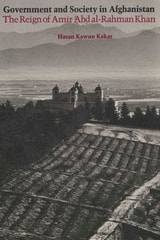
Government and Society in Afghanistan
The Reign of Amir ‘Abd al-Rahman KhanBy Hasan Kawun Kakar
University of Texas Press, 1979
This is an authoritative study of the administrative, social, and economic structure of Afghanistan during a decisive stage in its history. The period covered—the reign of the "Iron" Amir Rahman Khan—was in many ways the beginning of modern Afghanistan as a cohesive nation. Although Afghanistan had emerged as an entity in 1747, it was actually under the Amir that its borders were established, its internal unification completed, and the modern concept of nationhood implanted.
Kakar approaches this complex process by taking into consideration both the internal and the external forces that influenced its development. Thus, modernization, centralization, and nationalization are seen as both defensive reactions to European imperialism and necessary preconditions to capital formation and, consequently, industrialization.
The first part of the book covers the government of the Amir, from the personality of the ruler down to the operation of his new bureaucrats at the local level. Here Kakar presents a comprehensive treatment of the Afghan system of taxation and local government. The second part views these economic and social institutions from the perspective of the major segments of the populace—nomads, townsmen, tribes, women, slaves, landowners, mullahs, merchants, and so forth.
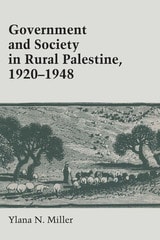
Government and Society in Rural Palestine, 1920-1948
By Ylana N. Miller
University of Texas Press, 1985
In 1947, Arabs made up two-thirds of the population of Palestine, and they owned most of its cultivable land. Why then, did they "lose" their homes and land to a relatively small Jewish community just emerging from the shocks of World War II? Did the Palestinians "lose" their homeland because they were backward, primitive, and reactionary? Or was Israel the product of persistent victimization of Palestinian Arabs by an imperialist power which supported Zionist colonization? Did the Palestinians sell each other out? Or were they helpless sufferers in the face of a sophisticated enemy with endless resources?
Too often discussions of Palestine are couched in such rhetorical language, based on the assumption that either Jews or Arabs are morally to blame for historical realities. This study seeks to go beyond attributions of responsibility to investigate the concrete conditions which determined and limited Palestinian Arab actions between 1920 and 1948. It was during that period, while Great Britain governed the area under a League of Nations mandate, that Palestine both emerged and disappeared as a modern political entity.
Many studies of Palestinian Arab nationalism have looked to Zionism as the primary agent of change in the region. Miller assumes the impact of Jewish settlement but goes beyond these earlier studies to explore the way in which policies of the Palestine government affected the daily lives of villagers—the majority of the population—and their understanding of the changes occurring around them. In this way, what emerges is a detailed analysis of the influence, for good or ill, that government policy had on village community life.
Based largely on archival sources never before used, this work allows the reader to gain a deeper appreciation of the internal life of the rural community, which had previously received relatively little attention. Understanding the experiences of Palestinians before 1948 helps us to comprehend immeasurably better the continuity of movements for Palestinian statehood as well as the continuing tensions and problems on the West Bank today.

Greening Brazil
Environmental Activism in State and SocietyKathryn Hochstetler and Margaret E. Keck
Duke University Press, 2007
The authors present a multilevel analysis encompassing institutions and individuals within the government—at national, state, and local levels—as well as the activists, interest groups, and nongovernmental organizations that operate outside formal political channels. They emphasize the importance of networks linking committed actors in the government bureaucracy with activists in civil society. Portraying a gradual process marked by periods of rapid advance, Hochstetler and Keck show how political opportunities have arisen from major political transformations such as the transition to democracy and from critical events, including the well-publicized murders of environmental activists in 1988 and 2004. Rather than view foreign governments and organizations as the instigators of environmental policy change in Brazil, the authors point to their importance at key moments as sources of leverage and support.

Guilds, Society and Economy in London 1450-1800
Ian Anders Gadd and Patrick Wallis
University of London Press, 2002