Results by title
100 books match the query 'Sociolinguistics' and 3 start with g
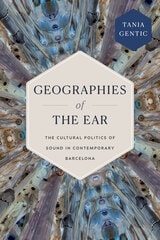
Geographies of the Ear
The Cultural Politics of Sound in Contemporary BarcelonaTania Gentic
Duke University Press, 2025
In Geographies of the Ear, Tania Gentic examines the language and soundscape of post-Franco Barcelona to listen for the remnants of a globalized colonial ear. She theorizes “echoic memory” to understand how sound circulates from the past to the present—and from neighborhood to nation to globe—to trace how sonic practices produce and contest modernity, community identity, and democracy. Focusing on migrant and tourist accents, free radio stations, punk music, drag performances, and antigentrification protests, Gentic shows how the underground sounds in Barcelona complicate a modernizing aural imaginary of place. By thinking through the auralities present in literature, fanzines, comic books, documentary films, television and print media, popular music, public protests, and even everyday conversation, Gentic outlines the difficulties of considering the contemporary city as either the product of a monolingual national identity or a lived space easily circumscribed by geographical categories such as North, South, East, or West.
[more]
Gesture in Multiparty Interaction
Emily Shaw
Gallaudet University Press, 2018
Gesture in Multiparty Interaction confronts the competing views that exist regarding gesture’s relationship to language. In this work, Emily Shaw examines embodied discourses in American Sign Language and spoken English and seeks to establish connections between sign language and co-speech gesture. By bringing the two modalities together, Shaw illuminates the similarities between certain phenomena and presents a unified analysis of embodied discourse that more clearly captures gesture’s connection to language as a whole.
Shaw filmed Deaf and hearing participants playing a gesture-based game as part of a social game night. Their interactions were then studied using discourse analysis to see whether and how Deaf and hearing people craft discourses through the use of their bodies. This volume examines gesture, not just for its iconic, imagistic qualities, but also as an interactive resource in signed and spoken discourse. In addition, Shaw addresses the key theoretical barriers that prevent a full accounting of gesture’s interface with signed and spoken language. Her study pushes further the notion that language is fundamentally embodied.
Shaw filmed Deaf and hearing participants playing a gesture-based game as part of a social game night. Their interactions were then studied using discourse analysis to see whether and how Deaf and hearing people craft discourses through the use of their bodies. This volume examines gesture, not just for its iconic, imagistic qualities, but also as an interactive resource in signed and spoken discourse. In addition, Shaw addresses the key theoretical barriers that prevent a full accounting of gesture’s interface with signed and spoken language. Her study pushes further the notion that language is fundamentally embodied.
[more]
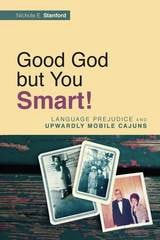
Good God but You Smart!
Language Prejudice and Upwardly Mobile CajunsNichole E. Stanford
Utah State University Press, 2016
Taking Cajuns as a case study, Good God but You Smart! explores the subtle ways language bias is used in classrooms, within families, and in pop culture references to enforce systemic economic inequality. It is the first book in composition studies to examine comprehensively, and from an insider’s perspective, the cultural and linguistic assimilation of Cajuns in Louisiana.
The study investigates the complicated motivations and cultural concessions of upwardly mobile Cajuns who “choose” to self-censor—to speak Standardized English over the Cajun English that carries their cultural identity. Drawing on surveys of English teachers in four Louisiana colleges, previously unpublished archival data, and Pierre Bourdieu’s theory of the legitimate language, author Nichole Stanford explores how socioeconomic and political pressures rooted in language prejudice make code switching, or self-censoring in public, seem a responsible decision. Yet teaching students to skirt others’ prejudice toward certain dialects only puts off actually dealing with the prejudice. Focusing on what goes on outside classrooms, Stanford critiques code switching and cautions users of code meshing that pedagogical responses within the educational system are limited by the reproductive function of schools. Each theory section includes parallel memoir sections in the Cajun tradition of storytelling to open an experiential window to the study without technical language.
Through its explication of language legitimacy and its grounding in lived experience, Good God but You Smart! is an essential addition to the pedagogical canon of language minority studies like those of Villanueva, Gilyard, Smitherman, and Rose.
[more]