Results by title
171 books match the query 'Soldiers' and 5 start with g
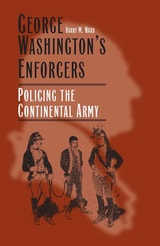
George Washington's Enforcers
Policing the Continental ArmyHarry M. Ward
Southern Illinois University Press, 2006
A well-disciplined army was vital to win American independence, but policing soldiers during the Revolution presented challenges. George Washington’s Enforcers: Policing the Continental Army examines how justice was left to the overlapping duties of special army personnel and how an improvised police force imposed rules and regulations on the common soldier. Historian Harry M. Ward describes these methods of police enforcement, emphasizing the brutality experienced by the enlisted men who were punished severely for even light transgressions. This volume explores the influences that shaped army practice and the quality of the soldiery, the enforcement of military justice, the use of guards as military police, and the application of punishment.
Washington’s army, which adopted the organization and justice code of the British army, labored under the direction of ill-trained and arrogant officers. Ward relates how the enlisted men, who had a propensity for troublemaking and desertion, not only were victims of the double standard that existed between officers and regular troops but also lacked legal protection in the army. The enforcement of military justice afforded the accused with little due process support.
Ward discusses the duties of the various personnel responsible for training and enforcing the standards of behavior, including duty officers, adjutants, brigade majors, inspectors, and sergeant majors. He includes the roles of life guards, camp guards, quarter guards, picket men, and safe guards, whose responsibilities ranged from escorting the commander in chief, intercepting spies and stragglers, and protecting farmers from marauding soldiers to searching for deserters, rounding up unauthorized personnel, and looking for delinquents in local towns and taverns.
George Washington’s Enforcers, which includes sixteen illustrations, also addresses the executions of the period, as both ritual and spectacle, and the deterrent value of capital punishment. Ward explains how Washington himself mixed clemency with severity and examines how army policies tested the mettle of this chief disciplinarian, who operated by the dictates of military necessity as perceived at the time.

Getting Used to Being Shot At
Mark K. Christ
University of Arkansas Press, 2002
Ghost Riders of Baghdad
Soldiers, Civilians, and the Myth of the SurgeDaniel A. Sjursen
University Press of New England, 2015
Giant Steps
Suffragettes and SoldiersMary Blair Immel
Indiana Historical Society Press, 2017
Gladius
The World of the Roman SoldierGuy de la Bédoyère
University of Chicago Press, 2020
Empire.
The Roman army was the greatest fighting machine in the ancient world. More than that, it was the single largest organization in Western antiquity, taking in members from all classes, from senators to freed slaves. The Roman Empire depended on its army not just to win its wars, defend its frontiers, and control the seas, but to act as the very engine of the state.
In Gladius, Guy de la Bédoyère takes us straight to the heart of what it meant to be a part of the Roman army. Rather than a history of the army itself, or a guide to military organization and fighting methods, this book is a ground-level recreation of what it was like to be a soldier in the army that made the empire. Surveying numerous aspects of life in the Roman army between 264 BCE and 337 CE, Gladius—the Latin word for sword—draws not only on the words of famed Roman historians, but also those of the soldiers themselves, as recorded in their religious dedications, tombstones, and even private letters and graffiti. Gladius reveals the everyday life of these soldiers and their families, whether stationed in a bleak frontier garrison in Britain or North Africa, tasked with guarding the emperor in Rome, fighting on foreign battlefields, mutinying over pay, marching in triumph, throwing their weight around on city streets, or enjoying esteem in honorable retirement.
By illuminating the history of one organization that reflected all corners of the Roman world, Gladius gives us a portrait of an ancient society that is unprecedented in both its broad sweep and gritty intimacy.