323 books match the query 'Southeast Asia' and 7 start with g

cover of Gamelan Gong Kebyar: The Art of Twentieth-Century Balinese Music

Gamelan Gong Kebyar

The Art of Twentieth-Century Balinese Music

Michael Tenzer

University of Chicago Press, 2000

The Balinese gamelan, with its shimmering tones, breathless pace, and compelling musical language, has long captivated musicians, composers, artists, and travelers. Here, Michael Tenzer offers a comprehensive and durable study of this sophisticated musical tradition, focusing on the preeminent twentieth-century genre, gamelan gong kebyar.

Combining the tools of the anthropologist, composer, music theorist, and performer, Tenzer moves fluidly between ethnography and technical discussions of musical composition and structure. In an approach as intricate as one might expect in studies of Western classical music, Tenzer's rigorous application of music theory and analysis to a non-Western orchestral genre is wholly original. Illustrated throughout, the book also includes nearly 100 pages of musical transcription (in Western notation) that correlate with 55 separate tracks compiled on two accompanying compact discs.

The most ambitious work on gamelan since Colin McPhee's classic Music in Bali, this book will interest musicians of all kinds and anyone interested in the art and culture of Southeast Asia, Indonesia, and Bali.

[more]
cover of Ghostly Desires: Queer Sexuality and Vernacular Buddhism in Contemporary Thai Cinema

Ghostly Desires

Queer Sexuality and Vernacular Buddhism in Contemporary Thai Cinema

Arnika Fuhrmann

Duke University Press, 2016
Through an examination of post-1997 Thai cinema and video art Arnika Fuhrmann shows how vernacular Buddhist tenets, stories, and images combine with sexual politics in figuring current struggles over notions of personhood, sexuality, and collective life. The drama, horror, heritage, and experimental art films she analyzes draw on Buddhist-informed conceptions of impermanence and prominently feature the motif of the female ghost. In these films the characters' eroticization in the spheres of loss and death represents an improvisation on the Buddhist disavowal of attachment and highlights under-recognized female and queer desire and persistence. Her feminist and queer readings reveal the entangled relationships between film, sexuality, Buddhist ideas, and the Thai state's regulation of heteronormative sexuality. Fuhrmann thereby provides insights into the configuration of contemporary Thailand while opening up new possibilities for thinking about queer personhood and femininity.
[more]
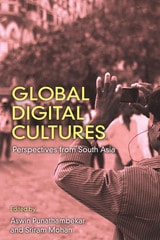
cover of Global Digital Cultures: Perspectives from South Asia

Global Digital Cultures

Perspectives from South Asia

Aswin Punathambekar and Sriram Mohan, Editors

University of Michigan Press, 2019
Digital media histories are part of a global network, and South Asia is a key nexus in shaping the trajectory of digital media in the twenty-first century. Digital platforms like Facebook, WhatsApp, and others are deeply embedded in the daily lives of millions of people around the world, shaping how people engage with others as kin, as citizens, and as consumers. Moving away from Anglo-American and strictly national frameworks, the essays in this book explore the intersections of local, national, regional, and global forces that shape contemporary digital culture(s) in regions like South Asia: the rise of digital and mobile media technologies, the ongoing transformation of established media industries, and emergent forms of digital media practice and use that are reconfiguring sociocultural, political, and economic terrains across the Indian subcontinent. From massive state-driven digital identity projects and YouTube censorship to Tinder and dating culture, from Twitter and primetime television to Facebook and political rumors, Global Digital Cultures focuses on enduring concerns of representation, identity, and power while grappling with algorithmic curation and data-driven processes of production, circulation, and consumption.

 
[more]
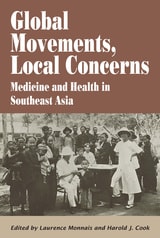
cover of Global Movements, Local Concerns: Medicine and Health in Southeast Asia

Global Movements, Local Concerns

Medicine and Health in Southeast Asia

Edited by Laurence Monnais and Harold J. Cook

National University of Singapore Press, 2012
The development of medicine in Southeast Asia over the past two centuries has not been a simple imposition of European scientific medicine, but a complex and negotiated process that drew on Southeast Asian health experts, local medical traditions, and changing national and popular expectations. The contributors to this volume show how the practices of health in Southeast Asia over the past two centuries were mediated by local medical traditions, colonial interests, governments and policies, international interventions, and by a wide range of health agents and intermediaries. Their findings call into question many of the claims based on medicalization and biopolitics that treat change as a process of rupture. While governments, both colonial and national, instituted policies that affected large numbers of people, much health care remained rooted in a more interactive and locally-mediated experience, in which tradition, adaptation and hybridization is as important as innovation and conflict. "Semi-subaltern" Western-trained doctors and varied traditional healers, many of them women, were among the cultural brokers involved in the building of healthcare systems, and helped circulate mixed practices and ideas about medicine and health even as they found their place in new professional and social hierarchies in an era of globalization.
[more]
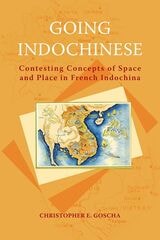
cover of Going Indochinese

Going Indochinese

Christopher E. Goscha

National University of Singapore Press, 2012

Why, Benedict Anderson once asked, did Javanese become Indonesian in 1945 whereas the Vietnamese balked at becoming Indochinese? In this classic study, Goscha shows that Vietnamese of all political colours came remarkably close to building a modern national identity based on the colonial model of Indochina while Lao and Cambodian nationalists rejected this precisely because it represented a Vietnamese entity. First published in 1995, the revised edition of this remarkable study is augmented with new material by the author and a foreword by Eric Jennings.
[more]
cover of Governor, Traveller, Scholar, Spy: The Career of Sir Cecil Clementi

Governor, Traveller, Scholar, Spy

The Career of Sir Cecil Clementi

Graham Hutchings

Hong Kong University Press, 2026

Governor, Traveller, Scholar, Spy traces the life and career of the talented colonial administrator Sir Cecil Clementi, who rose to become governor of Hong Kong and then the Straits Settlements. He governed Hong Kong at a time of revolutionary upheaval in China which brought the city to its economic knees and threatened Britain’s possession of the territory. Clementi strongly objected to London’s attempts to come to terms with Chiang Kai-shek’s Nationalist government and sought to protect Hong Kong from the intellectual currents sweeping through the mainland by making the city a bastion of traditional Chinese culture. As Governor of Straits Settlements and High Commissioner of the Federated Malay States, he championed the traditional rights of the Malay rulers and suppressed national sentiment among Malaya’s swelling Chinese population. Alarmed by his determination to press ahead with such policies despite opposition, the government in London forced Clementi into early retirement.

This is the first full-length biography of a highly gifted colonial administrator who spent half of his roughly 30-year career in Hong Kong and played a major role in the city’s history. As a young official, Clementi quickly mastered Chinese and published translations of Cantonese poetry. He undertook epic journeys across China on intelligence-gathering missions, was closely involved in the land settlement in the New Territories, and the creation of Hong Kong University. As governor, he championed the development of Kai Tak airport and the provision of Hong Kong’s water supply. He also appointed the first Chinese member of the city’s Executive Council. Yet he resisted reforms to the controversial mui-tsai system under which Chinese girls served as housemaids to Chinese families on the grounds that it was a Chinese "tradition." This study of his career, in which he was also posted to British Guiana and Ceylon, sheds light on how Britain administered the far-flung territories that formed its empire.

[more]
cover of Guns of February: Ordinary Japanese Soldiers' Views of the Malayan Campaign and the Fall of Singapore, 1941-42

Guns of February

Ordinary Japanese Soldiers' Views of the Malayan Campaign and the Fall of Singapore, 1941-42

Henry Frei

National University of Singapore Press, 1990

Guns of February shows the Fall of Singapore and Japan's 1941 military campaign in Malaya through the eyes of Japanese soldiers who took part, based on interviews, memoirs, war diaries, and other Japanese-language sources. Although an enormous number of books have been published on Japan's wartime advance into Southeast Asia, few books in English make much use of Japanese sources, and they reveal little of what happened on the Japanese side. In the words of the author, the Japanese"'advance by brigade groups', 'outflank the defence', 'sustain many casualties', and remain altogether a largely faceless mass bicycling their way down to Singapore." In Guns of February some of the voices of these soldiers are finally heard, and they tell a fascinating story. A few of them were professional soldiers who served their country with commitment and dedication, but many were conscripts hoping to stay alive, curious and apprehensive about the countries they entered, and moved by the plight of the people whose cities and towns they sometimes destroyed. Many were young men, interested in girls and in the sights and sounds of Southeast Asia, but also missing their families and the familiar world of Japan. It is a picture far removed from the staple view of the remorseless and fanatic Japanese soldier totally devoted to his Emperor and determined to die for his country. In writing this account of the Japanese advance on Singapore, the author attempted to show the universal humanity of the actors concerned.
[more]