Results by title
53 books match the query 'Southwest' and 2 start with g

Gateways to the Southwest
The Story of Arizona State ParksJay M. Price
University of Arizona Press, 2004
Arizona is home to some of the region's most stunning national parks and monuments and has had a long tradition of strong federal agencies—along with effective local governments—developing and managing parklands. Before World War II, protecting sites from development seemed counterproductive to a state government dominated by extractive industries. By the late 1950s this state that prided itself on being a tourist destination found its lack of state parks to be an embarrassment. Gateways to the Southwest is a history of the creation of state parks in Arizona, examining the ways in which different types of parks were created in the face of changing social values. Jay Price tells how Arizona's parks emerged from the recreation and tourism boom of the 1950s and 1960s, were shaped by the environmental movement of the 1970s and 1980s, and have been affected by the financial challenges that arose in the 1990s. He also explains how changing political realities led to different methods of creating parks like Catalina, Homol'ovi Ruins, and Kartchner Caverns. In addition, places that did not become state parks have as much to tell us as those that did. By the time the need for state parks was recognized in Arizona, most choice sites had already been developed, and Price reveals how acquiring land often proved difficult and expensive. State parks were of necessity developed in cooperation with the federal government, other state agencies, community leaders, and private organizations. As a result, parks born from land exchanges, partnerships, conservation easements, and other cooperative ventures are more complicated entities than the "state park" designation might suggest. Price's study shows that the key issue for parks has not been who owns a place but who manages it, and today Arizona's state parks are a network of lake-based recreation, historic sites, and environmental education areas reflecting issues just as complex as those of the region's better-known national parks. Gateways to the Southwest is a case study of resource stewardship in the Intermountain West that offers new insights into environmental history as it illustrates the challenges and opportunities facing public lands all over America.
[more]
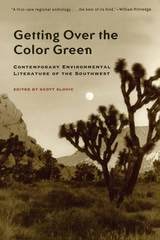
Getting Over the Color Green
Contemporary Environmental Literature of the SouthwestScott Slovic
University of Arizona Press, 2001
Desert vistas are often deemed vacant, inhospitable wastelands. Don't suggest that to Joy Harjo, Pat Mora, or other contemporary southwestern writers. In these arid stretches, often devoid of green, today's southwestern writers see pyrotechnic colors and Gothic shapes that excite and often overwhelm the imagination. And they capture this excitement in words that fix these desert images in the minds of readers who may too often look at the world through green-colored glasses. This anthology of contemporary nature writing from the Greater Southwest brings together a host of writers including peers of Edward Abbey such as Charles Bowden and Ann Zwinger and representatives of a new generation of writers such as Rick Bass and Terry Tempest Williams. The book is an eclectic blend of nonfiction and fiction, field notes and poetry, through which artists of diverse backgrounds both celebrate and illuminate the unique vitality and complexity of southwestern literature— proving that green is only one of many colors on their palette. The selections included here range all across the southwestern landscape and explore adventures in the wild, topics in natural history, living close to the land, and efforts at conservation and restoration. They clearly demonstrate that there is grace and beauty in this often-maligned part of the world— both in the human traditions that have developed in the region and in the natural features of the desert itself.
[more]