Results by title
226 books match the query 'Southwest, New' and 4 start with g
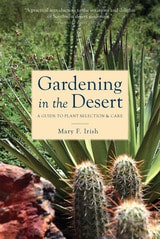
Gardening in the Desert
A Guide to Plant Selection and CareMary Irish
University of Arizona Press, 2000
Newcomers to the Southwest usually find that their favorite landscape plants aren't suited to the hot, dry climate. Many authors offer advice on adapting plants to the desert; now Mary Irish tells how gardeners can better adapt themselves to the challenge.
Drawing on her experience with public horticulture in the Phoenix metropolitan area, Irish explores the vexations and delights of desert gardening. She offers practical advice on plants and gardening practices for anyone who lives in the Southwest, from El Paso to Palm Springs, Tucson to Las Vegas.
Irish encourages readers who may be new to the desert—or desert dwellers who may be new to gardening—to stop struggling against heat, aridity, and poor soils and instead learn to use and appreciate the wonderful and well-adapted plants native to the desert. She shares information and anecdotes about trees, shrubs, perennials, agaves, cacti, and other plants that make gardening in the Southwest a unique experience, and provides further information about plants from other desert regions that will easily adapt to the Southwest. In addition to descriptions of plants, Irish also offers tips on planting, watering, pruning, and propagation.
For anyone who has struggled to maintain a patch of green or blanched at their water bill after unproductive irrigation, the answer to an attractive landscape may be as close as the desert around you. And for anyone who has bought a catalog guide to desert plants and not known which to choose, this book can set you on the right path. Mary Irish shows how to take heart in available plants of adaptable beauty in a book to enjoy while waiting for the next planting cycle.
Gardens of New Spain
How Mediterranean Plants and Foods Changed AmericaBy William W. Dunmire
University of Texas Press, 2004
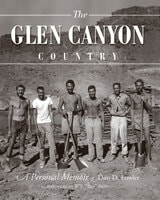
Glen Canyon Country, The
A Personal MemoirDon D Fowler
University of Utah Press, 2011
In his new book, The Glen Canyon Country, archaeologist Don D. Fowler shares the history of a place and the peoples who sojourned there over the course of several thousand years. To tell this story, he weaves his personal experience as a student working on the Glen Canyon Salvage Project with accounts of early explorers, geologists, miners, railroad developers, settlers, river runners, and others who entered this magical place. The book details the canyon’s story via historical and scientific summaries, biographical sketches, personal memoir, and previously unpublished photos of the land and its explorers.
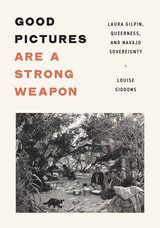
Good Pictures Are a Strong Weapon
Laura Gilpin, Queerness, and Navajo SovereigntyLouise Siddons
University of Minnesota Press, 2024
What are the limits of political solidarity, and how can visual culture contribute to social change?
A fundamental dilemma exists in documentary photography: can white artists successfully portray Indigenous lives and communities in a manner that neither appropriates nor romanticizes them? With an attentive and sensitive eye, Louise Siddons examines lesbian photographer Laura Gilpin’s classic 1968 book The Enduring Navaho to illuminate the intersectional politics of photography, Navajo sovereignty, and queerness over the course of the twentieth century.
Gilpin was a New York–trained fine arts photographer who started working with Navajo people when her partner accepted a job as a nurse in Arizona. She spent more than three decades documenting Navajo life and creating her book in collaboration with Navajo friends and colleagues. Framing her lesbian identity and her long relationship with the Navajo people around questions of allyship, Good Pictures Are a Strong Weapon addresses the long and problematic history of White photographers capturing images of Native life. Simultaneously, Siddons uses Gilpin’s work to explore the limitations of White advocacy in a political moment that emphasized the need for Indigenous visibility and voices.
Good Pictures Are a Strong Weapon introduces contemporary Diné (Navajo) artists as interlocutors, critics, and activists whose work embodies and extends the cultural sovereignty politics of earlier generations and makes visible the queerness often left implicit in Gilpin’s photographs. Siddons puts their work in conversation with Gilpin’s, taking up her mandate to viewers and readers of The Enduring Navajo to address Navajo aesthetics, traditions, politics, and people on their own terms.
Retail e-book files for this title are screen-reader friendly with images accompanied by short alt text and/or extended descriptions.