Results by title
382 books match the query 'Southwest (AZ, NM, OK, TX)' and 15 start with g
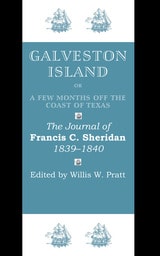
Galveston Island, or, A Few Months off the Coast of Texas
The Journal of Francis C. Sheridan, 1839–1840Edited by Willis W. Pratt
University of Texas Press, 1954
On the last Sunday of the year 1839, Francis Sheridan, an elegant young Irishman in the British diplomatic service, sailed from Barbados for the Republic of Texas. His mission in the new nation was to contribute the opinion of an eyewitness to the deliberations going on in London concerning proposed recognition of Texas.
This jounal contains some of the material that Sheridan used for his official report and much colorful detail that he did not use. First published by the University of Texas Press in 1956, it is the travel diary of a sophisticated and discerning student of human nature.
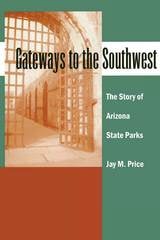
Gateways to the Southwest
The Story of Arizona State ParksJay M. Price
University of Arizona Press, 2004

Gay as a Grig
Memories of a North Texas GirlhoodBy Ellen Bowie Holland
University of Texas Press, 1963
Ellen Bowie Holland grew up in a house at Weatherford, Texas, that had the "motherly look of a large and gallant hen hovering over too many chicks" and that was inhabited by a "lively, warm-hearted family." This book is her record of the "whole world of little things which enriched young lives" in her small town.
Blessed with a discerning and sympathetic eye, she had much happiness to remember and record, and she employs a charming combination of nostalgia and comedy as she brings to life again these bygone days. Her childhood experiences are illuminated by the wisdom of maturity, and the whole is infused with a deft humor, developed through her skilled use of fantasy and through her ability to laugh at the pretensions of the Victorian life she saw.
Holland's book also is memorable as a record of her unforgettable parents:
"Mother was born on Columbus Day, and she and Columbus had a lot in common. She liked to discover things for herself and nothing pleased her more than to nicely finish off a job that she had been told could not be done" . . . "She wasn't geared for solitary musing. Like a salmon at spawning time she liked to swim upstream against rushing waters and bash into boulders" . . . "Mother's pattern of neatness reached out in all directions" . . . "Mother, sheathed like an armadillo" . . .
"Father, silk-hatted, or swallow-tailed, distinguished almost beyond belief" . . . "I never heard him raise his voice or laugh aloud" . . . "Father was not witty but he had an absolutely delightful sense of nonsense. His humor came smoothly upon the scene" . . .
Throughout the book the reader shares the author's consciousness of the vast distance between her own childhood and that of the grandchildren to whom the book is dedicated—a distance created by rapid technological change.
"From my window I look over an air-conditioned city and I see jets streaking across the sky and occasionally I hear one of them breaking the sound barrier" . . . "When I really want to awe myself I think about the fact that only one generation ago Mother saw friendly or marauding Indians roaming these same acres" . . . "Those of my age have come into a span of years where living conditions of all kinds have changed so abruptly, where obsolescence sets in so rapidly, that there is little in common between our infancy and our present."
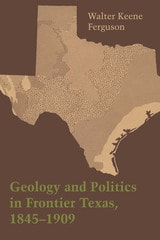
Geology and Politics in Frontier Texas, 1845–1909
By Walter Keene Ferguson
University of Texas Press, 1969
Conservation and development of natural resources are issues of critical importance throughout the world. These issues have been matters of public concern in Texas since legislators first adopted the state-sponsored geological survey as a means of extending government funds to private citizens who would help develop and advertise the mineral and agricultural wealth of Texas.
Walter Keene Ferguson examines the relation of politics to geological exploration during a critical period in Texas history—the first half-century of statehood. Although Texas shared its frontier experience with many other areas, it could not rely on federal aid in the form of land grants because the state government controlled the destiny of the public domain at all times. Acrimonious debate between farmers and urbanites of East Texas and pioneer ranchers of arid West Texas rendered the disposition of public lands even more difficult.
As tools for developing and advertising resources, the geological and agricultural surveys of 1858 and 1867 fulfilled the demands of expectant capitalism made by politicians, speculators, and railroad entrepreneurs. Reconnaissance geologists publicized the wealth of Texas.
Drought in 1886 and popular agitation against squandering of state land caused the emergence of a new concept of the geological survey as an instrument of land reform and public assistance. Lobbying by reformers and scientific organizations led to the formation of the Dumble Survey in 1888 and the University of Texas Mineral Survey in 1901. Stratigraphic analysis of the “individualities” of Texas geology helped the state realize its full economic potential and led to legislation to protect public mineral land from exploitation.
The youthful oil industry finally removed geological exploration from the political arena. As part of the University, a permanent Bureau of Economic Geology was established in 1909 to extend the benefits of scientific research to private citizens and state organizations on a nonpartisan basis.
Ferguson’s analysis of geological surveys in Texas contributes to an understanding not only of the geology and history of the state but of the urgent problem of evaluating the natural resources of underdeveloped regions.
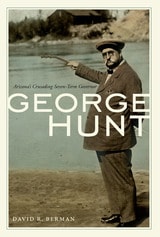
George Hunt
Arizona's Crusading Seven-Term GovernorDavid R. Berman
University of Arizona Press, 2015
Hunt was proof that style and physical appearance neither guarantee nor preclude political success, for the three-hundred-pound man of odd dress and bumbling speech had a political career that spanned the state’s Populism of the 1890s to the 1930s New Deal. Driven by causes, he was very active in public office but took little pleasure in doing the job. Called names by opponents and embarrassed by his lack of formal education, Hunt sometimes showed rage, self-pity, and bitterness at what he saw as betrayals and conspiracies against him.
The author assesses Hunt’s successes and failings as a political leader and take-charge governor struggling to produce results in a political system hostile to executive authority. Berman offers a nuanced look at Arizona’s first governor, providing an important new understanding of Arizona’s complex political history.
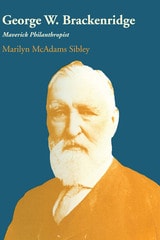
George W. Brackenridge
Maverick PhilanthropistBy Marilyn McAdams Sibley
University of Texas Press, 1973
George W. Brackenridge (1832–1920) was a paradox to his fellow Texans. A Republican in a solidly Democratic state, a financier in a cattleman's country, a Prohibitionist in the goodtime town of San Antonio, he devoted his energies to making a fortune only to give it to philanthropic causes.
Indiana born, Brackenridge came to Texas in 1853, but left the state during the Civil War to serve as U.S. Treasury agent and engage in the wartime cotton trade. Later he settled in San Antonio, where he founded a bank and invested in railroads, utilities, and other enterprises.
Some of Brackenridge's contemporaries never forgave him for his Civil War career, but others knew him as a public-spirited citizen, educator, and advocate of civil rights. He cared little for what others thought of him. Yet, he confided once in a rare interview that his fondest ambition was to leave the world a better place for his having lived in it. To this end, he gave generously of himself and his means.
His best-known benefaction is Brackenridge Park, which he gave to the city of San Antonio, but most of his contributions were in the field of education. As regent of the University of Texas for more than twenty-five years, he gave the institution its first dormitory, a large tract of land in Austin, and innumerable smaller gifts. He also offered to underwrite the expenses of the University when Governor James E. Ferguson vetoed the appropriation bill for 1917–1919.
Other educational institutions to benefit from his largess were the public schools of San Antonio, a Negro college in Seguin, and the University of Texas Medical Branch at Galveston. In addition, he assisted individual students, especially women, through scholarships and loans.
Believing that the betterment of humanity lay in education, Brackenridge arranged for the continuation of his philanthropies. By his will he created the George W. Brackenridge Foundation, the first of its kind in Texas and one of the first in the United States.
Marilyn McAdams Sibley's study of George W. Brackenridge is the first biography of an important and, for his time, unusual Texan. It presents new material concerning the Mexican cotton trade during the Civil War, on the beginnings of banking in Texas, and on higher education in Texas.
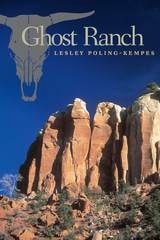
Ghost Ranch
Lesley Poling-Kempes
University of Arizona Press, 2005
Building on the history of the Abiquiu region that she told in Valley of Shining Stone, Ghost Ranch historian Lesley Poling-Kempes now unfolds the story of this celebrated retreat. She traces its transformation from el Rancho de los Brujos, a hideout for legendary outlaws, to a renowned cultural mecca and one of the Southwest’s premier conference centers.
First a dude ranch, Ghost Ranch became a magical sanctuary where the veil between heaven and earth seemed almost transparent. Focusing on those who visited from the 1920s and ’30s until the 1990s, Poling-Kempes tells how O’Keeffe and others—from Boston Brahmin Carol Bishop Stanley to paleontologist Edwin H. Colbert, Los Alamos physicists to movie stars—created a unique community that evolved into the institution that is Ghost Ranch today. For this book, Poling-Kempes has drawn on information not available when Valley of Shining Stone was written. The biography of Juan de Dios Gallegos has been enhanced and definitively corrected. The Robert Wood Johnson (of Johnson & Johnson) years at Ghost Ranch are recounted with reminiscences from family members. And the memories of David McAlpin Jr. shed light on how the Princeton circle that included the Packs, the Johnson brothers, the Rockefellers, and the McAlpins ended up as summer neighbors on the high desert of New Mexico.
After Arthur Pack’s gift of the ranch to the Presbyterian Church in 1955, Ghost Ranch became a spiritual home for thousands of people still awestruck by the landscape that O’Keeffe so lovingly committed to canvas; yet the care taken to protect Ghost Ranch’s land and character has preserved its sense of intimacy. By relating its remarkable story, Poling-Kempes invites all visitors to better appreciate its place as an honored wilderness—and to help safeguard its future.

God's Country, Uncle Sam's Land
Faith and Conflict in the American WestTodd M. Kerstetter
University of Illinois Press, 2005
God's Country, Uncle Sam's Land analyzes Mormon history from the Utah Expedition and Mountain Meadows Massacre of 1857 through subsequent decades of federal legislative and judicial actions aimed at ending polygamy and limiting church power. It also focuses on the Lakota Ghost Dancers and the Wounded Knee Massacre in South Dakota (1890), and the Branch Davidians in Waco, Texas (1993). In sharp contrast to the mythic image of the West as the "Land of the Free," these three tragic episodes reveal the West as a cultural battleground--in the words of one reporter, "a collision of guns, God, and government." Asking important questions about what happens when groups with a deep trust in their differing inner truths meet, Kerstetter exposes the religious motivations behind government policies that worked to alter Mormonism and extinguish Native American beliefs.
Grand Canyon Place Names
Byrd H. Granger
University of Arizona Press, 1960
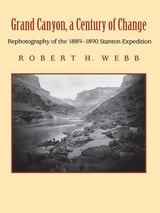
Grand Canyon, A Century of Change
Rephotography of the 1889-1890 Stanton ExpeditionRobert H. Webb
University of Arizona Press, 1996
Grand Canyon, a Century of Change assembles the most dramatic of these paired photographs to demonstrate both the persistence of nature and the presence of humanity. Unexpected longevity of some plant species, effects of animal grazing, and expansion of cacti are all captured by the replicate photographs. More telling is evidence of the impact of Glen Canyon Dam: increased riparian vegetation, new marshes, aggraded debris fans, and eroded sand bars. In the accompanying text, Webb provides a thorough analysis of what each pair of photographs shows and places the project in its historical context. Complementing his narrative are six sidebar articles by authorities on Canyon natural history that further attest to a century of change. The level of detail obtained from the photographs represents one of the most extensive long-term monitoring efforts ever conducted in a national park; it is the most detailed documentation effort ever performed using repeat photography.
Much more than simply a picture book, Grand Canyon, a Century of Change is an environmental history of the river corridor, a fascinating book that clearly shows the impact of human influence on Grand Canyon and warns us that its future is very much in our hands.
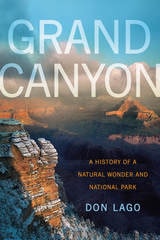
Grand Canyon
A History of a Natural Wonder and National ParkDon Lago
University of Nevada Press, 2015
The Grand Canyon became a microcosm of the history and evolving values of the
National Park Service, long conflicted between encouraging tourism and protecting nature. Many vivid characters shaped the canyon’s past. Its largest story is one of cultural history and changing American visions of the land.
Grand Canyon: A History of a Natural Wonder and National Park is a mixture of great storytelling, unlikely characters, and important ideas. The book will appeal to both general readers and scholars interested in seeking a broader understanding of the canyon.
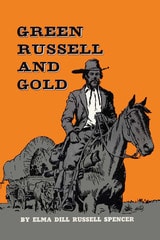
Green Russell and Gold
By Elma Dill Russell Spencer
University of Texas Press, 1966
The family history of the Russells of Georgia is a saga of the Westward Movement during the middle fifty years of the nineteenth century. The "Russell boys," as prospectors and miners, moved with the frontier as it followed fresh discoveries of gold, from Georgia to California to Colorado. Then, after the interlude of the Civil War, they settled in the new territories, turning their abilities and ruggedness of character to the development of careers on other frontiers—ranching, farming, land development, medicine—in Montana, Colorado, and Texas.
Elma Dill Russell Spencer, a descendant of one of these unusual brothers, relates their story as she learned it from family tradition transmitted by Grandma Russell, from family letters, from public documents, and from historical accounts of the exciting era.
The reader of her narrative sees the evolution of Western society in the vast wasteland of mountain and prairie from the viewpoint of the people who were making history, people too engrossed in their own problems to realize the far-reaching significance of their achievement. The reader sees the struggle to wrest gold from the streams and hills with primitive tools and techniques; the development of tent villages into populous towns affording most of the comforts of the East; the evolution of a code of mining laws, of protection from violence and crime; the building of schools; the emergence of sectional problems and divided loyalties; the Civil War, mostly through noncombatants' eyes; the progressive changes in transportation, until the railroads tied the West to the East. The reader also encounters Indians, who ride in and out of these pages, and other fascinating types of characters associated with "the wild, varied, and always unpredictable" frontier.
The odyssey of the Russell brothers as they struggle home to Georgia from Union-sympathizing Denver is particularly full of action, with tense moments in the account of narrowly escaped death—at the hands of Indians, through the ravages of disease, and from the enmity of Yankee foes.
This book was originally published as Gold Country in 1958; the University of Texas Press edition was completely revised and first published in 1966.
Grenville Goodwin Among the Western Apache
Letters from the FieldEdited by Morris E. Opler
University of Arizona Press, 1973
During this same period, Morris Opler was studying the Chiricahua and Mescalero Apache in New Mexico. In order to exchange information about their studies, Goodwin and Opler began corresponding. Both men were convinced that a long-overdue, systematic comparison of Apachean cultures would yield significant results.
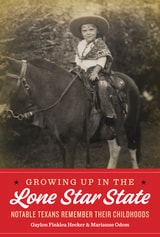
Growing Up in the Lone Star State
Notable Texans Remember Their ChildhoodsBy Gaylon Finklea Hecker and Marianne Odom
University of Texas Press, 2021
Gaylon Finklea Hecker and Marianne Odom began the interviews for this book in 1981 and devoted a professional lifetime to collecting the memories of accomplished Texans to determine what, if anything, about growing up in the Lone Star State prepared them for success.
The resulting forty-seven oral history interviews begin with tales from the early 1900s, when Texas was an agrarian state, and continue through the growth of major cities and the country’s race to the moon. Interviewees recalled life in former slave colonies; on gigantic ranches, tiny farms, and sharecropper fields; and in one-horse towns and big-city neighborhoods, with relatable stories as diverse as the state’s geography.
The oldest interviewees witnessed women earning the right to vote and weathered the Great Depression. Many remembered two world wars, while others recalled the Texas City explosion of 1947 and the tornado that devastated Waco in 1953. They witnessed the advent of television and the nightly news, which helped many come to terms with the assassination of a president that took place too close to home.
Their absorbing reflections are stories of good and bad, hope and despair, poverty and wealth, depression and inspiration, which would have been different if lived anywhere but Texas.
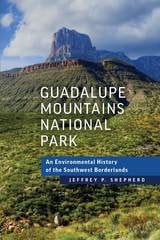
Guadalupe Mountains National Park
An Environmental History of the Southwest BorderlandsJeffrey P. Shepherd
University of Massachusetts Press, 2019
Drawing upon published sources, oral histories, and previously unused archival documents, Jeffrey P. Shepherd situates the Guadalupe Mountains and the national park in the context of epic tales of Spanish exploration, westward expansion, Native survival, immigrant settlement, the conservation movement, early tourism, and regional economic development. As Americans cope with climate change, polarized political rhetoric, and suburban sprawl, public spaces such as Guadalupe Mountains National Park remind us about our ties to nature and our historical relationships with the environment.