260 books match the query 'Soviet Union' and 4 start with g
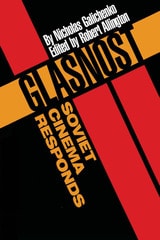
cover of Glasnost—Soviet Cinema Responds

Glasnost—Soviet Cinema Responds

By Nicholas Galichenko

University of Texas Press, 1991

With the coming of glasnost to the Soviet Union, filmmakers began to explore previously forbidden themes, and distributors released films that were suppressed by pre-glasnost-era censors. Soviet cinema underwent a revolution, one that mirrors and helps interpret the social revolution that took place throughout the USSR. Glasnost—Soviet Cinema Responds is the first overall survey of the effects of this revolution on the work of Soviet filmmakers and their films.

The book is structured as a series of three essays and a filmography of the directors of glasnost cinema. The first essay, "The Age of Perestroika," describes the changes that occurred in Soviet cinema as it freed itself from the legacy of Stalinism and socialist realism. It also considers the influence of film educator and director Mikhail Romm. "Youth in Turmoil" takes a sociological look at films about youth, the most dynamic and socially revealing of glasnost-era productions. "Odysseys in Inner Space" charts a new direction in Soviet cinema as it focuses on the inner world of individuals.

The filmography includes thirty-three of the most significant glasnost-era directors, including Tengiz Abuladze, Karen Shakhnazarov, and Sergei Soloviev, with a comprehensive list of their films. Discussions of many individual films, such as Repentance, The Messenger Boy, and The Wild Pigeon, and interviews with the directors reveal the effects that glasnost and perestroika have had on the directors' lives and art.
[more]
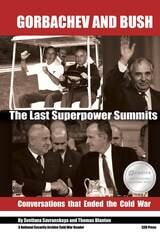
cover of Gorbachev and Bush: The Last Superpower Summits. Conversations that Ended the Cold War

Gorbachev and Bush

The Last Superpower Summits. Conversations that Ended the Cold War

The National Security Archive Savranskaya

Central European University Press, 2020
This book presents and interprets archival records of the meetings between Mikhail Gorbachev and George W. Bush between 1989 and 1991, including transcripts of conversations between top leaders on the rapid and monumental events of the final days of the Cold War. Particularly effective interlocutors were the foreign ministers Eduard Shevardnadze and James Baker, especially interesting when they interacted directly with Bush or Gorbachev. The documents were obtained from the Gorbachev Foundation and the Russian State Archives and from the United States government through requests under the Freedom of Information Act. Taking place at a time of revolutionary change in Eastern Europe, stimulated in part by Gorbachev and by Eastern Europeans (the Solidarity movement, dissidents, reform communists), the Malta Summit of 1989 and subsequent meetings helped defuse any potential for superpower conflict. Each of the five summits is covered in a separate chapter, introduced by an essay that places the transcripts in historical context. The anthology offers a fascinating glimpse into the relationship that defined the last, waning years of the Cold War—a unique record of these historic, highest-level conversations that effectively brought it to a close. The quality and scope of the dialogue between these world leaders was unprecedented and is likely never to be repeated.
[more]
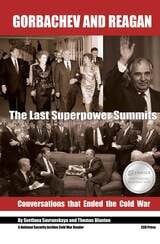
cover of Gorbachev and Reagan: The Last Superpower Summits. Conversations that Ended the Cold War

Gorbachev and Reagan

The Last Superpower Summits. Conversations that Ended the Cold War

The National Security Archive Savranskaya

Central European University Press, 2020

This book is the culmination of twenty years of research in which the editors gathered thousands of pages documenting the most important conversations of the late Cold War. Every word Ronald Reagan and Mikhail Gorbachev said to each other in their five superpower summits from 1985 to 1988 is included in this volume. The editors argue in their contextual essays and detailed notes that these summits fueled a learning process on both sides of the Cold War. Their anthology provides insight into the nuanced shifts of monumentally important discussions, showing how Moscow’s sense of threat was eased and how a hawkish Reagan softened his tone in negotiations during his second presidential term. Documents from foreign ministers Eduard Shevardnadze and George Shultz offer a particularly intriguing look into the handful of conversations that ended almost half a century of conflict. These verbatim transcripts, until now top secret, are combined with fascinating photos and crucial information from declassified preparatory and after-action documents from both the Americans and Soviets, obtained in the US through the Freedom of Information Act and in Russia from the Gorbachev Foundation, the State Archive of the Russian Federation in Moscow, and from the personal files of Anatoly Chernyaev, Gorbachev’s foreign policy adviser.
[more]
cover of Gossip & Metaphysics: Russian Modernist Poems & Prose

Gossip & Metaphysics

Russian Modernist Poems & Prose

Edited by Katie Farris, Ilya Kaminsky, and Valzhyna Mort

Tupelo Press, 2014

There has been no anthology in English dedicated to the poetics of the great generation of Russian modernists. For a group of poets so widely admired, relatively little seems known about their philosophy of poetry and their poetic influences, and although there is tremendous aesthetic diversity in this group, they have more in common than many readers assume. Russian poetry was a small world, made even smaller by the arrests, disappearances, pogroms, famines, assassinations, and political conflagration of the revolutionary era, and literary differences were often overcome by a mutual sense of historic cataclysm. This anthology’s structure is like textile, with many common threads intertwining, doubling back, sometimes unraveling—creating a matrix of poetic conversation: Mayakovsky on Khlebnikov, Pasternak on Mayakovsky, Tsvetaeva on Pasternak, Brodsky on Tsvetaeva, Akhmatova on Mandelstam. Shared themes range from expected (the word) to serendipitous (the ocean). Above all these poets are obsessed with proximity—to God, to nature and place, to poetic predecessors, to language (their own and others), and always, forever, to the inexpressible.
[more]