149 books match the query 'Spanish & Portuguese' and 3 start with g
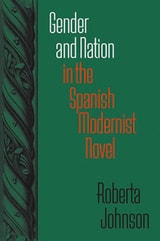
cover of Gender and Nation in the Spanish Modernist Novel

Gender and Nation in the Spanish Modernist Novel

Roberta Johnson

Vanderbilt University Press, 2003

Offering a fresh, revisionist analysis of Spanish fiction from 1900 to 1940, this study examines the work of both men and women writers and how they practiced differing forms of modernism. As Roberta Johnson notes, Spanish male novelists emphasized technical and verbal innovation in representing the contents of an individual consciousness and thus were more modernist in the usual understanding of the term. Female writers, on the other hand, were less aesthetically innovative but engaged in a social modernism that focused on domestic issues, gender roles, and relations between the sexes. Compared to the more conventional--even reactionary--ways their male counterparts treated such matters, Spanish women's fiction in the first half of the twentieth century was often revolutionary.

The book begins by tracing the history of public discourse on gender from the 1890s through the 1930s, a discourse that included the rise of feminism. Each chapter then analyzes works by female and male novelists that address key issues related to gender and nationalism: the concept of intrahistoria, or an essential Spanish soul; modernist uses of figures from the Spanish literary tradition, notably Don Quixote and Don Juan; biological theories of gender prevalent in the 1920s and 1930s; and the growth of an organized feminist movement that coincided with the burgeoning Republican movement.

This is the first book dealing with this period of Spanish literature to consider women novelists, such as Maria Martinez Sierra, Carmen de Burgos, and Concha Espina, alongside canonical male novelists, including Miguel de Unamuno, Ramon del Valle-Inclan, and Pio Baroja. With its contrasting conceptions of modernism, Johnson's work provides a compelling new model for bridging the gender divide in the study of Spanish fiction.
[more]
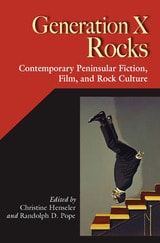
cover of Generation X Rocks: Contemporary Peninsular Fiction, Film, and Rock Culture

Generation X Rocks

Contemporary Peninsular Fiction, Film, and Rock Culture

Christine Henseler

Vanderbilt University Press, 2007
Essays in this volume explore the popular cultural effects of rock culture on high literary production in Spain in the 1990s.
[more]
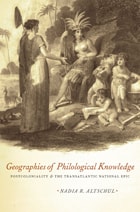
cover of Geographies of Philological Knowledge: Postcoloniality and the Transatlantic National Epic

Geographies of Philological Knowledge

Postcoloniality and the Transatlantic National Epic

Nadia R. Altschul

University of Chicago Press, 2012

Geographies of Philological Knowledge examines the relationship between medievalism and colonialism in the nineteenth-century Hispanic American context through the striking case of the Creole Andrés Bello (1781–1865), a Venezuelan grammarian, editor, legal scholar, and politician, and his lifelong philological work on the medieval heroic narrative that would later become Spain’s national epic, the Poem of the Cid. Nadia R. Altschul combs Bello’s study of the poem and finds throughout it evidence of a “coloniality of knowledge.”
 
Altschul  reveals how, during the nineteenth century, the framework for philological scholarship established in and for core European nations—France, England, and especially Germany—was exported to Spain and Hispanic America as the proper way of doing medieval studies. She argues that the global designs of European philological scholarship are conspicuous in the domain of disciplinary historiography, especially when examining the local history of a Creole Hispanic American like Bello, who is neither fully European nor fully alien to European culture. Altschul likewise highlights Hispanic America’s intellectual internalization of coloniality and its understanding of itself as an extension of Europe.  
 
A timely example of interdisciplinary history, interconnected history, and transnational study, Geographies of Philological Knowledge breaks with previous nationalist and colonialist histories and thus forges a new path for the future of medieval studies.
[more]