Results by title
454 books match the query 'Study and teaching (Higher)' and 11 start with g
Gender Influences
Reading Student TextsDonnalee Rubin. Foreword by Nan Johnson
Southern Illinois University Press, 1993
Donnalee Rubin examines the responses of thirty-one freshman composition teachers to student writing and shows the negative effects of gender bias on assessment to prove that gender perceptions and expectations can influence assessment decisions that seem neutral on the surface. Arguing that certain pedagogies are more likely to minimize gender bias than others, Rubin believes that teachers are more likely to overcome the influence of gender bias on their teaching if they adopt a process-based method and work intimately with their students through nondirective, supportive conferences.
Rubin characterizes the conference/process-centered class as the type of environment in which maternal teaching can be cultivated. She stresses that maternal can describe any teacher, male or female, who exhibits the nurturing and supportive qualities that the conference/process approach embodies. With a primary focus on the student’s well-being and development as a person and a writer, the maternal teacher is in a better position to overcome gender bias that could distort the interpretation of student texts. In order for writing instructors to increase their sensitivity to gender issues in assessment, Rubin recommends that they self-consciously engage in what she calls "responsive reading." Responsive reading occurs when the teacher reads with an eye toward providing the sorts of supportive feedback and dialectic exchange that will encourage student writers to think for themselves and to revise effectively. Rubin argues that when teachers commit to a responsive-reading pedagogy, they are more likely to question their reactions to student writing along the lines of gender influence and to strive for self-conscious awareness of how their own inner male-female voices may distort their reading of student texts. She challenges all writing teachers to become more aware of the inevitable challenge gender influence presents.

General Education in the Social Sciences
Centennial Reflections on the College of the University of ChicagoEdited by John J. MacAloon
University of Chicago Press, 1992
Social Science 2 holds the place of honor among these educational projects. For more than half a century, Soc 2 has been one of the most influential courses in American undergraduate education. This unique, year-long course, the oldest and most distinguished of its kind at any American university, has served as an ongoing experiment in how the social sciences can be taught and learned in the general education context.
In this collection John MacAloon has gathered essays by fourteen eminent social scientists—such as David Riesman, Michael Schudson, and F. Champion Ward—who as either teachers or students were profoundly shaped by Soc 2. Their multifarious and selective memories—full of dissonances and harmonies of recollection, judgment, and voice—create a compelling biography of a course and a college that have survived tumultous change through sustained and committed argument.
This book will be of great interest to anyone interested not only in the theory but the practice of higher education.
Generation Vet
Composition, Student Veterans, and the Post-9/11 UniversitySue Doe
Utah State University Press, 2014
Institutions of higher education are experiencing the largest influx of enrolled veterans since World War II, and these student veterans are transforming post-secondary classroom dynamics. While many campus divisions like admissions and student services are actively moving to accommodate the rise in this demographic, little research about this population and their educational needs is available, and academic departments have been slower to adjust. In Generation Vet, fifteen chapters offer well-researched, pedagogically savvy recommendations for curricular and programmatic responses to student veterans for English and writing studies departments.
In work with veterans in writing-intensive courses and community contexts, questions of citizenship, disability, activism, community-campus relationships, and retention come to the fore. Moreover, writing-intensive courses can be sites of significant cultural exchanges—even clashes—as veterans bring military values, rhetorical traditions, and communication styles that may challenge the values, beliefs, and assumptions of traditional college students and faculty.
This classroom-oriented text addresses a wide range of issues concerning veterans, pedagogy, rhetoric, and writing program administration. Written by diverse scholar-teachers and written in diverse genres, the essays in this collection promise to enhance our understanding of student veterans, composition pedagogy and administration, and the post-9/11 university.
Geographies of Writing
Inhabiting Places and Encountering DifferenceNedra Reynolds
Southern Illinois University Press, 2004
Twenty-first-century technological innovations have revolutionized the way we experience space, causing an increased sense of fragmentation, danger, and placelessness. In Geographies of Writing: Inhabiting Places and Encountering Difference, Nedra Reynolds addresses these problems in the context of higher education, arguing that theories of writing and rhetoric must engage the metaphorical implications of place without ignoring materiality.
Geographies of Writing makes three closely related contributions: one theoretical, to reimagine composing as spatial, material, and visual; one political, to understand the sociospatial construction of difference; and one pedagogical, to teach writing as a set of spatial practices. Aided by seven maps and illustrations that reinforce the book’s visual rhetoric, Geographies of Writing shows how composition tasks and electronic space function as conduits for navigating reality.
Gestural Listening In and Beyond the Classroom
Laura Feibush
Utah State University Press, 2026
Attuned to the subtle choreographies of the classroom, Gestural Listening In and Beyond the Classroom investigates how students and instructors show that they are listening to each other—and, sometimes, that they are not. While rhetorical scholarship traditionally focuses on speaking and writing, listening can also be understood as a rhetorical force that makes things happen. Listening has the power to move, bring about, cause, and catalyze. This conductive aspect of listening is its embodied manifestation—termed “gestural listening.”
Laura Feibush first traces the roots of embodied listening through cultural and rhetorical history and then uses findings from a classroom study to inform an insightful discussion of respect, resistance, and self-regulation as the key dynamics that characterize listening in contemporary educational spaces. She reveals how the gestures of listening refract across identity categories in ways that have surprising effects on how classroom participants respond to one another. This accessibly written book attends to hands and faces, nodding and note-taking, and the presence of phones and laptops, as well as other forms of nonverbal backchanneling, such as where people sit, when they interrupt, and when they engage in impactful quietness.
The power of gestural listening is not limited to the classroom. Its quiet yet profound influence can elucidate many sites of interaction: in-person and virtual academic settings as well as those far beyond the educational space, such as scenes of protest, worship, and performance. Gestural Listening In and Beyond the Classroom shows how, when understood as possessing its own repertoire of impressive and expressive capacities, listening emerges as a fascinating site of study and offers exercises, activities, and other materials to help educators, counselors, and all those engaging in communicative work enact a new awareness of gestural listening as a rhetorical force.
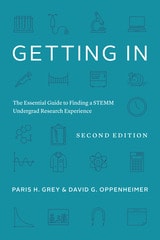
Getting In
The Essential Guide to Finding a STEMM Undergrad Research ExperienceParis H. Grey and David G. Oppenheimer
University of Chicago Press, 2023
Conducting research is an important foundation for many undergraduates on STEMM career paths. But landing an extremely competitive research spot that is also an enriching experience involves knowing how to present yourself effectively and an awareness of your goals and expectations. In this book, an expert lab manager and a longtime principal investigator share their secrets for obtaining these coveted positions.
Offering advice to students in a wide variety of STEMM fields at both research-intensive universities and primarily undergraduate institutions, Getting In helps students navigate the hidden curriculum of academia, unofficial rules that disproportionately affect first-generation college students and those from low-income backgrounds and communities historically underrepresented in science. The authors provide not only an overview of STEMM research and lab opportunities but also specific strategies for the entire application process—including how to write emails that get noticed by busy professors, how to ask for a research position during office hours, and interview questions to prepare for—so students can claim their place in research settings.
With its emphasis on the many interpersonal and professional benefits of research experiences, Getting In equips all STEMM undergrads with the tools they need both to secure these valued positions and to develop habits that will build productive relationships with their future research mentors.
As an undergrad, Getting In will help you:
- determine how much time you can spend on research by evaluating your current activity level and goals.
- find the time to do research without giving up your social life or risking your GPA.
- avoid common mistakes in the search, application, or interview that make it harder to find a research experience.
- write emails that get you noticed by busy professors by customizing the included templates.
- prepare for tough interview questions so you’ll impress the interviewer with your answers, and be able to determine if the position is right for you.
As a research mentor, Getting In will help your students:
- navigate the hidden curriculum of finding a research experience in science, technology, engineering, math, and medicine (STEMM).
- set realistic expectations for their research experience.
- understand why conducting research requires effort and will include some failure and other challenges.
- be active participants in their success in the lab.

Glanz und Abglanz
Two Centuries of German Studies in the University of LondonEdited by John L. Flood and Anne Simon
University of London Press, 2017
Going North Thinking West
The Intersections of Social Class, Critical Thinking, and Politicized Writing InstructionIrvin Peckham
Utah State University Press, 2010
Going Public
Civic and Community EngagementHiram E. Fitzgerald
Michigan State University Press, 2013
The terms “civic engagement” and “community engagement” have various definitions, but they are united by the sense that individuals who are civically engaged not only are concerned about the quality of life in their communities but also take action to improve conditions for the common good. In the United States, to be civically engaged means to actively participate in a civil democratic society. Going Public examines programs related to civic engagement and the ways in which faculty and students participate in communities in order to improve them. Engagement scholarship is a scholarship of action, a scholarship of practice that takes place both in and with the community. Within the framework of this new scholarship, the mission of the academy does not begin and end with intellectual discovery and fact-finding. Rather, the academy joins forces with the community, and together they use their knowledge and resources to address pressing social, civic, economic, and moral problems. Each chapter in this book tells a unique story of community engagement and the scholarship of practice in a diverse range of settings, documenting successes and failures, the unintended consequences, and the questions yet to be answered.
Grounded Literacies in a Transnational WAC/WID Ecology
A Korean-U.S. StudyJay Jordan
University Press of Colorado, 2022
Guide to College Writing Assessment
Peggy O'Neill, Cindy Moore, and Brian Huot
Utah State University Press, 2009
A Guide to College Writing Assessment is designed as an introduction and source book for WPAs, department chairs, teachers, and administrators. Always cognizant of the critical components of particular teaching contexts, O’Neill, Moore, and Huot have written sophisticated but accessible chapters on the history, theory, application and background of writing assessment, and they offer a dozen appendices of practical samples and models for a range of common assessment needs.
Because there are numerous resources available to assist faculty in assessing the writing of individual students in particular classrooms, A Guide to College Writing Assessment focuses on approaches to the kinds of assessment that typically happen outside of individual classrooms: placement evaluation, exit examination, programmatic assessment, and faculty evaluation. Most of all, the argument of this book is that creating the conditions for meaningful college writing assessment hinges not only on understanding the history and theories informing assessment practice, but also on composition programs availing themselves of the full range of available assessment practices.