Results by title
155 books match the query 'Telecommunications' and 4 start with g
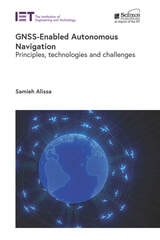
GNSS-Enabled Autonomous Navigation
Principles, technologies and challengesSamieh Alissa
The Institution of Engineering and Technology, 2026
The world is moving into an era of unprecedented transformation driven by automation and intelligent systems. This future hinges not just on artificial intelligence and machine learning's intelligence but also - fundamentally - on autonomous systems' ability to know where they are and how they are moving with precision, dependably, and continuously. Navigation is the centre of all autonomous platforms. Navigation is that foundational ability whereby a system can be aware of where it is, where it must go, and how to get there safely. Global Navigation Satellite Systems (GNSS) not only enable navigation but also synchronization of telecommunications networks, electricity distribution and financial transactions, and constitute a central infrastructure of the digital age.
[more]

Geometrical Theory of Diffraction
V.A. Borovikov
The Institution of Engineering and Technology, 1994
The geometrical theory of diffraction (GTD) is an efficient method of analysis and design of wave fields. It is widely used in antenna synthesis in microwave, millimetre and infra-red bands, in circuit engineering and laser system design. It is a convenient tool for tackling the problems of wave propagation and scattering at bodies of complex shape. The method combines the simplicity and physical transparency of geometrical optics with high computational accuracy over a wide dynamic range of quantities analysed. The advantage of GTD is particularly pronounced in applications where the wavelength is small compared with the typical size of scatterers, i.e. in situations where the known analytical techniques - variational calculus and numerical analysis - are no longer applicable.
[more]
Geometrical Theory of Diffraction for Electromagnetic Waves
Graeme L. James
The Institution of Engineering and Technology, 1986
The continuous development of the Geometrical Theory of Diffraction (GTD), from its conception in the 1950s, has now established it as a leading analytical technique in the prediction of high-frequency electromagnetic radiation and scattering phenomena. Consequently, there is an increasing demand for research workers and students in electromagnetic waves to be familiar with this technique. In this book they will find a thorough and clear exposition of the GTD formulation for vector fields. It begins by describing the foundations of the theory in canonical problems and then proceeds to develop the method to treat a variety of circumstances. Where applicable, the relationship between GTD and other high-frequency methods, such as aperture field and the physical optics approximation, is stressed throughout the text. The purpose of the book, apart from expounding the GTD method, is to present useful formulations that can be readily applied to solve practical engineering problems. To this end, the final chapter supplies some fully worked examples to demonstrate the practical application of the GTD techniques developed in the earlier chapters.
[more]
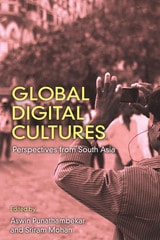
Global Digital Cultures
Perspectives from South AsiaAswin Punathambekar and Sriram Mohan, Editors
University of Michigan Press, 2019
Digital media histories are part of a global network, and South Asia is a key nexus in shaping the trajectory of digital media in the twenty-first century. Digital platforms like Facebook, WhatsApp, and others are deeply embedded in the daily lives of millions of people around the world, shaping how people engage with others as kin, as citizens, and as consumers. Moving away from Anglo-American and strictly national frameworks, the essays in this book explore the intersections of local, national, regional, and global forces that shape contemporary digital culture(s) in regions like South Asia: the rise of digital and mobile media technologies, the ongoing transformation of established media industries, and emergent forms of digital media practice and use that are reconfiguring sociocultural, political, and economic terrains across the Indian subcontinent. From massive state-driven digital identity projects and YouTube censorship to Tinder and dating culture, from Twitter and primetime television to Facebook and political rumors, Global Digital Cultures focuses on enduring concerns of representation, identity, and power while grappling with algorithmic curation and data-driven processes of production, circulation, and consumption.
[more]