Results by title
333 books match the query 'Television' and 9 start with g
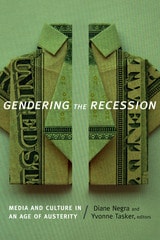
Gendering the Recession
Media and Culture in an Age of AusterityDiane Negra and Yvonne Tasker, eds.
Duke University Press, 2014
Contributors. Sarah Banet-Weiser, Hamilton Carroll, Hannah Hamad, Anikó Imre, Suzanne Leonard, Isabel Molina-Guzmán, Sinéad Molony, Elizabeth Nathanson, Diane Negra, Tim Snelson, Yvonne Tasker, Pamela Thoma
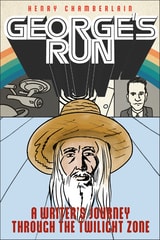
George's Run
A Writer's Journey through the Twilight ZoneHenry Chamberlain
Rutgers University Press, 2023
Later in life, Johnson befriended comics journalist and artist Henry Chamberlain, and the two had long chats about his amazing life and career. Now Chamberlain pays tribute to his late friend in the graphic novel George’s Run, which brings Johnson’s creative milieu to life in vividly illustrated color panels. The result feels less like reading a conventional biography and more like sitting in on an intimate conversation between friends as they recollect key moments in pop culture history, as well as the colorful band of writers known as the “Rat Pack of Science Fiction.”

Get Real
Crafting Race in the Reality Television IndustryEva Hageman
Duke University Press, 2027
Global Indigenous Media
Cultures, Poetics, and PoliticsPamela Wilson and Michelle Stewart, eds.
Duke University Press, 2008
Global Indigenous Media addresses Indigenous self-representation across many media forms, including feature film, documentary, animation, video art, television and radio, the Internet, digital archiving, and journalism. The volume’s sixteen essays reflect the dynamism of Indigenous media-making around the world. One contributor examines animated films for children produced by Indigenous-owned companies in the United States and Canada. Another explains how Indigenous media producers in Burma (Myanmar) work with NGOs and outsiders against the country’s brutal regime. Still another considers how the Ticuna Indians of Brazil are positioning themselves in relation to the international community as they collaborate in creating a CD-ROM about Ticuna knowledge and rituals. In the volume’s closing essay, Faye Ginsburg points out some of the problematic assumptions about globalization, media, and culture underlying the term “digital age” and claims that the age has arrived. Together the essays reveal the crucial role of Indigenous media in contemporary media at every level: local, regional, national, and international.
Contributors: Lisa Brooten, Kathleen Buddle, Cache Collective, Michael Christie, Amalia Córdova,
Galina Diatchkova, Priscila Faulhaber, Louis Forline, Jennifer Gauthier, Faye Ginsburg, Alexandra Halkin, Joanna Hearne, Ruth McElroy, Mario A. Murillo, Sari Pietikäinen, Juan Francisco Salazar,
Laurel Smith, Michelle Stewart, Pamela Wilson
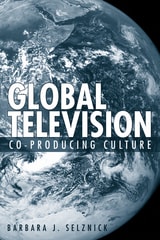
Global Television
Co-Producing CultureBarbara J. Selznick
Temple University Press, 2008
The face of U.S. television broadcasting is changing in ways that are both profound and subtle. Global Television uncovers the particular processes by which the international circulation of culture takes place, while addressing larger cultural issues such as identity formation.
Focusing on how the process of internationally made programming such as Highlander: The Series and The Odyssey—amusingly dubbed “Europudding” and “commercial white bread”—are changing television into a transnational commodity, Barbara Selznick considers how this mode of production—as a means by which transnational television is created—has both economic rewards and cultural benefits as well as drawbacks.
Global Television explores the ways these international co-productions create a “global” culture as well as help form a national identity. From British “brand” programming (e.g, Cracker) that airs on A&E in the U.S. to children’s television programs such as Plaza Sesamo, and documentaries, Selznick indicates that while the style, narrative, themes and ideologies may be interesting, corporate capitalism ultimately affects and impacts these programs in significant ways.
Gold Dust on the Air
Television Anthology Drama and Midcentury American CultureMolly A. Schneider
University of Texas Press, 2024
2025 Broadcast Historian Award, Library of American Broadcasting Foundation
How mid-century television anthologies reflected and shaped US values and identities.
From the late 1940s to the early 1960s, anthology dramas presented “quality” television programming in weekly stand-alone television plays meant to entertain and provide cultural uplift to American society. Programs such as Playhouse 90, Studio One, and The Twilight Zone became important emblems of American creative potential on television. But their propensity for addressing matters of major social concern also meant that they often courted controversy. Although the anthology’s tenure would be brief, its importance in the television landscape would be great, and the ways the format negotiated ideas about “Americanness” at midcentury would be a crucial facet of its significance.
In Gold Dust on the Air, Molly Schneider traces a cultural history of the “Golden Age” anthology, addressing topics such as the format’s association with Method acting and debates about “authentic” American experience, its engagement with ideas about “conformity” in the context of Cold War pressures, and its depictions of war in a medium sponsored by defense contractors. Drawing on archival research, deep textual examination, and scholarship on both television history and broader American culture, Schneider posits the anthology series as a site of struggle over national meaning.
Groove Tube
Sixties Television and the Youth RebellionAniko Bodroghkozy
Duke University Press, 2001
Bodroghkozy argues that, in order to woo an increasingly lucrative baby boomer audience, television had to appeal to the social and political values of a generation of young people who were enmeshed in the hippie counterculture, the antiwar movement, campus protests, urban guerilla action—in general, a culture of rebellion. She takes a close look at the compromises and negotiations that were involved in determining TV content, as well as the ideological difficulties producers and networks faced in attempting to appeal to a youthful cohort so disaffected from dominant institutions. While programs that featured narratives about hippies, draft resisters, or revolutionaries are examined under this lens, Groove Tube doesn’t stop there: it also examines how the nation’s rebellious youth responded to these representations. Bodroghkozy explains how, as members of the first “TV generation,” some made sense of their societal disaffection in part through their childhood experience with this powerful new medium.
Groove Tube will interest sociologists, American historians, students and scholars of television and media studies, and others who want to know more about the 1960s.
Growing Up With Television
Everyday Learning Among Young AdolescentsJoellen Fisherkeller
Temple University Press, 2002
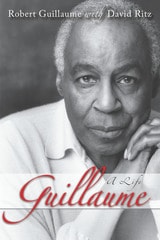
Guillaume
A LifeRobert Guillaume & David Ritz
University of Missouri Press, 2002
Guillaume: A Life is the autobiography of esteemed Broadway, Hollywood, and television star Robert Guillaume. Ten months after suffering a stroke, Guillaume—perhaps best known as television’s Benson—began this autobiography with award-winning author and collaborator David Ritz.
The book goes beyond the recounting of a long and successful career to examine the forces that shaped the man: family, religion, race, and class. Startlingly candid and disarmingly self-aware, Guillaume seeks to know and understand himself, his treatment of the women in his life, and the choices he made along the way. He pursues the truth, however painful it may be, says Ritz, guided by two questions, “Who the hell am I?” and “What made me do what I did?”
Born in St. Louis in 1927 to a young, abused, unstable mother, and reared by a strong, hardworking grandmother, Robert Guillaume managed to move from the poverty and adversity of his youth to a rich, full career as an actor and a singer. Fierce determination and sharp focus enabled this man born to hardship and racial discrimination to study, learn, cultivate his natural talents, and succeed at the performance career he pursued with a vengeance. Guillaume first performed in the strict Catholic schools and churches to which his grandmother, who understood that education would be the key to any success he might achieve, sent him. There his love of classical music was nurtured, and he was encouraged to perform.
From a child longing for his mother’s love to a man unsure of the meaning of love for many of the women in his life, from a young performer struggling to succeed on Broadway and in Hollywood to a grief-stricken father watching his son die of AIDS, Robert Guillaume tells what it was like to realize celebrity and what he sacrificed in the process. Readers will savor the success story of this artist who achieved great recognition and fame, but who never lost sight of his beginnings. Appealing to all audiences, Guillaume is a revealing and poignant autobiography of an extraordinary and distinguished American thespian.