132 books match the query 'Thomas, Aquinas, Saint' and 7 start with g
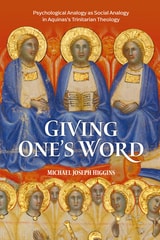
cover of Giving One's Word: Interpersonal Love, Knowledge, and Self-Giving in Aquinas's Psychological Analogy for the Trinity

Giving One's Word

Interpersonal Love, Knowledge, and Self-Giving in Aquinas's Psychological Analogy for the Trinity

Michael Joseph Higgins

Catholic University of America Press, 2025
According to the vast majority of recent Trinitarian theologians, to believe in the Trinity is to believe that God is Love: it is to believe in three divine Persons who know each other, love each other, and give themselves to each other. St. Thomas Aquinas is rarely invoked as a patron of such a social approach to the Trinity. Aquinas’s Trinitarian theology, after all, revolves around the immanent processions of a Word and Love within the unity of the divine essence. Many have assumed that this “psychological analogy” is removed from—or even incompatible with—interpersonal knowledge, love, and self-giving. Some have concluded that Aquinas is therefore unable to accommodate a social Trinity. Others have argued that he is open to a social Trinity, but that his psychological categories need to be complemented by a more overtly social framework. This study, however, shows that these psychological categories themselves are shot through with interpersonal knowledge, love, and self-giving. More specifically, Aquinas’s psychological analogy is often accused of emphasizing the unity of the divine essence at the expense of the distinction of the divine Persons. In fact, it emphasizes distinction just as basically as it emphasizes unity, and it ensures that the distinction between the divine Persons is a radical one. Similarly, it is criticized for being a matter of self-knowledge instead of interpersonal knowledge, self-love instead of interpersonal love, and self-regard instead of self-giving. In fact, it is a matter of self-knowledge as interpersonal knowledge, self-love as interpersonal love, and self-regard as self-giving: it ensures that there can be no self-knowledge or self-love in God that is not just as basically interpersonal knowledge, interpersonal love, and interpersonal self-giving. Aquinas’s psychological analogy, then, does not shut down the possibility of interpersonal Trinity. Nor does it need to be complemented from the outside by an interpersonal Trinity. Instead, it contains within itself an intensely interpersonal Trinity.
[more]
cover of God Is Love: Thomas Aquinas on the Being and Action of the Holy Spirit

God Is Love

Thomas Aquinas on the Being and Action of the Holy Spirit

Michael D. Torre

Catholic University of America Press, 2026
This book dedicates three essays each to three different theological problems regarding the Holy Spirit: In God and for Us (The "Filioque" and "Uncreated Grace"); Thomas's Understanding (Not His Commentators) of the Relation between nature and sanctifying grace; and our ability (and that of the angels at their creation) in fact to resist God' grace and thus be the first cause of sin. This later problem is developed in an "excursus" on the way God moves the free will, one that takes into consideration much recent work on this issue and situates the essays' position in relation to it. The book ends with a brief epilogue on the credibility of God, again giving Thomas's account of this. The principal aim throughout is to understand the doctrine of Thomas Aquinas. It places his views in relation to three audiences: chiefly to the orthodox regarding the first issue; to Catholics in relation to the second; and to Protestants in relation to the third. Thus, its second aim is to join "ecumenical debate" about these matters. The essays were mostly written to be delivered orally, to an informed audience of philosophers and theologians., but one that consisted of "generalists" and serious students of Thomas, as well as of "professional" philosophers and theologians. All three of the debated issues discussed have generated an enormous amount of disagreement and debate, not a little of it being quite "technical." Thus, each issue would easily require a long and significant book to be addressed as it deserves. The essays do not do this, but they do indicate what Torre holds is the "directive line" of Thomas's thought that deserves to be defended and developed in each case, and, in each case, this line is held to be markedly different than many have thought it to be.
[more]
cover of God and the Natural Law: Reading of Thomas Aquinas

God and the Natural Law

Reading of Thomas Aquinas

Fulvio Di Blasi

St. Augustine's Press, 2006

It seems that to retain credibility in a post-Kantian and analytic world, contemporary natural law theory has tried to show its independence both from God and from human nature. But can there be a natural-law theory without the “natural” – not grounded in facts of nature – and without “law” – not in need of a Legislator? In God and the Natural Law, Fulvio Di
Blasi begins with an original analysis of the current debate in ethics, jurisprudence, and politics in order to set the stage for a sound understanding of the concept of natural law. This leads to the heart of the book: a recovery of the authentic meaning of the two main concepts of classical natural-law theory as synthesized by Thomas Aquinas – the will of God and the order of nature.
 
The wide revival of practical philosophy and ethics of objective-values in recent decades has involved a robust rediscovery of classical natural-law theory. This rediscovery is marked by two main traits: an emphasis on the autonomy of practical reason (as a reaction to modern voluntarism centered on the external will of the legislator); and an emphasis on the originality of practical reason (as a reaction to the idea of a rational deduction of
moral truths from the facts of nature). Without denying an autonomous character to ethics, or the need for a strong critique of moral rationalism, Di Blasi argues that Aquinas’s thought remains unintelligible if we remove from it either God or the metaphysical understanding of
nature.
 
[more]
cover of God's Love through the Spirit

God's Love through the Spirit

Kenneth M. Loyer

Catholic University of America Press, 2014
Although the doctrine of the Holy Spirit has often been a neglected subject in theology, it remains vital for understanding both the Christian confession of God as Trinity and the nature of the Christian life. In view of those two topics, God's Love through the Spirit examines the relationship between love and the person and work of the Holy Spirit in Thomas Aquinas and John Wesley - two very different figures whose teachings on the Spirit and the Christian life are found to be, on the whole, surprisingly compatible. An investigation into Aquinas's amor-based pneumatology, including a groundbreaking analysis of his recently discovered Pentecost sermon, and a fresh assessment of the doctrine of sanctification in Wesley show that in distinctive yet largely complementary ways, Aquinas and Wesley provide resources that can be used to reclaim a richer pneumatology, specifically in relation to the theological virtue of love.
[more]
cover of Good and Evil Actions: A Journey through Saint Thomas Aquinas

Good and Evil Actions

A Journey through Saint Thomas Aquinas

Steven J. Jensen

Catholic University of America Press, 2010
In Good and Evil Actions, Steven J. Jensen navigates a path through the debate, retrieving what is of value from each interpretation
[more]
cover of Grace, Predestination, and the Permission of Sin: A Thomistic Analysis

Grace, Predestination, and the Permission of Sin

A Thomistic Analysis

Taylor O'Neill

Catholic University of America Press, 2019
Grace, Predestination, and the Permission of Sin seeks to analyze a revisionist movement within Thomism in the 20th century over and against the traditional or classical Thomistic commentatorial treatment of physical premotion, grace, and the permission of sin, especially as these relate to the mysteries of predestination and reprobation. The over-arching critique leveled by the revisionists against the classic treatment is that Bañezian scholasticism had disregarded the dissymmetry between the line of good (God's causation of salutary acts) and the line of evil (God's permission of defect and sin). The teaching of St. Thomas is explored via intimate consideration of his texts. The thought of St. Thomas is then compared with the work of Domingo Bañez and the foremost 'Bañezian' of the 20th century, Reginald Garrigou-Lagrange. The work then shifts to a consideration of the major players of the revisionist treatment, including Francisco Marín-Sola, Jacques Maritain, and Bernard Lonergan. Jean-Herve Nicolas is also taken up as one who had held both accounts during his lifetime. The work analyzes and critiques the revisionist theories according to the fundamental tenets of the classical account. Upon final analysis, it seeks to show that the classical account sufficiently distances God's causal role in regard to free salutary acts and His non-causal role in regard to free sinful acts. Moreover, the revisionist account presents significant metaphysical problems and challenges major tenets of classical theism, such as the divine omnipotence, simplicity, and the exhaustive nature of divine providence. Finally, the implications of the traditional view are considered in light of the spiritual life. It is argued that the classical account is the only one which provides an adequate theological foundation for the Church's robust mystical and spiritual tradition, and in particular, the abandonment to divine providence.
[more]
cover of Gregory Corso: Doubting Thomist

Gregory Corso

Doubting Thomist

Kirby Olson

Southern Illinois University Press, 2002

Gregory Corso is the most intensely spiritual of the Beat generation poets and still by far the least explored. The virtue of Kirby Olson’s Gregory Corso: Doubting Thomist is that it is the first book to place all of Corso’s work in a philosophical perspective, concentrating on Corso as a poet torn between a static Catholic Thomist viewpoint and that of a progressive surrealist.

While Corso is a subject of great controversy—his work often being seen as nihilistic and wildly comic—Olson argues that Corso’s poetry, in fact, maintains an insistent theme of doubt and faith with regard to his early Catholicism. Although many critics have attempted to read his poetry, and some have done so brilliantly, Olson—in his approach and focus—is the first to attempt to give a holistic understanding of the oeuvre as essentially one not of entertainment or hilarity but of a deep spiritual and philosophical quest by an important and profound mind.

In nine chapters, Olson addresses Corso from a broad philosophical perspective and shows how Corso takes on particular philosophical issues and contributes to new understandings. Corso’s concerns, like his influence, extend beyond the Beat generation as he speaks about concerns that have troubled thinkers from the beginning of the Western tradition, and his answers offer provocative new openings for thought.

Corso may very well be the most important Catholic poet in the American literary canon, a visionary like Burroughs and Ginsberg, whose work illuminated a generation. Written in a lively and engaging style, Gregory Corso: Doubting Thomist seeks to keep Corso’s memory alive and at last delve fully into Corso’s poetry.

[more]