Results by title
303 books match the query 'Time' and 6 start with g
Gambling, Space, and Time
Shifting Boundaries and CulturesPauliina Raento
University of Nevada Press, 2011
The eight essays in Gambling, Space, and Time use a global and interdisciplinary approach to examine two significant areas of gambling studies that have not been widely explored--the ever-changing boundaries that divide and organize gambling spaces, and the cultures, perceptions, and emotions related to gambling. The contributors represent a variety of disciplines: history, geography, sociology, anthropology, political science, and law.
The essays consider such topics as the impact of technological advances on gambling activities, the role of the nation-state in the gambling industry, and the ways that cultural and moral values influence the availability of gambling and the behavior of gamblers. The case studies offer rich new insights into a gambling industry that is both a global phenomenon and a powerful engine of local change.

Gettysburg, Time and Again
Restaging America and Its Civil Wars TodayMads Daugbjerg
University of Massachusetts Press, 2027
Tracing how the Civil War continues to shape the landscapes, politics, and culture of today
Every year, thousands of Americans don Civil War uniforms and restage the bloodiest battle ever fought on American soil. In Gettysburg, Time and Again, Mads Daugbjerg explores how the Civil War continues to inhabit the present. Bringing together reenactors, National Park Service rangers, ghost hunters, tourists, and local residents, this study examines how Americans across social and political divides engage the past through the landscapes, institutions, and everyday practices of public history.
At once historically grounded and urgently contemporary, this book speaks directly to current struggles over the meaning of America and its values. Rather than treating time and history as abstract concepts, Daugbjerg approaches them as lived, material forces produced through commemorative landscapes, interpretive labor, and the relentless restaging of 1863 for contemporary audiences. Studying reenactment illuminates not only a distinctive cultural practice but also the broader processes through which the past is continuously reshaped, repeated, and felt in the present. He argues that present-day American unrest can be understood, in part, as a conflict over how the past is curated. He further suggests that Americans today often occupy profoundly different temporal worlds.
Daugbjerg traces these tensions through landscapes, material culture, tourism infrastructures, and social life at Gettysburg. Challenging the commonsense notion of history as linear progression, Gettysburg, Time and Again reveals repetition as a defining feature of American historical experience. By offering a finely grained anthropology of the “present past,” Daugbjerg shows how history’s afterlives remain powerfully out of sync and why those temporal disjunctions matter now.
Given World and Time
Temporalities in ContextTyrus Miller
Central European University Press, 2008
Gods in the Time of Democracy
Kajri Jain
Duke University Press, 2021
Going Virtual
Programs and Insights from a Time of CrisisSarah Ostman
American Library Association, 2021
- COVID-19 Misinformation Challenge, featuring an email quiz, to encourage participants to separate fact from fiction;
- weekly virtual storytimes;
- community cooking demonstrations via Zoom;
- an online grocery store tour, complete with tips about shopping healthy on a budget;
- a virtual beer tasting that boasted 80 attendees;
- socially distanced "creativity crates" for summer reading;
- an online Minecraft club for kids ages 6 and up;
- a Zoom presentation about grieving and funerals during COVID, featuring the director of a local funeral home;
- Art Talk Tuesday, a one-hour, docent-led program;
- a virtual lecture on the history of witchcraft, presented by a public library in partnership with a university rare book room, that drew thousands of viewers;
- "knitting for knewbies" kits for curbside pickup;
- Songs from the Stacks, an ongoing virtual concert series in the style of NPR’s “Tiny Desk”;
- a pink supermoon viewing party that included people howling at the moon together from their homes on Facebook Live;
- and many others
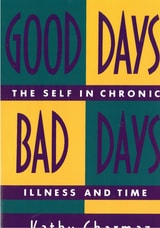
Good Days, Bad Days
The Self and Chronic Illness in TimeKathy C Charmaz
Rutgers University Press, 1993
Illness provides a mirror that allows sufferers to see themselves and to become more introspective. As they struggle for control over illness and control over time, they also struggle to control the central images of the self. For example, the chronically ill may situate their self-concepts in the past, present, or future. Charmaz examines under what conditions they situate their self-concepts in each of those timeframes. People may say they live one day at a time. They may bracket certain experiences, such as a heart attack, as timemarkers or turning points in the past. Or they may look ahead to recovering their health. Or ahead to death.
Charmaz artfully combines near jargon-free analysis with moving stories about how people have experienced illness, usually told in the sufferers' own words. She enters the world of the chronically ill, and brings us into it.