Results by title
111 books match the query 'Trials, litigation, etc' and 3 start with g
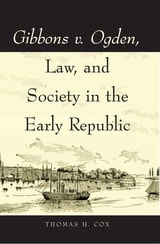
Gibbons v. Ogden, Law, and Society in the Early Republic
Thomas H. Cox
Ohio University Press, 2009
Gibbons v. Ogden, Law, and Society in the Early Republic examines a landmark decision in American jurisprudence, the first Supreme Court case to deal with the thorny legal issue of interstate commerce.
Decided in 1824, Gibbons v. Ogden arose out of litigation between owners of rival steamboat lines over passenger and freight routes between the neighboring states of New York and New Jersey. But what began as a local dispute over the right to ferry the paying public from the New Jersey shore to New York City soon found its way into John Marshall’s court and constitutional history. The case is consistently ranked as one of the twenty most significant Supreme Court decisions and is still taught in constitutional law courses, cited in state and federal cases, and quoted in articles on constitutional, business, and technological history.
Gibbons v. Ogden initially attracted enormous public attention because it involved the development of a new and sensational form of technology. To early Americans, steamboats were floating symbols of progress—cheaper and quicker transportation that could bring goods to market and refinement to the backcountry. A product of the rough-and-tumble world of nascent capitalism and legal innovation, the case became a landmark decision that established the supremacy of federal regulation of interstate trade, curtailed states’ rights, and promoted a national market economy. The case has been invoked by prohibitionists, New Dealers, civil rights activists, and social conservatives alike in debates over federal regulation of issues ranging from labor standards to gun control. This lively study fills in the social and political context in which the case was decided—the colorful and fascinating personalities, the entrepreneurial spirit of the early republic, and the technological breakthroughs that brought modernity to the masses.
Good Faith and Truthful Ignorance
A Case of Transatlantic BigamyAlexandra Parma Cook and Noble David Cook
Duke University Press, 1991
So begins the labyrinthine legal tale and engrossing drama of an explorer and his two wives, skillfully reconstructed through the expert and original archival research of Alexandra Parma Cook and Noble David Cook. Drawing on the remarkable records from the trial, the narrative of Francisco’s adventures provides a window into daily life in sixteenth-century Spain, as well as the mentalité and experience of conquest and settlement of the New World. Told from the point of view of the conquerors, Francisco’s story reveals not only the lives of the middle class and minor nobility but also much about those at the lower rungs of the social order and relations between the sexes.
In the tradition of Carlo Ginzberg’s The Cheese and the Worms and Natalie Zemon Davis’ The Return of Martin Guerre, Good Faith and Truthful Ignorance illuminates an historical period—the world of sixteenth-century Spain and Peru—through the wonderful and unusual story of one man and his two wives.
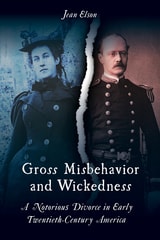
Gross Misbehavior and Wickedness
A Notorious Divorce in Early Twentieth-Century AmericaJean Elson
Temple University Press, 2017
Gross Misbehavior and Wickedness—the charges Nina levied at James for his adultery (with the family governess) and extreme cruelty—recounts the protracted legal proceedings in juicy detail.
Jean Elson uses court documents, correspondence, journals, and interviews with descendants to recount the salacious case. In the process, she underscores how divorce—in an era when women needed husbands for economic support—was associated with women’s aspirations for independence and rights. The Walkers’ dispute, replete with plot twists and memorable characters, sheds light on a critical period in the evolution of American culture.