Results by title
62 books match the query 'Twain, Mark' and 3 start with g
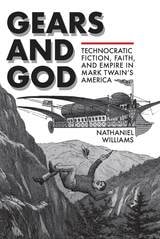
Gears and God
Technocratic Fiction, Faith, and Empire in Mark Twain's AmericaNathaniel Williams
University of Alabama Press, 2018
In Gears and God: Technocratic Fiction, Faith, and Empire in Mark Twain’s America, Nathaniel Williams analyzes the genre of technology-themed exploration novels—dime novel adventure stories featuring steam-powered and electrified robots, airships, and submersibles. This genre proliferated during the same cultural moment when evolutionary science was dismantling Americans’ prevailing, biblically based understanding of human history.
While their heyday occurred in the late 1800s, technocratic adventure novels like Twain’s A Connecticut Yankee in King Arthur’s Court inspired later fiction about science and technology. Similar to the science fiction plotlines of writers like Jules Verne and H. Rider Haggard, and anticipating the adventures of Tom Swift some decades later, these novels feature Americans using technology to visit and seize control of remote locales, a trait that has led many scholars to view them primarily as protoimperialist narratives. Their legacy, however, is more complicated. As they grew in popularity, such works became as concerned with the preservation of a fraught Anglo-Protestant American identity as they were with spreading that identity across the globe.
Many of these novels frequently assert the Bible’s authority as a historical source. Collectively, such stories popularized the notion that technology and travel might essentially “prove” the Bible’s veracity—a message that continues to be deployed in contemporary debates over intelligent design, the teaching of evolution in public schools, and in reality TV shows that seek historical evidence for biblical events. Williams argues that these fictions performed significant cultural work, and he consolidates evidence from the novels themselves, as well as news articles, sermons, and other sources of the era, outlining and mapping the development of technocratic fiction.
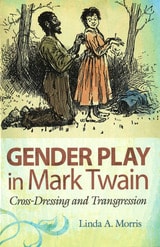
Gender Play in Mark Twain
Cross-Dressing and TransgressionLinda A. Morris
University of Missouri Press, 2007
Huckleberry Finn dressing as a girl is a famously comic scene in Mark Twain’s novel but hardly out of character—for the author, that is. Twain “troubled gender” in much of his otherwise traditional fiction, depicting children whose sexual identities are switched at birth, tomboys, same-sex married couples, and even a male French painter who impersonates his own fictive sister and becomes engaged to another man.
This book explores Mark Twain’s extensive use of cross-dressing across his career by exposing the substantial cast of characters who masqueraded as members of the opposite sex or who otherwise defied gender expectations. Linda Morris grounds her study in an understanding of the era’s theatrical cross-dressing and changing mores and even events in the Clemens household. She examines and interprets Twain’s exploration of characters who transgress gendered conventions while tracing the degree to which themes of gender disruption interact with other themes, such as his critique of race, his concern with death in his classic “boys’ books,” and his career-long preoccupation with twins and twinning.
Approaching familiar texts in surprising new ways, Morris reexamines the relationship between Huck and Jim; discusses racial and gender crossing in Pudd’nhead Wilson; and sheds new light on Twain’s difficulty in depicting the most famous cross-dresser in history, Joan of Arc. She also considers a number of his later “transvestite tales” that feature transgressive figures such as Hellfire Hotchkiss, who is hampered by her “misplaced sex.”
Morris challenges views of Twain that see his work as reinforcing traditional notions of gender along sharply divided lines. She shows that Twain depicts cross-dressing sometimes as comic or absurd, other times as darkly tragic—but that even at his most playful, he contests traditional Victorian notions about the fixity of gender roles.
Analyzing such characteristics of Twain’s fiction as his fascination with details of clothing and the ever-present element of play, Morris shows us his understanding that gender, like race, is a social construction—and above all a performance. Gender Play in Mark Twain: Cross-Dressing and Transgression broadens our understanding of the writer as it lends rich insight into his works.

Gravity
Selected Letters of Olivia Langdon ClemensEdited by Barbara E. Snedecor
University of Missouri Press, 2023