109 books match the query 'United States. Army' and 4 start with g
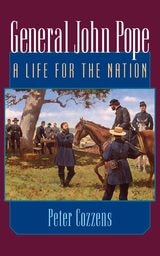
cover of General John Pope: A LIFE FOR THE NATION

General John Pope

A LIFE FOR THE NATION

Peter Cozzens

University of Illinois Press, 2000

Ambitious and outspoken, John Pope was one of the most controversial figures to hold high command during the Civil War, Reconstruction, and in the American West. General John Pope: A Life for the Nation is the first full biography of this much maligned figure who played crucial roles in both the Eastern and the Western Theaters of the Civil War.
 
Renowned Civil War scholar Peter Cozzens has mined Pope's own memoirs and a wealth of other primary sources to provide a complete picture of this gifted strategist. Uncovering new information about Pope's pre- and postwar career and his path to power, Cozzens delineates the political environment that surrounded Pope and provided the context for his actions.
 
Cozzens examines Pope's early career first as commander of the Army of the Mississippi and then as leader of a hastily formed Army of Virginia against Robert E. Lee. After his famous defeat at the Second Battle of Bull Run, Pope was sent to the frontier. There he held important commands on the western plains over the next twenty-four years, all the while struggling to clear his reputation of the events at Second Bull Run. A principal architect of the Red River War, which broke the resistance of the Southern Plains Indians, Pope espoused humanitarian treatment of subjugated tribes and was recognized as one of the army's leading authorities on Indian affairs.
 
In place of the simplistic caricature that has satisfied most historians, Cozzens has crafted an accurate, humane, balanced portrait of a complex man involved with the most complex issues of his day. A monumental work on a long-neglected figure, General John Pope offers a fresh look at a key nineteenth-century military leader as well as the most detailed analysis available of Federal leadership during the Second Bull Run campaign.
 
[more]
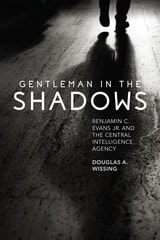
cover of Gentleman in the Shadows: Benjamin C. Evans Jr. and the Central Intelligence Agency

Gentleman in the Shadows

Benjamin C. Evans Jr. and the Central Intelligence Agency

Douglas A. Wissing

Indiana Historical Society Press, 2019
Gentleman in the Shadows is a biography of Benjamin C. Evans Jr., a Central Intelligence Agency executive who operated at the top levels of the U.S. intelligence community during the darkest days of the Cold War. After serving as a covert case officer in revolutionary Havana, Cuba, and then managing The Asia Foundation, a sprawling CIA front organization, Evans was promoted to the CIA headquarters’ seventh floor, where the executive directorate team managed world-changing intelligence missions. A socially adept administrator, Evans was the CIA Executive Secretary for seven Directors of Central Intelligence under four presidential administrations. Evans was part of the tumultuous period that included America’s crusade to democratize Occupied Japan, the Korean War, nuclear standoffs with the Soviet Union, the anti-Castro counterrevolutionary movement that climaxed in the Bay of Pigs invasion, the Vietnam War, Watergate, and the Family Jewels furor after the CIA’s dirty secrets were revealed. Through his marriage, Evans was a member of America’s elite, which figured so prominently in the U.S. intelligence services. Born and raised in a prosperous family in Crawfordsville, Indiana, Evans was imbued with conservative Hoosier values that celebrated servant-leadership. Following his graduation from the U.S. Military Academy at West Point, Evans’s social savvy and encultured mores stood him in good stead in Occupied Japan, where he served as aide-de-camp to General Eugene Harrison, a decorated World War II intelligence officer and Occupation administrator. It was in Occupied Japan that Evans and the general’s stepdaughter, Jan King, fell in love, and later married. When President Harry Truman recognized he needed a foreign intelligence service, General Harrison was on the commission that established what came to be the CIA. Not too many years later, Harrison and his cohorts insured that his son-in-law Evans, by then a respected military intelligence officer, was offered a position in the agency.CIA families not uncommonly led double lives of sequestered thoughts, unasked questions, and intimate deception. An empathetic family man, Evans paid a psychological price for his emotionally isolated life in the clandestine service.Gentleman in the Shadows is a biography of Benjamin C. Evans Jr., a Central Intelligence Agency executive who operated at the top levels of the U.S. intelligence community during the darkest days of the Cold War. After serving as a covert case officer in revolutionary Havana, Cuba, and then managing The Asia Foundation, a sprawling CIA front organization, Evans was promoted to the CIA headquarters’ seventh floor, where the executive directorate team managed world-changing intelligence missions. A socially adept administrator, Evans was the CIA Executive Secretary for seven Directors of Central Intelligence under four presidential administrations. Evans was part of the tumultuous period that included America’s crusade to democratize Occupied Japan, the Korean War, nuclear standoffs with the Soviet Union, the anti-Castro counterrevolutionary movement that climaxed in the Bay of Pigs invasion, the Vietnam War, Watergate, and the Family Jewels furor after the CIA’s dirty secrets were revealed. Through his marriage, Evans was a member of America’s elite, which figured so prominently in the U.S. intelligence services. Born and raised in a prosperous family in Crawfordsville, Indiana, Evans was imbued with conservative Hoosier values that celebrated servant-leadership. Following his graduation from the U.S. Military Academy at West Point, Evans’s social savvy and encultured mores stood him in good stead in Occupied Japan, where he served as aide-de-camp to General Eugene Harrison, a decorated World War II intelligence officer and Occupation administrator. It was in Occupied Japan that Evans and the general’s stepdaughter, Jan King, fell in love, and later married. When President Harry Truman recognized he needed a foreign intelligence service, General Harrison was on the commission that established what came to be the CIA. Not too many years later, Harrison and his cohorts insured that his son-in-law Evans, by then a respected military intelligence officer, was offered a position in the agency.CIA families not uncommonly led double lives of sequestered thoughts, unasked questions, and intimate deception. An empathetic family man, Evans paid a psychological price for his emotionally isolated life in the clandestine service.
[more]
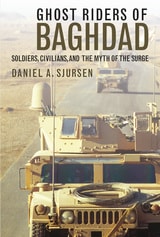
cover of Ghost Riders of Baghdad: Soldiers, Civilians, and the Myth of the Surge

Ghost Riders of Baghdad

Soldiers, Civilians, and the Myth of the Surge

Daniel A. Sjursen

University Press of New England, 2015
From October 2006 to December 2007, Daniel A. Sjursen—then a U.S. Army lieutenant—led a light scout platoon across Baghdad. The experiences of Ghost Rider platoon provide a soldier’s-eye view of the incredible complexities of warfare, peacekeeping, and counterinsurgency in one of the world’s most ancient cities. Sjursen reflects broadly and critically on the prevailing narrative of the surge as savior of America’s longest war, on the overall military strategy in Iraq, and on U.S. relations with ordinary Iraqis. At a time when just a handful of U.S. senators and representatives have a family member in combat, Sjursen also writes movingly on questions of America’s patterns of national service. Who now serves and why? What connection does America’s professional army have to the broader society and culture? What is the price we pay for abandoning the model of the citizen soldier? With the bloody emergence of ISIS in 2014, Iraq and its beleaguered, battle-scarred people are again much in the news. Unlike other books on the U.S. war in Iraq, Ghost Riders of Baghdad is part battlefield chronicle, part critique of American military strategy and policy, and part appreciation of Iraq and its people. At once a military memoir, history, and cultural commentary, Ghost Riders of Bahdad delivers a compelling story and a deep appreciation of both those who serve and the civilians they strive to protect. Sjursen provides a riveting addition to our understanding of modern warfare and its human costs.
[more]
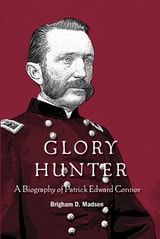
cover of Glory Hunter: A Biography of Patric Edward Connor

Glory Hunter

A Biography of Patric Edward Connor

Brigham Madsen

University of Utah Press, 1990

The life of Patrick Edward Connor serves as a half-century slice of western American history. After leaving New York City, where he had arrived at the age of twelve as a poor Irish immigrant, the nineteen-year-old youth joined the U.S. Army in 1839. He fought in the war with Mexico and then joined the gold rush in California until marrying and settling down in Stockton in 1854.

The Civil War found him volunteering again, this time as colonel of California troops sent to the Utah Territory to protect the mail lines from Indian attacks. Bitterly anti-Mormon, Connor spent the war years alternately engaging in a war of words with Brigham Young or in fighting Indians in northern Utah and present-day Wyoming. After the Civil War, ex-Major General Connor began mining operations in Utah and Nevada, ventures that went from boom to bust. He spent his final years in straitened financial circumstances.

Patrick Edward Connor was a “Man of the West,” possessing both its prejudices and its democratic, independent spirit. His greatest success lay as a military leader, and he would have agreed that he was made for war, not peace. He left an imprint on the history of the American West, remembered as the founder of Fort Douglas, as the “first gentile in Utah,” the “father of Utah mining,” and the “father of the Liberal Party in Utah.”


[more]