349 books match the query 'Violence' and 6 start with g

cover of Gender Violence and the Press: The St. Kizito Story

Gender Violence and the Press

The St. Kizito Story

H. Leslie Steeves

Ohio University Press, 1997
On the night of Saturday, July 13, 1991, a mob of male students at the St. Kizito Mixed Secondary School in Meru, Kenya, attacked their female classmates in a dormitory. Nineteen schoolgirls were killed in the melee and more than 70 were raped or gang raped. The explanations in the press for the attack included a rebellion by male students over administrative mismanagement, academic stress, cultural norms for the Meru ethnic group, and victim characteristics (as assumed in rape myths). Rape had been tolerated at the school, according to press accounts. Dr. Steeves studied all stories published in three Nairobi daily newspapers and a weekly Kenyan newsmagazine for the year following the crime. She also examined a sampling of international reports. Her qualitative analysis sought to identify “framing patterns” supportive of patriarchal or of feminist ideologies of rape, and the ways in which those patterns have been affected by news values and traditions. Gender Violence and the Press shows how media discourse may allow space for feminist interests within the dominant patriarchal ideology. In this instance, the appearance of resistant views was significant in making alternative meanings available and in supporting women’s growing anti-violence activism.
[more]
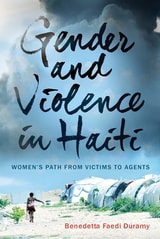
cover of Gender and Violence in Haiti: Women’s Path from Victims to Agents

Gender and Violence in Haiti

Women’s Path from Victims to Agents

Benedetta Faedi Duramy

Rutgers University Press, 2014

Women in Haiti are frequent victims of sexual violence and armed assault. Yet an astonishing proportion of these victims also act as perpetrators of violent crime, often as part of armed groups. Award-winning legal scholar Benedetta Faedi Duramy visited Haiti to discover what causes these women to act in such destructive ways and what might be done to stop this tragic cycle of violence.

Gender and Violence in Haiti is the product of more than a year of extensive firsthand observations and interviews with the women who have been caught up in the widespread violence plaguing Haiti. Drawing from the experiences of a diverse group of Haitian women, Faedi Duramy finds that both the victims and perpetrators of violence share a common sense of anger and desperation. Untangling the many factors that cause these women to commit violence, from self-defense to revenge, she identifies concrete measures that can lead them to feel vindicated and protected by their communities.

Faedi Duramy vividly conveys the horrifying conditions pervading Haiti, even before the 2010 earthquake. But Gender and Violence in Haiti also carries a message of hope—and shows what local authorities and international relief agencies can do to help the women of Haiti.
[more]
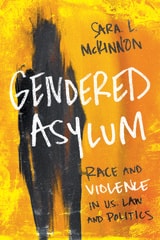
cover of Gendered Asylum: Race and Violence in U.S. Law and Politics

Gendered Asylum

Race and Violence in U.S. Law and Politics

Sara L. McKinnon

University of Illinois Press, 2016

Women filing gender-based asylum claims long faced skepticism and outright rejection within the United States immigration system. Despite erratic progress, the United States still fails to recognize gender as an established category for experiencing persecution. Gender exists in a sort of limbo segregated from other aspects of identity and experience.

Sara L. McKinnon exposes racialized rhetorics of violence in politics and charts the development of gender as a category in American asylum law. Starting with the late 1980s, when gender-based requests first emerged in case law, McKinnon analyzes gender- and sexuality-related cases against the backdrop of national and transnational politics. Her focus falls on cases as diverse as Guatemalan and Salvadoran women sexually abused during the Dirty Wars and transgender asylum seekers from around the world fleeing brutally violent situations. She reviews the claims, evidence, testimony, and message strategies that unfolded in these legal arguments and decisions, and illuminates how legal decisions turned gender into a political construct vulnerable to American national and global interests. She also explores myriad related aspects of the process, including how subjects are racialized and the effects of that racialization, and the consequences of policies that position gender as a signifier for women via normative assumptions about sex and heterosexuality.

Wide-ranging and rich with human detail, Gendered Asylum uses feminist, immigration, and legal studies to engage one of the hotly debated issues of our time.
[more]
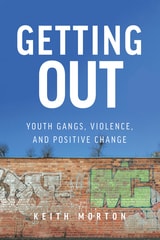
cover of Getting Out: Youth Gangs, Violence, and Positive Change

Getting Out

Youth Gangs, Violence, and Positive Change

Keith Morton

University of Massachusetts Press, 2019

For eight years Keith Morton codirected a safe-space program for youth involved in gang or street violence in Providence, Rhode Island. Getting Out is a result of the innovative perspectives he developed as he worked alongside staff from a local nonviolence institute to help these young people make life-affirming choices. Rather than view their violence as pathological, Morton explains that gang members are victims of violence, and the trauma they have experienced leads them to choose violence as the most meaningful option available. To support young people as they “unlearned” violence and pursued nonviolent alternatives, he offered what he calls a "Youth Positive" approach that prioritizes healing over punishment and recognizes them as full human beings. Informed by deep personal connections with these youth, Morton contends that to help them, we need to change our question from “What is wrong with you?” to “What happened to you?”

[more]
cover of Global Visions of Violence: Agency and Persecution in World Christianity

Global Visions of Violence

Agency and Persecution in World Christianity

Jason Bruner

Rutgers University Press, 2023

In Global Visions of Violence, the editors and contributors argue that violence creates a lens, bridge, and method for interdisciplinary collaboration that examines Christianity worldwide in the twentieth and twenty-first centuries. By analyzing the myriad ways violence, persecution, and suffering impact Christians and the imagination of Christian identity globally, this interdisciplinary volume integrates the perspectives of ethicists, historians, anthropologists, and ethnographers to generate new conversations. Taken together, the chapters in this book challenge scholarship on Christian growth that has not accounted for violence while analyzing persecution narratives that can wield data toward partisan ends.  This allows Global Visions of Violence to push urgent conversations forward, giving voice to projects that illuminate wide and often hidden landscapes that have been shaped by global visions of violence, and seeking solutions that end violence and turn toward the pursuit of justice, peace, and human rights among suffering Christians. 
[more]
cover of Guerrillas, Unionists, and Violence on the Confederate Home Front

Guerrillas, Unionists, and Violence on the Confederate Home Front

Daniel E. Sutherland

University of Arkansas Press, 1999

Until recently, this localized violence was largely ignored, scholars focusing instead on large-scale operations of the war—the decisions and actions of generals and presidents. But as Daniel Sutherland reminds us, the impact of battles and elections cannot be properly understood without an examination of the struggle for survival on the home front, of lives lived in the atmosphere created by war. Sutherland gathers eleven essays by such noted Civil War scholars as Michael Fellman, Donald Frazier, Noel Fisher, and B. F. Cooling, each one exploring the Confederacy's internal war in a different state. All help to broaden our view of the complexity of war and to provide us with a clear picture of war's consequences, its impact on communities, homes, and families. This strong collection of essays delves deeply into what Daniel Sutherland calls "the desperate side of war," enriching our understanding of a turbulent and divisive period in American history.
[more]