71 books match the query 'Voice' and 3 start with g

cover of Gaze and Voice as Love Objects: SIC 1

Gaze and Voice as Love Objects

SIC 1

Renata Salecl and Slavoj Žižek, eds.

Duke University Press, 1996

The gaze entices, inspects, fascinates. The voice hypnotizes, seduces, disarms. Are gaze and voice part of the relationship we call love . . . or hate? If so, what part? How do they function? This provocative book examines love as the mediating entity in the essential antagonism between the sexes, and gaze and voice as love's medium. The contributors proceed from the Lacanian premise that "there is no sexual relationship," that the sexes are in no way complementary and that love—figured in the gaze and the voice —embodies the promise and impossibility of any relation between them.

The first detailed Lacanian elaboration of this topic, Gaze and Voice as Love Objects examines the status of gaze, voice, and love in philosophy from Plato to Kant, in ideology from early Christianity to contemporary cynicism, in music from Hildegard of Bingen to Richard Wagner, in literature from Edith Wharton's Age of Innocence to Kazuo Ishiguro's The Remains of the Day, and in cinema from Michael Powell's Peeping Tom to Kieslowski's A Short Film on Love. Throughout, the contributors seek to show that the conflict between the sexes is the site of a larger battle over the destiny of modernity. With insights into the underlying target of racist and sexist violence, this book offers surprising revelations into the nature of an ancient enigma—love.

Contributors. Elisabeth Bronfen, Mladen Dolar, Fredric Jameson, Renata Salecl, Slavoj Žižek, Alenka Zupancic
[more]
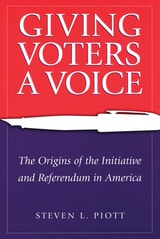
cover of Giving Voters a Voice: The Origins of the Initiative and Referendum in America

Giving Voters a Voice

The Origins of the Initiative and Referendum in America

Steven L. Piott

University of Missouri Press, 2003
Giving Voters a Voice studies the origins of direct legislation, one of the most important political reforms enacted during the Progressive Era. Steven L. Piott begins with the source of the idea in the United States and proceeds to the earliest efforts aimed at generating a national movement to expand the parameters of popular democracy in the 1890s. He then broadens his examination to include the unique ways in which twenty-two states came to enact legislation allowing for the statewide initiative and referendum between 1898 and 1918. The book’s appendix offers the only comprehensive listing of all the ballot propositions and vote totals for the period.
Most historians of the Progressive Era have concluded that narrow self-interest prevented labor, farmers, and the middle class from working together to achieve important reforms. Giving Voters a Voice demonstrates that middle-class reformers, trade unionists, and farm organizers formed loose political coalitions and directed grass-roots campaigns to gain passage of initiative and referendum statutes because direct legislation offered the best means to correct political, economic, and social abuses. But there was more than just a shared sense of common interest that brought these seemingly oppositional groups together. What really made them willing to speak, lobby, and work together was quite simply the frustration felt by voters who sensed that they had become economically dependent and politically powerless.
Each state in which proponents conducted an active campaign to win adoption of direct legislation is studied in detail. The book analyzes the crucial roles played by individuals who led the movement to empower voters by enabling them to enact or veto legislation directly, and reveals the arguments, the stumbling blocks, and political compromises that are often slighted in generalized overviews. Each state possessed its own political dynamic. Giving Voters a Voice offers the reader a richness of detail and a completeness of coverage not found elsewhere.
[more]
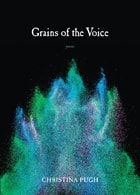
cover of Grains of the Voice: Poems

Grains of the Voice

Poems

Christina Pugh

Northwestern University Press, 2013

Christina Pugh’s Grains of the Voice exhibits a pervasive fascination with sound in all its manifestations. The hu­man voice, musical instruments, the sounds produced by the natural and man-made worlds—all serve at one time or another as both the framework of poems and the occa­sion for their lightning-quick changes of direction, of tone, of point of reference. The poems are eclectic in their al­lusiveness, filled with echoes—and sometimes the words themselves—of other poets, but just as often of songs both popular and obscure, of the noise of pop culture, and of philosophers’ writings. But Pugh always wears her learn­ing lightly. Beneath the jewellike surfaces of her poems is a strenuous investigation of the nature of and need for communication and a celebration of the endless variety of its forms. 

[more]