Results by title
388 books match the query 'War' and 10 start with g

Gameplay Mode
War, Simulation, and TechnoculturePatrick Crogan
University of Minnesota Press, 2011
From flight simulators and first-person shooters to MMPOG and innovative strategy games like 2008’s Spore, computer games owe their development to computer simulation and imaging produced by and for the military during the Cold War. To understand their place in contemporary culture, Patrick Crogan argues, we must first understand the military logics that created and continue to inform them. Gameplay Mode situates computer games and gaming within the contemporary technocultural moment, connecting them to developments in the conceptualization of pure war since the Second World War and the evolution of simulation as both a technological achievement and a sociopolitical tool.
Crogan begins by locating the origins of computer games in the development of cybernetic weapons systems in the 1940s, the U.S. Air Force’s attempt to use computer simulation to protect the country against nuclear attack, and the U.S. military’s development of the SIMNET simulated battlefield network in the late 1980s. He then examines specific game modes and genres in detail, from the creation of virtual space in fight simulation games and the co-option of narrative forms in gameplay to the continuities between online gaming sociality and real-world communities and the potential of experimental or artgame projects like September 12th: A Toy World and Painstation, to critique conventional computer games.
Drawing on critical theoretical perspectives on computer-based technoculture, Crogan reveals the profound extent to which today’s computer games—and the wider culture they increasingly influence—are informed by the technoscientific program they inherited from the military-industrial complex. But, Crogan concludes, games can play with, as well as play out, their underlying logic, offering the potential for computer gaming to anticipate a different, more peaceful and hopeful future.

Ganado Mucho / Tótsohnii Hastiin
Navajo Peace Chief in Times of War and ChangeTodd M. Compton
University of Utah Press, 2027
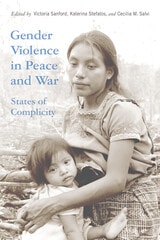
Gender Violence in Peace and War
States of ComplicitySanford, Victoria
Rutgers University Press, 2016
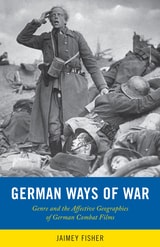
German Ways of War
The Affective Geographies and Generic Transformations of German War FilmsJaimey Fisher
Rutgers University Press, 2022
Getting to War
Predicting International Conflict with Mass Media IndicatorsW. Ben Hunt
University of Michigan Press, 1997
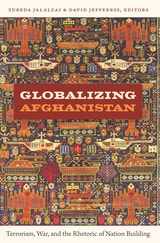
Globalizing Afghanistan
Terrorism, War, and the Rhetoric of Nation BuildingZubeda Jalalzai and David Jefferess, eds.
Duke University Press, 2011
Contributors. Gwen Bergner, Maliha Chishti, Cheshmak Farhoumand-Sims, Nigel C. Gibson, Zubeda Jalalzai, David Jefferess, Altaf Ullah Khan, Kamran Rastegar, Rodney J. Steward, Imre Szeman
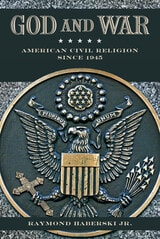
God and War
American Civil Religion since 1945Haberski, Jr., Raymond
Rutgers University Press, 2012
Americans have long considered their country to be good—a nation "under God" with a profound role to play in the world. Yet nothing tests that proposition like war. Raymond Haberski argues that since 1945 the common moral assumptions expressed in an American civil religion have become increasingly defined by the nation's experience with war.
God and War traces how three great postwar “trials”—the Cold War, the Vietnam War, and the War on Terror—have revealed the promise and perils of an American civil religion. Throughout the Cold War, Americans combined faith in God and faith in the nation to struggle against not only communism but their own internal demons. The Vietnam War tested whether America remained a nation "under God," inspiring, somewhat ironically, an awakening among a group of religious, intellectual and political leaders to save the nation's soul. With the tenth anniversary of 9/11 behind us and the subsequent wars in Iraq and Afghanistan winding down, Americans might now explore whether civil religion can exist apart from the power of war to affirm the value of the nation to its people and the world.
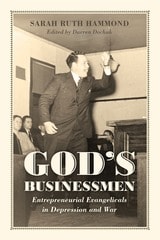
God's Businessmen
Entrepreneurial Evangelicals in Depression and WarSarah Ruth Hammond
University of Chicago Press, 2017
The evangelical embrace of conservatism is a familiar feature of the contemporary political landscape. What’s less well-known, however, is that the connection predates the Reagan revolution, going all the way back to the Depression and World War II. Evangelical businessmen at the time were quite active in opposing the New Deal—on both theological and economic grounds—and in doing so claimed a place alongside other conservatives in the public sphere. Like previous generations of devout laymen, they self-consciously merged their religious and business lives, financing and organizing evangelical causes with the kind of visionary pragmatism that they practiced in the boardroom.
In God’s Businessmen, Sarah Ruth Hammond explores not only these men’s personal trajectories but also those of the service clubs and other institutions that, like them, believed that businessmen were God’s instrument for the Christianization of the world. Hammond presents a capacious portrait of the relationship between the evangelical business community and the New Deal—and in doing so makes important contributions to American religious history, business history, and the history of the American state.
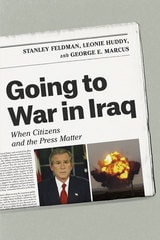
Going to War in Iraq
When Citizens and the Press MatterStanley Feldman, Leonie Huddy, and George E. Marcus
University of Chicago Press, 2015
Drawing on the most comprehensive survey of public reactions to the war, Stanley Feldman, Leonie Huddy, and George E. Marcus revisit this critical period and come back with a very different story. Polling data from that critical period shows that the Bush administration’s carefully orchestrated campaign not only failed to raise Republican support for the war but, surprisingly, led Democrats and political independents to increasingly oppose the war at odds with most prominent Democratic leaders. More importantly, the research shows that what constitutes the news matters. People who read the newspaper were more likely to reject the claims coming out of Washington because they were exposed to the sort of high-quality investigative journalism still being written at traditional newspapers. That was not the case for those who got their news from television. Making a case for the crucial role of a press that lives up to the best norms and practices of print journalism, the book lays bare what is at stake for the functioning of democracy—especially in times of crisis—as newspapers increasingly become an endangered species.
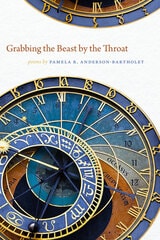
Grabbing the Beast by the Throat
Pamela R. Anderson-Bartholet
Michigan State University Press, 2027
Grabbing the Beast by the Throat is a gripping volume of historical fiction in poetry that follows the life of Pavel Svoboda, a Czechoslovakian man whose life turns upside down when Nazi Germany invades Czechoslovakia and brings Europe to the brink of World War II. Readers witness Pavel’s evolution from a carefree college student with a close-knit family into a resistance fighter who opposes Hitler’s brutal regime. When other college students are slaughtered for protesting the occupation and his Jewish girlfriend is taken to Terezín (Theresienstadt) Concentration Camp, Pavel joins the Czech resistance to protect the people he loves, undermine those in power, and help regain his country’s freedom.
In America and around the world, the clear rise of fascism makes it vitally important that we continue to learn from the past. Grounded in history, this book is a powerful—and unmistakably timely—reminder that there are times when we must fight for freedom.