Results by title
62 books match the query 'Women artists' and 2 start with g
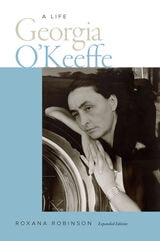
Georgia O'Keeffe
A LifeRoxana Robinson
Brandeis University Press, 2020
One of the greatest and most admired artists of the twentieth century, Georgia O’Keeffe led a life rich in intense relationships—with family, friends, and especially with fellow artist Alfred Stieglitz. Her extraordinary accomplishments, such as the often eroticized flowers, bones, stones, skulls, and pelvises she painted with such command, are all the more remarkable when seen in the context of the struggle she waged between the rigorous demands of love and work.
When Roxana Robinson’s definitive biography of O’Keeffe was first published in 1989, it received rave reviews and was named a New York Times Notable Book of the Year. This new edition features a new foreword by the author setting O’Keefe in an artistic context over the last thirty years since the book was first published, as well as previously unpublished letters of the young O’Keeffe to her lover, Arthur MacMahon. It also relates the story of Robinson’s own encounter with the artist. As interest in O’Keeffe continues to grow among museum-goers and scholars alike, this book remains indispensable for understanding her life and art.
When Roxana Robinson’s definitive biography of O’Keeffe was first published in 1989, it received rave reviews and was named a New York Times Notable Book of the Year. This new edition features a new foreword by the author setting O’Keefe in an artistic context over the last thirty years since the book was first published, as well as previously unpublished letters of the young O’Keeffe to her lover, Arthur MacMahon. It also relates the story of Robinson’s own encounter with the artist. As interest in O’Keeffe continues to grow among museum-goers and scholars alike, this book remains indispensable for understanding her life and art.
[more]
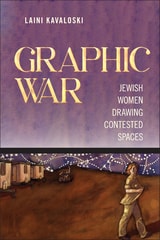
Graphic War
Jewish Women Drawing Contested SpacesLaini Kavaloski
Rutgers University Press, 2026
Employing geographical and political structures to her analyses, Laini Kavaloski argues that spatial forms that represent boundaries such as walls, ghettos, and war zones together with the artistic renderings of emotion, gendered experiences, and cultural narratives make visible the consequences of war on bodies and political futures. Representations of Jewish territorial positions are not only metaphoric but are also active forces in determining the effects of boundaries—political and cultural— on Jewish lives. Through an archive of contemporary memoirs that grapple with Jewish experiences of war, Graphic War makes visible the consequences of state structures, militarized environments, and nationalisms on the female body and in doing so registers a shift from the persistent Jewish identification with 20th-century oppression toward a narrative of Jewish belonging based in transnational agency and activism in the 21st Century.
[more]