127 books match the query 'World politics' and 6 start with g
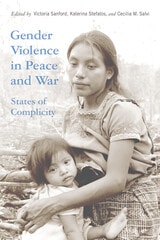
cover of Gender Violence in Peace and War: States of Complicity

Gender Violence in Peace and War

States of Complicity

Sanford, Victoria

Rutgers University Press, 2016
Reports from war zones often note the obscene victimization of women, who are frequently raped, tortured, beaten, and pressed into sexual servitude. Yet this reign of terror against women not only occurs during exceptional moments of social collapse, but during peacetime too. As this powerful book argues, violence against women should be understood as a systemic problem—one for which the state must be held accountable. 
 
The twelve essays in Gender Violence in Peace and War present a continuum of cases where the state enables violence against women—from state-sponsored torture to lax prosecution of sexual assault. Some contributors uncover buried histories of state violence against women throughout the twentieth century, in locations as diverse as Ireland, Indonesia, and Guatemala. Others spotlight ongoing struggles to define the state’s role in preventing gendered violence, from domestic abuse policies in the Russian Federation to anti-trafficking laws in the United States. 
 
Bringing together cutting-edge research from political science, history, gender studies, anthropology, and legal studies, this collection offers a comparative analysis of how the state facilitates, legitimates, and perpetuates gender violence worldwide. The contributors also offer vital insights into how states might adequately protect women’s rights in peacetime, as well as how to intervene when a state declares war on its female citizens.  
 
[more]
cover of Gender, Sexuality, and the Cold War: A Global Perspective

Gender, Sexuality, and the Cold War

A Global Perspective

Philip E. Muehlenbeck

Vanderbilt University Press, 2017

As Marko Dumančić writes in his introduction to Gender, Sexuality, and the Cold War, "despite the centrality of gender and sexuality in human relations, their scholarly study has played a secondary role in the history of the Cold War. . . . It is not an exaggeration to say that few were left unaffected by Cold War gender politics; even those who were in charge of producing, disseminating, and enforcing cultural norms were called on to live by the gender and sexuality models into which they breathed life." This underscores the importance of this volume, as here scholars tackle issues ranging from depictions of masculinity during the all-consuming space race, to the vibrant activism of Indian peasant women during this period, to the policing of sexuality inside the militaries of the world.

Gender, Sexuality, and the Cold War brings together a diverse group of scholars whose combined research spans fifteen countries across five continents, claiming a place as the first volume to examine how issues of gender and sexuality impacted both the domestic and foreign policies of states, far beyond the borders of the United States, during the tumult of the Cold War.


Table of Contents

Preface

Introduction: Hidden in Plain Sight: The Histories of Gender and Sexuality during the Cold War
Marko Dumančić

Part I: Sexuality

Faceless and Stateless: French Occupation Policy toward Women and Children in Postwar Germany (1945-1949)
Katherine Rossy

Patriarchy and Segregation: Policing Sexuality in US-Icelandic Military Relations
Valur Ingimundarson

Queering Subversives in Cold War Canada
Patrizia Gentile

"Nonreligious Activities": Sex, Anticommunism, and Progressive Christianity in Late Cold War Brazil
Benjamin A. Cowan

Manning the Enemy: US Perspectives on International Birthrates during the Cold War
Kathleen A. Tobin

Part II: Femininities

Indian Peasant Women's Activism in a Hot Cold War
Elisabeth Armstrong

The Medicalization of Childhood in Mexico during the Early Cold War, 1945-1960
Nichole Sanders

Africa's Kitchen Debate: Ghanaian Domestic Space in the Age of the Cold War
Jeffrey S. Ahlman

Mobilizing Women? State Feminisms in Communist Czechoslovakia and Socialist Egypt
May Hawas and Philip E. Muehlenbeck

A Vietnamese Woman Directs the War Story: Duc Hoan, 1937-2003
Karen Turner

Global Feminism and Cold War Paradigms: Women's International NGOs and the United Nations, 1970-1985
Karen Garner

Part III: Masculinities

"Men of the World" or "Uniformed Boys"? Hegemonic Masculinity and the British Army in the Era of the Korean War
Grace Huxford

Yuri Gagarin and Celebrity Masculinity in Soviet Culture
Erica L. Fraser
[more]
cover of Gentleman in the Shadows: Benjamin C. Evans Jr. and the Central Intelligence Agency

Gentleman in the Shadows

Benjamin C. Evans Jr. and the Central Intelligence Agency

Douglas A. Wissing

Indiana Historical Society Press, 2019

Gentleman in the Shadows is a biography of Benjamin C. Evans Jr., a Central Intelligence Agency executive who operated at the top levels of the U.S. intelligence community during the darkest days of the Cold War. After serving as a covert case officer in revolutionary Havana, Cuba, and then managing The Asia Foundation, a sprawling CIA front organization, Evans was promoted to the CIA headquarters’ seventh floor, where the executive directorate team managed world-changing intelligence missions. A socially adept administrator, Evans was the CIA Executive Secretary for seven Directors of Central Intelligence under four presidential administrations. Evans was part of the tumultuous period that included America’s crusade to democratize Occupied Japan, the Korean War, nuclear standoffs with the Soviet Union, the anti-Castro counterrevolutionary movement that climaxed in the Bay of Pigs invasion, the Vietnam War, Watergate, and the Family Jewels furor after the CIA’s dirty secrets were revealed. Through his marriage, Evans was a member of America’s elite, which figured so prominently in the U.S. intelligence services. Born and raised in a prosperous family in Crawfordsville, Indiana, Evans was imbued with conservative Hoosier values that celebrated servant-leadership. Following his graduation from the U.S. Military Academy at West Point, Evans’s social savvy and encultured mores stood him in good stead in Occupied Japan, where he served as aide-de-camp to General Eugene Harrison, a decorated World War II intelligence officer and Occupation administrator. It was in Occupied Japan that Evans and the general’s stepdaughter, Jan King, fell in love, and later married. When President Harry Truman recognized he needed a foreign intelligence service, General Harrison was on the commission that established what came to be the CIA. Not too many years later, Harrison and his cohorts insured that his son-in-law Evans, by then a respected military intelligence officer, was offered a position in the agency.CIA families not uncommonly led double lives of sequestered thoughts, unasked questions, and intimate deception. An empathetic family man, Evans paid a psychological price for his emotionally isolated life in the clandestine service.Gentleman in the Shadows is a biography of Benjamin C. Evans Jr., a Central Intelligence Agency executive who operated at the top levels of the U.S. intelligence community during the darkest days of the Cold War. After serving as a covert case officer in revolutionary Havana, Cuba, and then managing The Asia Foundation, a sprawling CIA front organization, Evans was promoted to the CIA headquarters’ seventh floor, where the executive directorate team managed world-changing intelligence missions. A socially adept administrator, Evans was the CIA Executive Secretary for seven Directors of Central Intelligence under four presidential administrations. Evans was part of the tumultuous period that included America’s crusade to democratize Occupied Japan, the Korean War, nuclear standoffs with the Soviet Union, the anti-Castro counterrevolutionary movement that climaxed in the Bay of Pigs invasion, the Vietnam War, Watergate, and the Family Jewels furor after the CIA’s dirty secrets were revealed. Through his marriage, Evans was a member of America’s elite, which figured so prominently in the U.S. intelligence services. Born and raised in a prosperous family in Crawfordsville, Indiana, Evans was imbued with conservative Hoosier values that celebrated servant-leadership. Following his graduation from the U.S. Military Academy at West Point, Evans’s social savvy and encultured mores stood him in good stead in Occupied Japan, where he served as aide-de-camp to General Eugene Harrison, a decorated World War II intelligence officer and Occupation administrator. It was in Occupied Japan that Evans and the general’s stepdaughter, Jan King, fell in love, and later married. When President Harry Truman recognized he needed a foreign intelligence service, General Harrison was on the commission that established what came to be the CIA. Not too many years later, Harrison and his cohorts insured that his son-in-law Evans, by then a respected military intelligence officer, was offered a position in the agency.CIA families not uncommonly led double lives of sequestered thoughts, unasked questions, and intimate deception. An empathetic family man, Evans paid a psychological price for his emotionally isolated life in the clandestine service.
[more]
cover of Geopolitical Economy: After US Hegemony, Globalization and Empire

Geopolitical Economy

After US Hegemony, Globalization and Empire

Radhika Desai

Pluto Press, 2013

Geopolitical Economy radically reinterprets the historical evolution of the world order, as a multi-polar world emerges from the dust of the financial and economic crisis.

Radhika Desai offers a radical critique of the theories of US hegemony, globalisation and empire which dominate academic international political economy and international relations, revealing their ideological origins in successive failed US attempts at world dominance through the dollar.

Desai revitalizes revolutionary intellectual traditions which combine class and national perspectives on ‘the relations of producing nations’. At a time of global upheavals and profound shifts in the distribution of world power, Geopolitical Economy forges a vivid and compelling account of the historical processes which are shaping the contemporary international order.
[more]
cover of Global Perspectives on the United States: Pro-Americanism, Anti-Americanism, and the Discourses Between

Global Perspectives on the United States

Pro-Americanism, Anti-Americanism, and the Discourses Between

Edited by Virginia R. Dominguez and Jane C. Desmond

University of Illinois Press, 2017

This daring collaborative effort showcases dialogues between international scholars engaged with the United States from abroad. The writers investigate the analytic methods and choices that label certain talk, images, behaviors, and allusions as "American" and how to read the data on such material. The editors present the essays in pairs that overlap in theme or region. Each author subsequently comments on the other's work. A third scholar or team of scholars from a different discipline or geographic location then provides another level of analysis. Contributors: Andrzej Antoszek, Sophia Balakian, Zsófia Bán, Sabine Bröck, Ian Condry, Kate Delaney, Jane C. Desmond, Virginia R. Dominguez, Ira Dworkin, Richard Ellis, Guillermo Ibarra, Seyed Mohammad Marandi, Giorgio Mariani, Ana Mauad, Loes Nas, Edward Schatz, Manar Shorbagy, Kristin Solli, Amy Spellacy, and Michael Titlestad.
[more]
cover of Global Rivalries From the Cold War to Iraq

Global Rivalries From the Cold War to Iraq

Kees van der Pijl

Pluto Press, 2006

This book offers a highly original analysis of world events in the light of the Iraq War. It explores the history and development of relations between major countries in the international community and the impact that successive wars and changes in the global political economy have had on the way states relate to each other today.

Tracing the liberal state structure back to the closing stages of the English Civil War and settlement in North America, it argues that the rise of the English-speaking West has created rivalries between contender states that are never entirely put to rest. With each round of Western expansion, new rivalries are created.

Offering a truly global analysis that covers every area of the world - from Europe and America to China, the Middle East, Latin America and Russia -- he analyses the development of international relations post WWII, and questions whether the neoliberal project and its human rights ideology have collapsed back into authoritarianism under the guise of the 'war on terror'.
[more]