Results by title
118 books match the query 'Youth' and 4 start with g
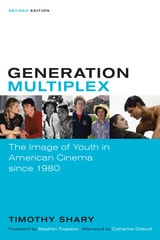
Generation Multiplex
The Image of Youth in American Cinema since 1980By Timothy Shary
University of Texas Press, 2014
Generation Multiplex (2002) was the first comprehensive study of the representation of teenagers in American cinema since David Considine’s Cinema of Adolescence in 1985. This updated and expanded edition reaffirms the idea that films about youth constitute a legitimate genre worthy of study on its own terms. Identifying four distinct subgenres—school, delinquency, horror, and romance—Timothy Shary explores hundreds of representative films while offering in-depth discussion of movies that constitute key moments in the genre, including Fast Times at Ridgemont High, A Nightmare on Elm Street, The Breakfast Club, Say Anything . . . , Boyz N the Hood, Scream, American Pie, Napoleon Dynamite, Superbad, The Twilight Saga, and The Hunger Games. Analyzing developments in teen films since 2002, Shary covers such topics as the increasing availability of movies on demand, which has given teens greater access to both popular and lesser-seen films; the recent dominance of supernatural and fantasy films as a category within the genre; and how the ongoing commodification of teen images in media affects real-life issues such as school bullying, athletic development, sexual identity, and teenage pregnancy.
Generations Past
Youth in East African HistoryAndrew Burton
Ohio University Press, 2010
Contemporary Africa is demographically characterized above all else by its youthfulness. In East Africa the median age of the population is now a striking 17.5 years, and more than 65 percent of the population is age 24 or under. This situation has attracted growing scholarly attention, resulting in an important and rapidly expanding literature on the position of youth in African societies.
While the scholarship examining the contemporary role of youth in African societies is rich and growing, the historical dimension has been largely neglected in the literature thus far. Generations Past seeks to address this gap through a wide-ranging selection of essays that covers an array of youth-related themes in historical perspective. Thirteen chapters explore the historical dimensions of youth in nineteenth-, twentieth-, and twenty-first–century Ugandan, Tanzanian, and Kenyan societies. Key themes running through the book include the analytical utility of youth as a social category; intergenerational relations and the passage of time; youth as a social and political problem; sex and gender roles among East African youth; and youth as historical agents of change. The strong list of contributors includes prominent scholars of the region, and the collection encompasses a good geographical spread of all three East African countries.

Golden and Blue Like My Heart
Masculinity, Youth, and Power Among Soccer Fans in Mexico CityRoger Magazine
University of Arizona Press, 2007
Roger Magazine takes readers inside Mexico’s soccer stadiums to explore young men’s participation in struggles over the future of that country’s urban society. His firsthand observations of the fan clubs—las porras—yield a unique inside look at confrontations in the stands over group organization, particularly at the emergence of rebel segments within the clubs. His study offers a close-up look at ground-level struggles over social organization in contemporary urban Mexico, showing how young male fans both blindly reproduce and consciously manipulate images of violence and disorder derived from national myths about typical urban Mexican men.
Golden and Blue Like My Heart offers a new way of understanding the dynamics of fandom while shedding new light on larger social processes and youth culture in Mexico. And with its insight into soccer culture, politico-economic transition, and masculinity, it has important and wide-reaching implications for all of Latin America.
Growing Up With Television
Everyday Learning Among Young AdolescentsJoellen Fisherkeller
Temple University Press, 2002