Results by title
3258 books match the query 'Art' and 80 start with g
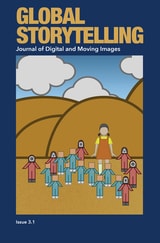
Global Storytelling, vol. 3, no. 1
East Asian Serial Dramas in the Era of Global Streaming Services: Journal of Digital and Moving ImagesSpecial Issue Editors: Tze-lan Sang, Lina Qu, and Ying Zhu
Michigan Publishing Services, 2023
Special Issue Editors Tze-lan Sang, Lina Qu, and Ying Zhu
IN THIS ISSUE
Tze-lan Sang, Lina Qu, and Ying Zhu - East Asian Serial Dramas in the Era of Global Streaming Services: Special Issue Editors’ Introduction
Research Articles
Ying Zhu - The Therapeutic and the Transgressive: Chinese Fansub Straddling between Hollywood IP Laws and Chinese State Censorship
David Humphrey - Japanese Dramas and the Streaming Success Story that Wasn’t: How Industry Practices and IP Shape Japan’s Access to Global Streaming
Yucong Hao - Transmedia Adaptation, Sonic Affect, and Multisensory Participation in Contemporary Chinese Danmei Radio Drama
Eunice Ying Ci Lim - The Nostalgic Negotiation of Post-TV Legibility in Mom, Don’t Do That!
Winnie Yanjing Wu - How Pachinko Mirrors Migrant Life: Rethinking the Temporal, Spatial, and Linguistic Dimensions of Migration
Drama Reviews
Mei Mingxue Nan - Squid Game: The Hall of Screens in the Age of Platform Cosmopolitanism
Shuwen Yang - Review of Light the Night
Short Essay
Sheng-mei Ma - Three Bad Kids, One Loving Killer: Red China Noir in Blakean Symmetry
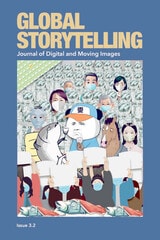
Global Storytelling, vol. 3, no. 2
Satirical Activism and Youth Culture in and Beyond COVID-19 China: Journal of Digital and Moving ImagesSpecial Issue Editor: Haiqing Yu
Michigan Publishing Services, 2024
Haiqing Yu. COVID-19, Satirical Activism, and Chinese Youth Culture: An Introduction
Research Articles
Ying Zhu and Junqi Peng. From Diaosi to Sang to Tangping: The Chinese DST Youth Subculture Online
Shaohua Guo. Moments of "Madness": Cynicism in Times of COVID
Howard Choy. Laughter in the Time of Coronavirus: Epidemic Humor and Satire in Chinese Women's Digital Diaries
Shaoyu Tang. Political In Between: Streaming Stand-Up Comedy and Feminist Reckoning in Contemporary Mainland China
Jingxue Zhang and Charlie Yi Zhang. The Power of Citation: Feminist Counter-Appropriation of State Discourses in Post-Reform China
Book Reviews
Ethan Tussey. Revised Research Methodology for the Age of Media Industries Speculation - Review of Specworld: Folds, Faults, and Fractures in Embedded Creator Industries by John Thornton Caldwell, University of California Press, 2023
Michael Keane. Precarious Creativity and the State in New Era China - Review of Chinese Creator Economies: Labor and Bilateral Creative Workers by Jian Lin, New York University Press, 2023
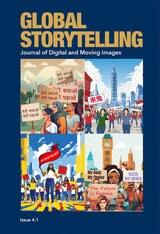
Global Storytelling, vol. 4, no. 1
The Global Social Mediascape of Feminism and Misogyny (Summer 2024)Special Issue Editor: Hong Zeng
Michigan Publishing Services, 2024
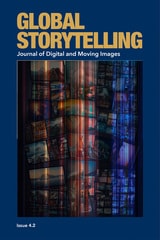
Global Storytelling, vol. 4, no. 2
Netflix and East Asian Audiovisual Culture (Winter 2024)Special Issue Editor: Dal Yong Jin
Michigan Publishing Services, 2024
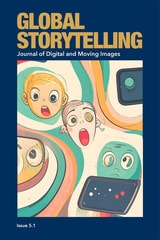
Global Storytelling, vol. 5, no. 1
Digital Narratives in Transnational Circulation: Power, Vulnerability, and Creative PossibilitySpecial Issue Editors: Jun Lei and Shaohua Guo
Michigan Publishing Services, 2025
Global Storytelling: Journal of Digital and Moving Images, housed at the Academy of Film and published by Michigan Publishing, is an open access, peer-reviewed international and interdisciplinary journal for intellectual debates concerning the politics, economics, culture, media, and technology of the moving image.
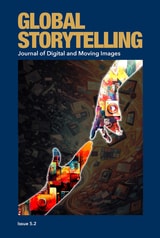
Global Storytelling, vol. 5, no. 2
Visual Storytelling and Entrepreneurship: The Representations of Daily LifeSpecial Issue Editors: Erick Behar-Villegas and Víctor Manuel Jiménez-Rodríguez
Michigan Publishing Services, 2026
Global Storytelling: Journal of Digital and Moving Images, housed at the Academy of Film and published by Michigan Publishing, is an open access, peer-reviewed international and interdisciplinary journal for intellectual debates concerning the politics, economics, culture, media, and technology of the moving image.

Global Trade and Visual Arts in Federal New England
Patricia Johnston
University of New Hampshire Press, 2014
This book will appeal to a broad audience of historians and students of American visual art, as well as scholars and students of fine and decorative arts.
Hardcover is un-jacketed.
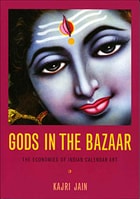
Gods in the Bazaar
The Economies of Indian Calendar ArtKajri Jain
Duke University Press, 2007
Jain draws on interviews with artists, printers, publishers, and consumers as well as analyses of the prints themselves to trace the economies—of art, commerce, religion, and desire—within which calendar images and ideas about them are formulated. For Jain, an analysis of the bazaar, or vernacular commercial arena, is crucial to understanding not only the calendar art that circulates within the bazaar but also India’s postcolonial modernity and the ways that its mass culture has developed in close connection with a religiously inflected nationalism. The bazaar is characterized by the coexistence of seemingly incompatible elements: bourgeois-liberal and neoliberal modernism on the one hand, and vernacular discourses and practices on the other. Jain argues that from the colonial era to the present, capitalist expansion has depended on the maintenance of these multiple coexisting realms: the sacred, the commercial, and the artistic; the official and the vernacular.
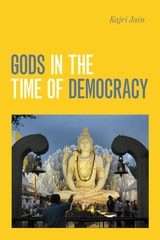
Gods in the Time of Democracy
Kajri Jain
Duke University Press, 2021
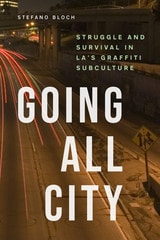
Going All City
Struggle and Survival in LA's Graffiti SubcultureStefano Bloch
University of Chicago Press, 2019
In the age of commissioned wall murals and trendy street art, it’s easy to forget graffiti’s complicated and often violent past in the United States. Though graffiti has become one of the most influential art forms of the twenty-first century, cities across the United States waged a war against it from the late 1970s to the early 2000s, complete with brutal police task forces. Who were the vilified taggers they targeted? Teenagers, usually, from low-income neighborhoods with little to their names except a few spray cans and a desperate need to be seen—to mark their presence on city walls and buildings even as their cities turned a blind eye to them.
Going All City is the mesmerizing and painful story of these young graffiti writers, told by one of their own. Prolific LA writer Stefano Bloch came of age in the late 1990s amid constant violence, poverty, and vulnerability. He recounts vicious interactions with police; debating whether to take friends with gunshot wounds to the hospital; coping with his mother’s heroin addiction; instability and homelessness; and his dread that his stepfather would get out of jail and tip his unstable life into full-blown chaos. But he also recalls moments of peace and exhilaration: marking a fresh tag; the thrill of running with his crew at night; exploring the secret landscape of LA; the dream and success of going all city.
Bloch holds nothing back in this fierce, poignant memoir. Going All City is an unflinching portrait of a deeply maligned subculture and an unforgettable account of what writing on city walls means to the most vulnerable people living within them.
Going Public
Creating Visibility in the Field of ArtEdited by Sigrid Adorf, Sønke Gau, and Basil Rogger
Diaphanes, 2022
There are many ways to go public in art. There’s exhibiting, publishing, or reviewing. It is only through making artworks public that they become accessible to audiences—a performative act that also involves a marketplace of money and attention. Yet reception is an essential aspect of production.
This book looks at why such reception should not be limited to the art public, positing that going public as an aesthetic and political strategy necessitates an emancipatory practice of public communication that allows, and aspires to, uncertainties, questions, and complexities.

Governing Visions of the Real
The National Film Unit and Griersonian Documentary Film in Aotearoa/New ZealandLars Weckbecker
Intellect Books, 2015
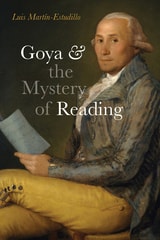
Goya and the Mystery of Reading
Luis Martín-Estudillo
Vanderbilt University Press, 2023
Goya and the Mystery of Reading explores the critical impact this transition had on the work of an artist who aimed not to copy the world around him, but to see it anew—to read it. Goya's creations offer a sustained reflection on the implications of reading, which he depicted as an ambiguous, often mysterious activity: one which could lead to knowledge or ecstasy, to self-fulfillment or self-destruction, to piety or perdition. At the same time, he used reading to elicit new possibilities of interpretation. This book reveals for the first time the historical, intellectual, and artistic underpinnings of reading as one of the pillars of his art.
This book is the recipient of the 2023 Norman L. and Roselea J. Goldberg Prize from Vanderbilt University Press for the best book in the area of art or medicine.
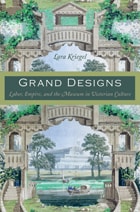
Grand Designs
Labor, Empire, and the Museum in Victorian CultureLara Kriegel
Duke University Press, 2007
Drawing on a wide range of sources, including museum guidebooks, design manuals, illustrated newspapers, pattern books, and government reports, Kriegel brings to life the many Victorians who claimed a stake in aesthetic reform during the middle years of the nineteenth century. The aspiring artists who attended the Government School of Design, the embattled provincial printers who sought a strengthened industrial copyright, the exhibition-going millions who visited the Crystal Palace, the lower-middle-class consumers who learned new principles of taste in metropolitan museums, and the working men of London who critiqued the city’s art and design collections—all are cast by Kriegel as leading cultural actors of their day. Grand Designs shows how these Victorians vied to upend aesthetic hierarchies in an imperial age and, in the process, to refashion London’s public culture.
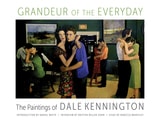
Grandeur of the Everyday
The Paintings of Dale KenningtonDale Kennington, Introduction by Daniel White, Conversation with Kristen Miller Zohn, Essay by Rebecca Brantley
University of Alabama Press, 2017
Grandeur of the Everyday is the first full-length volume dedicated to the life and work of Dale Kennington—an accomplished master of contemporary American realism. Kennington’s works often hold a strange familiarity, even for those coming to her work for the first time. Her paintings are at once familiar and yet defy specificity of place, clear and lucid while also dense in content. These effects derive from her unique ability to capture the essence of everyday living, the ordinary “in between” moments we often overlook in our day-to-day habits and transactions.
Kennington referred to her paintings as “merged memories.” Combining elements of photography, memory, and imagination, Kennington’s art is an entrancing blend of contemporary and magical realism, with themes ranging from loneliness to community and culture, from class and race relations to the juxtaposition of private and public life. Rather than study the spectacular, she concentrated on commonplace moments of human interaction, inviting observers of her paintings to ponder their significance and to complete their implicit narratives. Often relying on local subjects for her paintings—barbershops, bars, restaurants, gospel concerts, motel rooms, nursing homes—she presented a diversity of local experience.
Grandeur of the Everyday is a treasure trove of her most accomplished creations and includes more than eighty-five examples of both Kennington’s easel paintings on canvas and her freestanding wooden folding screens. The volume also offers an original interview with the artist conducted by Kristen Miller Zohn, an introduction by art historian Daniel White, and a critical essay by the director of the Wiregrass Museum of Art, Rebecca Brantley.
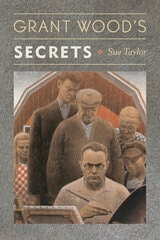
Grant Wood’s Secrets
Sue Taylor
University of Delaware Press, 2011
Published by University of Delaware Press. Distributed worldwide by Rutgers University Press.
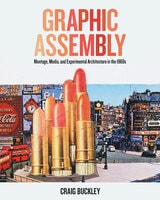
Graphic Assembly
Montage, Media, and Experimental Architecture in the 1960sCraig Buckley
University of Minnesota Press, 2018
An innovative look at the contribution of montage to twentieth-century architecture—now in paperback
Graphic Assembly unearths the role played by montage and collage in the development of architectural culture over the past century, revealing their unexamined yet crucial significance. Craig Buckley brings together experimental architectural practices based in London, Paris, Vienna, and Florence, showing how breakthroughs in optical media and printing technologies enabled avant-garde architects to reimagine their field.
Graphic Assembly considers a range of architects and movements from the 1950s through the early ’70s, including Theo Crosby, Hans Hollein, and John McHale; the magazine Clip-Kit; and the groups Archigram, Superstudio, and Utopie. It gives a thorough account of how montage concepts informed the design of buildings, prototypes, models, exhibitions, and multimedia environments, accompanied by Buckley’s insightful interpretations of the iconic images, exhibitions, and buildings of the 1960s that mark how the decade is remembered.
Richly illustrated with never-before-published material from more than a dozen archives and private collections, Graphic Assembly offers a comparative overview of the network of experimental architectural practice in Europe. It provides a deep historical account of the cut-and-paste techniques now prevalent with architecture’s digital turn, demonstrating the great importance of montage to architecture past, present, and future.
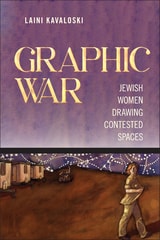
Graphic War
Jewish Women Drawing Contested SpacesLaini Kavaloski
Rutgers University Press, 2026
Greek Gods in the East
Hellenistic Iconographic Schemes in Central AsiaLadislav Stanco
Karolinum Press, 2012
Greek Inscriptions
Ancient ScriptsPeter Liddel
J. Paul Getty Trust, The, 2025
Ancient Greek inscriptions are crucially important in understanding the cultures of Greece and the Mediterranean in antiquity. They provide glimpses of the behavior of the people of the time, including clues about their mindsets and aspirations. These public records combine word and image in a multitude of ways and are rich in the insights they offer.
The inscriptions examined in this volume come from a range of objects on metal or stone that include laws, decrees, accounts and inventories, honorific texts, dedications to deities, and funerary epitaphs. They give a broad view of interstate relations, historical narratives, and the political administration of various city-states while also providing new perspectives on concepts such as democracy, citizenship, gender, ethnicity, religion, and the supernatural. Peter Liddel emphasizes the physical form of the texts alongside their importance in understanding ancient Greek culture. Accessible and insightful, Greek Inscriptions both highlights the significance and history of these artifacts and examines their reception in the modern world.
Greek Prostitutes in the Ancient Mediterranean, 800 BCE–200 CE
Allison Glazebrook
University of Wisconsin Press, 2011
Greek Prostitutes in the Ancient Mediterranean, 800 BCE–200 CE challenges the often-romanticized view of the prostitute as an urbane and liberated courtesan by examining the social and economic realities of the sex industry in Greco-Roman culture. Departing from the conventional focus on elite society, these essays consider the Greek prostitute as displaced foreigner, slave, and member of an urban underclass.
The contributors draw on a wide range of material and textual evidence to discuss portrayals of prostitutes on painted vases and in the literary tradition, their roles at symposia (Greek drinking parties), and their place in the everyday life of the polis. Reassessing many assumptions about the people who provided and purchased sexual services, this volume yields a new look at gender, sexuality, urbanism, and economy in the ancient Mediterranean world.

Greenwich Village 1963
Avant-Garde Performance and the Effervescent BodySally Banes
Duke University Press, 1993
A leading writer on cultural history, Banes draws a vibrant portrait of the artists and performers who gave the 1963 Village its exhilarating force, the avant-garde whose interweaving of public and private life, work and play, art and ordinary experience, began a wholesale reworking of the social and cultural fabric of America. Among these young artists were many who went on to become acknowledged masters in their fields, including Andy Warhol, John Cage, Yoko Ono, Yvonne Rainer, Lanford Wilson, Sam Shepard, Brian de Palma, Harvey Keitel, Kate Millet, and Claes Oldenburg. In live performance--Off-Off Broadway theater, Happenings, Fluxus, and dance--as well as in Pop Art and underground film, we see this generation of artists laying the groundwork for the explosion of the counterculture in the late 1960s and the emergence of postmodernism in the 1970s. Exploring themes of community, freedom, equality, the body, and the absolute, Banes shows us how the Sixties artists, though shaped by a culture of hope and optimism, helped to galvanize a culture of criticism and change. As 1963 came to define the Sixties, so this vivid account of the year will redefine a crucial generation in recent American history.

Gregg Bordowitz
I Wanna Be WellEdited by Robyn Farrell and Solveig Nelson
University of Chicago Press, 0
The first monograph to trace artist and activist Gregg Bordowitz’s visual practice.
For over four decades, Gregg Bordowitz has been a force in contemporary art, recognized for his work as an AIDS activist and an artist working in video, conceptual art, and institutional critique. During the 1980s, Bordowitz made vital contributions in the early years of ACT UP (AIDS Coalition to Unleash Power) in New York, where he cofounded video collectives including Testing the Limits and DIVA (Damn Interfering Video Activists). His collaborative activist work formed the foundation of his art practice—a sprawling, diverse, and deeply human endeavor that has explored his gay and Jewish identities within the context of the ongoing AIDS crisis.
Despite his expansive artistic production, activism, and influence, there has yet to be a full monographic exploration of Bordowitz’s work. This landmark volume serves as the first publication dedicated exclusively to his visual work, offering a comprehensive portrait of an artist in constant motion. I Wanna Be Well—named after the 1977 Ramones song—traces the emergence of his visual art practice. Developed in close collaboration with Bordowitz and a team of art historians, curators, scholars, poets, and artists who have worked with him over the years, this book reveals Bordowitz’s practice as an evolving investigation of how to live, teach, and make art through sustained acts of care, critique, and remembrance. Lavishly illustrated with color throughout, the essays, interviews, poetry, and other writings gathered here present a rich look at Bordowitz’s life and career.
Grime, Glitter, and Glass
The Body and the Sonic in Contemporary Black ArtNikki A. Greene
Duke University Press, 2024

Ground Truth
Art History and the Invention of Computer VisionElizabeth C. Mansfield
University of Minnesota Press, 2027
An in-depth examination of how computer vision in AI is indebted to artistic ideals from the Enlightenment
When Dutch megabank ING launched a 2016 advertising campaign spearheaded by an AI-generated “next Rembrandt,” it demonstrated just how deeply Western assumptions about the history of art had infiltrated fledgling artificial intelligence technologies. Working backward from this computer-generated Old Master painting, Elizabeth C. Mansfield traces the history of computer vision (the branch of AI research concerned with visual perception, recognition, and design) back to Enlightenment fantasies of intelligent machines and artistic automata.
Through her inquiry in eighteenth-century European fascination with art-making machines, Mansfield connects centuries-old automata to contemporary AI systems like DALL-E and Midjourney, showing how the history of art abides as a ghost in the machine of computer vision. She documents the artistic ambitions, aesthetic experiments, commercial pressures, and crises of authenticity that occur during the development of a technology designed to emulate aspects of human visual perception.
An innovative art historical response to computer vision, Ground Truth offers important new directions for a renewed engagement with art’s humanist and digital generation history. At a time when the humanist enterprise is being questioned, Mansfield makes the different worlds of art history and computer vision mutually intelligible in this compelling account of both.
Retail e-book files for this title are screen-reader friendly with images accompanied by short alt text and/or extended descriptions.
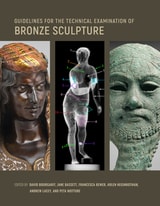
Guidelines for the Technical Examination of Bronze Sculpture
David Bourgarit
J. Paul Getty Trust, The, 2023
Since the fourth millennium BCE, bronze has been the preferred medium for some of the most prestigious and sacred works of art. But only through interdisciplinary research can the fabrication of these extraordinary objects be properly investigated, interpreted, and documented. This innovative publication bridges the expertise of myriad art-technological specialists to create a new framework for advancing the understanding of bronze sculpture.
Essential reading for curators, conservators, scientists, archaeologists, sculptors, metallurgists, founders, dealers, collectors, and anyone interested in the life cycle of a bronze, this volume explains how to identify the evidence of process steps, metals used, casting defects, and surface work and alterations before moving on to address analytical techniques ranging from visual exams to imaging, material analyses, and dating. The guidelines are accompanied by detailed illustrations, including videos, charts, and animations; a robust vocabulary, ensuring precision across English, German, French, Italian, and Chinese; a diverse selection of case studies; and a comprehensive bibliography.
The free online edition of this open-access publication is available at getty.edu/publications/bronze-guidelines/ and includes videos and zoomable illustrations. Also available are free PDF and EPUB downloads of the book.

Gustave Caillebotte and the Fashioning of Identity in Impressionist Paris
Edited by Norma Broude
Rutgers University Press, 2002
The essays that comprise this volume exemplify the best aspects of recent Caillebotte scholarship. They employ a variety of perspectives to examine the ways in which his art sheds light on the formation of individual and class identities in Paris during the early years of the Third Republic—an era of transition marked by the burgeoning of capitalism and the instabilities of newly shifting gender roles in the modern world.
Addressing a wide range of major paintings by Caillebotte, the contributors reveal the compound ways in which the artist encoded his images and the multiple interpretations to which these images are susceptible. Juxtaposed so as to complement and challenge one another, these essays build a provocative whole as they probe issues of spectatorship and authorial intention. The contributors—all internationally known scholars and art professionals—create an important theoretical framework for the discussion of Caillebotte’s work.
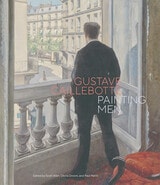
Gustave Caillebotte
Painting MenScott Allan
J. Paul Getty Trust, The, 2024
More than any other French Impressionist, painter Gustave Caillebotte (1848–1894) observed and depicted the many men in his life, including his brothers and friends, employees, and the workers and bourgeois in his Parisian neighborhood. Male subjects feature prominently in some of his best-known works, such as The Floor Scrapers, Man at His Bath, Young Man at His Window, Boating Party, and Paris Street, Rainy Day. The originality of his paintings of men is fully explored for the first time in this catalogue, published to accompany a major international exhibition co-organized by the J. Paul Getty Museum, Musée d’Orsay, and the Art Institute of Chicago.
Alongside paintings, drawings, and photographs, as well as an appendix featuring maps and new biographical research that sheds light on Caillebotte’s social network, this volume includes historically grounded thematic essays by curators and leading scholars. By exploring the complex and varied facets of Caillebotte’s identity—as son, brother, soldier, bachelor, amateur, sportsman, and so on—these essays pose questions of identity, leaving space for ambiguous and fluid expressions of gender and masculinity—for both Caillebotte and the larger late nineteenth-century French world.
This volume is published to accompany an exhibition on view at the Musée d’Orsay from October 8, 2024, to January 19, 2025, J. Paul Getty Museum at the Getty Center from March 25 to May 25, 2025, and The Art Institute of Chicago from June 29 to October 5, 2025.
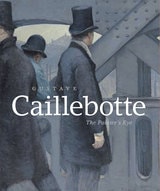
Gustave Caillebotte
The Painter's EyeMary Morton and George Shackelford
University of Chicago Press, 2015
The book features fifty of Caillebotte’s strongest paintings, including post-conservation images of Paris Street; Rainy Day, along with The Floorscrapers and Pont de l’Europe, all of which date from a particularly fertile period between 1875 and 1882. The artist was criticized at the time for being too realistic and not impressionistic enough, but he was a pioneer in adopting the angled perspective of a modern camera to compose his scenes. Caillebotte’s skill and originality are evident even in the book’s reproductions, and the essays offer critical insights into his inspiration and subjects.
This sumptuously illustrated publication makes clear why Caillebotte is among the most intriguing artists of nineteenth-century France, and it deepens our understanding of the history of impressionism.
Gutai
Decentering ModernismMing Tiampo
University of Chicago Press, 2011
Gutai is the first book in English to examine Japan’s best-known modern art movement, a circle of postwar artists whose avant-garde paintings, performances, and installations foreshadowed many key developments in American and European experimental art.
Working with previously unpublished photographs and archival resources, Ming Tiampo considers Gutai’s pioneering transnational practice, spurred on by mid-century developments in mass media and travel that made the movement’s field of reception and influence global in scope. Using these lines of transmission to claim a place for Gutai among modernist art practices while tracing the impact of Japan on art in Europe and America, Tiampo demonstrates the fundamental transnationality of modernism. Ultimately, Tiampo offers a new conceptual model for writing a global history of art, making Gutai an important and original contribution to modern art history.