Results by title
2817 books match the query 'Nature' and 87 start with g
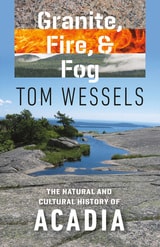
Granite, Fire, and Fog
The Natural and Cultural History of AcadiaTom Wessels
University Press of New England, 2017
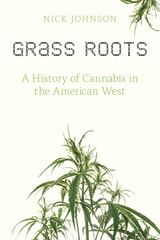
Grass Roots
A History of Cannabis in the American WestNick Johnson
Oregon State University Press, 2017
To understand how we got here and how the legal cannabis industry might become more environmentally sustainable, Grass Roots looks at the history of marijuana growing in the American West, from early Mexican American growers on sugar beet farms to today’s sophisticated greenhouse gardens. Over the past eighty years, federal marijuana prohibition has had a multitude of consequences, but one of the most important is also one of the most overlooked—environmental degradation. Grass Roots argues that the most environmentally negligent farming practices—such as indoor growing—were borne out of prohibition. Now those same practices are continuing under legalization.
Grass Roots uses the history of cannabis as a crop to make sense of its regulation in the present, highlighting current efforts to make the marijuana industry more sustainable. In exploring the agricultural history of cannabis, There are many social and political histories of cannabis, but in considering cannabis as a plant rather than as a drug, Grass Roots offers the only agriculturally focused history to date.
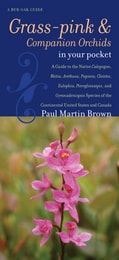
Grass-pinks and Companion Orchids in Your Pocket
A Guide to the Native Calopogon, Bletia, Arethusa, Pogonia, Cleistes, Eulophia, Pteroglossaspis, andPaul Martin Brown
University of Iowa Press, 2008
Brown provides general distributional information, time of flowering, and habitat requirements for each species as well as a complete list of hybrids and the many different growth and color forms that can make identifying orchids so intriguing. For the grass-pinks and companions he includes information on 16 species, 2 additional varieties, and 7 hybrids.
Grass-pinks, with their showy pink to white flowers, are some of the most conspicuous wild orchids encountered in the prairies, bogs, and open wetlands of eastern North America. Most of these species are easy to identify based upon their general appearance, range, and time of flowering. Answering three simple questions—when, where, and how does it grow?—and comparing the living plant with the striking photos in the backpack-friendly laminated guide should enable both professional and amateur naturalists to achieve the satisfaction of identifying a specific orchid.
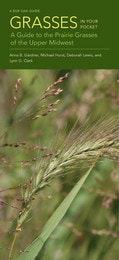
Grasses in Your Pocket
A Guide to the Prairie Grasses of the Upper MidwestAnna B. Gardner, Michael Hurst, Deborah Lewis, and Lynn G. Clark
University of Iowa Press, 2014
The authors have organized species into groups by their most easily noted field characteristics. Are the flowering heads branched or unbranched? Are the branches dense, narrow, or fingerlike? For each species, its native or exotic status is followed by the months of flowering, abundance, general habitat, height, diagnostic features, geographic range, and, if relevant, threatened or endangered status.
Even amateur naturalists can identify big and little bluestem and prairie dropseed in the field, but both professional and amateur naturalists find certain grasses harder to identify, especially the less common or rare species such as cluster fescue and sand reedgrass. The photographs and descriptions in Grasses in Your Pocket will be an invaluable reference for outdoor expeditions in midwestern grasslands.
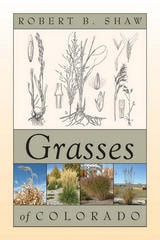
Grasses of Colorado
Robert B. Shaw
University Press of Colorado, 2008
Colorado's elevation range of more than 11,000 feet creates a wide variety of habitats that supports a spectacular diversity of grasses. With 335 known species, Colorado has one of the most diverse and extensive grass floras in the United States.
Comprehensive coverage, useful keys, and detailed species descriptions in Grasses of Colorado will make this volume the standard reference for years to come. Robert B. Shaw provides overviews of Colorado's physiography and ecoregions and introduces the grass plant in plain, enjoyable text. He includes a checklist of Colorado grasses, a bibliography, and a glossary of terms that may be unfamiliar to nonspecialists. Line drawings, state distribution maps, and habitat notes for each species enable accurate plant identification, familiarity with regional ecogeography, and increased understanding of plant ecology of the Rocky Mountains.
A monumental accomplishment certain to become the standard work on the subject, Grasses of Colorado synthesizes existing literature and incorporates recent scientific findings to offer a complete, current reference.
Grasses
Bromus to Paspalum, Second EditionRobert H. Mohlenbrock
Southern Illinois University Press, 2002
Since the publication of the first edition of Grasses: Bromus to Paspalumin 1972, twenty-two additional taxa of grasses have been discovered in Illinois that are properly placed in this volume. In addition, numerous nomenclatural changes have occurred for plants previously discovered, and many distributional records have been added. New keys have been prepared for each genus where additional species from Illinois are known. For new species, full-page illustrations are provided. This second edition updates the status of Illinois grasses. The book features 263 figures from the first edition plus 21 new figures for this edition by Paul W. Nelson.
Genera of grasses included in this work are Aegilops, Agropyron, Agrostis, Aira, Alopecurus, Anthoxanthum, Avena, Beckmannia, Briza, Bromus, Calamagrostis, Cinna, Dactylis, Deschampsia, Elyhordeum, Elymus, Elytrigia, Festuca, Hierochloe, Holcus, Hordeum, Koeleria, Lolium, Milium, Paspalum, Pennisetum, Phalaris, Phleum, Poa, Puccinellia, Sclerochloa, Secale, Sphenopholis, Torreyochloa, Triticum, and Vulpia.
Grasses
Panicum to Danthonia, Second EditionRobert H. Mohlenbrock
Southern Illinois University Press, 2001
Since the publication of the first edition of Grasses: Panicum to Danthonia in 1973, twenty additional taxa of grasses have been discovered in Illinois that are properly placed in this volume. In addition, numerous nomenclatural changes have occurred for plants already known from the state, and many distributional records have been added. This second edition updates the status of grasses in Illinois. Paul W. Nelson has provided illustrations for all of the additions.
Because the nature of grass structures is generally so different from that of other flowering plants, a special terminology is applied to them. In his introduction, Robert H. Mohlenbrock cites these terms, with descriptions that make the identification of unknown specimens possible. Mohlenbrock’s division of the grass family into subfamilies and tribes is a major departure from the sequence usually found in most floristic works in North America.
Synonyms that have been applied to species in the northeastern United States are given under each species. A description based primarily on Illinois material covers the more important features of the species. The common names—Paflic Grass, Billion Dollar Grass or Japanese Millett, Thread Love Grass, and Goose Grass—are the ones used locally in the state. The habitat designation and dot maps showing county distribution of each grass are provided only for grasses in Illinois, but the overall range for each species is also given.
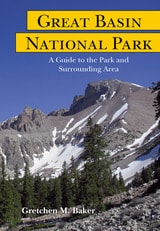
Great Basin National Park
A Guide to the Park and Surrounding AreaGretchen M. Baker
Utah State University Press, 2012
Great Basin National Park is in large part a high-alpine park, but it sits in one of America’s driest, least populated, and most isolated deserts. That contrast is one facet of the diversity that characterizes this region. Within and outside the park are phenomenal landscape features, biotic wonders, unique environments, varied historic sites, and the local colors of isolated towns and ranches. Vast Snake and Spring Valleys, bracketing the national park, are also subjects of one of the West's most divisive environment contests, over what on the surface seems most absent but underground is abundant enough for sprawling Las Vegas to covet it—water.
Great Lake
An Unnatural History of Lake MichiganTheodore J. Karamanski
University of Michigan Press, 2026
Great Lake is a comprehensive survey of the manifold ways Americans, from the first Native American communities to the present age, have abused, nurtured, loved, and neglected this massive freshwater resource. Extending 307 miles from north to south, the lake cuts across climatic, environmental, and physiographic zones, from the prairies of Illinois to the boreal forests of the north. Bordered by large cities like Chicago and Milwaukee as well as smaller Wisconsin resorts and northern Michigan mines and mill towns, the lake touches people in urban centers and countryside. Thus, the history of Lake Michigan combines the history of frontier resource extraction, agricultural abundance, industrialization, and dense urbanization in the American heartland. Great Lake is the story of the ever-escalating and divergent demands Americans have placed on Lake Michigan, how the lake’s ecosystem responded to those changes, and how together they have shaped the modern American Midwest.
Great Lakes Champions
Grassroots Efforts to Clean Up Polluted WatershedsJohn H. Hartig
Michigan State University Press, 2022
Great Lakes Chronicle
Essays on Coastal WisconsinWisconsin Coastal Management
Wisconsin Historical Society Press, 2018

Great Lakes Sea Lamprey
The 70 Year War on a Biological InvaderCory Brant
University of Michigan Press, 2019
Threatening the complete collapse of the fishery, the sea lamprey invasion triggered an environmental awakening in the region and prompted an international treaty that secured unprecedented cooperation across political boundaries to protect the Great Lakes. Fueled by a pioneering scientific spirit, the war on Great Lakes sea lampreys led to discoveries that are the backbone of the program that eventually brought the creature under control and still protects the largest freshwater ecosystem in the world to this day.
Great Lakes Sea Lamprey draws on extensive interviews with individuals who experienced the invasion firsthand as well as a trove of unexplored archival materials to tell the incredible story of sea lamprey in the Great Lakes—what started the invasion, how it was halted, and what this history can teach us about the response to biological invaders in the present and future. Richly illustrated with color and black & white photographs, the book will interest readers concerned with the health of the Great Lakes, the history of the conservation movement, and the ongoing threat of invasive species.
Great Plains
America's Lingering WildMichael Forsberg
University of Chicago Press, 2009
The Great Plains were once among the greatest grasslands on the planet. But as the United States and Canada grew westward, the Plains were plowed up, fenced in, overgrazed, and otherwise degraded. Today, this fragmented landscape is the most endangered and least protected ecosystem in North America. But all is not lost on the prairie. Through lyrical photographs, essays, historical images, and maps, this beautifully illustrated book gets beneath the surface of the Plains, revealing the lingering wild that still survives and whose diverse natural communities, native creatures, migratory traditions, and natural systems together create one vast and extraordinary whole.
Three broad geographic regions in Great Plains are covered in detail, evoked in the unforgettable and often haunting images taken by Michael Forsberg. Between the fall of 2005 and the winter of 2008, Forsberg traveled roughly 100,000 miles across 12 states and three provinces, from southern Canada to northern Mexico, to complete the photographic fieldwork for this project, underwritten by The Nature Conservancy. Complementing Forsberg’s images and firsthand accounts are essays by Great Plains scholar David Wishart and acclaimed writer Dan O’Brien. Each section of the book begins with a thorough overview by Wishart, while O’Brien—a wildlife biologist and rancher as well as a writer—uses his powerful literary voice to put the Great Plains into a human context, connecting their natural history with man’s uses and abuses.
The Great Plains are a dynamic but often forgotten landscape—overlooked, undervalued, misunderstood, and in desperate need of conservation. This book helps lead the way forward, informing and inspiring readers to recognize the wild spirit and splendor of this irreplaceable part of the planet.
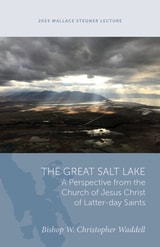
Great Salt Lake
A Perspective from the Church of Jesus Christ of Latter-day SaintsBishop W. Christopher Waddell
University of Utah Press, 2024

Green Afternoons
Oregon Gardens to VisitAmy Houchen
Oregon State University Press, 1998
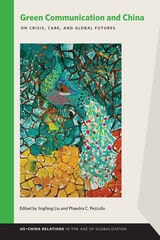
Green Communication and China
On Crisis, Care, and Global FuturesJingfang Liu
Michigan State University Press, 2020
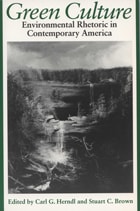
Green Culture
Environmental Rhetoric In Contemporary AmericaCarl Herndl
University of Wisconsin Press, 1996
Listen to politicians, social scientists, naturalists, and economists talk about the environment, and a problem becomes clear: dramatic differences on environmental issues are embedded in dramatically different discourses. This book explores these differences and shows how an understanding of rhetoric might lead to their resolution. The authors examine specific environmental debates—over the Great Lakes and Yellowstone, a toxic waste dump in North Carolina and an episode in Red Lodge, Montana. They look at how genres such as nature writing and specific works such as Rachel Carson’s Silent Spring have influenced environmental discourse. And they investigate the impact of cultural traditions, from the landscape painting of the Hudson River School to the rhetoric of the John Birch Society, on our discussions and positions on the environment.
Most of the scholars gathered here are also hikers, canoeists, climbers, or bird watchers, and their work reflects a deep, personal interest in the natural world in connection with the human community. Concerned throughout to make the methods of rhetorical analysis perfectly clear, they offer readers a rare chance to see what, precisely, we are talking about when we talk about the environment.

Green Documentary
Environmental Documentary in the 21st CenturyHelen Hughes
Intellect Books, 2014
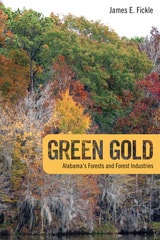
Green Gold
Alabama's Forests and Forest IndustriesJames E. Fickle
University of Alabama Press, 2014
Green Gold is a thorough and valuable compilation of information on Alabama’s timber and forest products industry, the largest manufacturing industry in the state.
Alabama has the third-largest commercial forest in the nation, after only Georgia and Oregon. Fully two-thirds of the state’s land supports the growth of over fifteen billion trees on twenty-two million acres, which explains why Alabama looks entirely green from space. Green Gold presents the story of human use of and impact on Alabama’s forests from pioneer days to the present, as James E. Fickle chronicles the history of the industry from unbridled greed and exploitation through virtual abandonment to revival, restoration, and enlightened stewardship.
As the state’s largest manufacturing industry, forest products have traditionally included naval stores such as tar, pitch, and turpentine, especially in the southern longleaf stands; sawmill lumber, both hardwood and pine; and pulp and paper milling. Green Gold documents all aspects of the industry, including the advent of “scientific forestry” and the development of reforestation practices with sustained yields. Also addressed are the historical impacts of Native Americans and of early settlers who used axes, saws, and water- and steam-powered sawmills to clear and utilize forests. Along with an account of railroad logging and the big mills of the lumber bonanza days of the late nineteenth and early twentieth centuries, the book also chronicles the arrival of professional foresters to the state, who began to deal with the devastating legacy of “cut out and get out” logging and to fight the perennial curse of woods arson. Finally, Green Gold examines the rise of the tree farm movement, the rebirth of large-scale lumbering, the advent of modern environmental concerns, and the movement toward the “Fourth Forest” in Alabama.
A Copublication with the Alabama Forestry Foundation
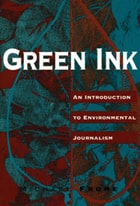
Green Ink
Michael Frome
University of Utah Press, 1998
Michael Frome, who began his distinguished career in environmental journalism in the 1960s, has been called the dean of American conservation. As former Senator Gaylord Nelson once told the members of Congress, "No writer in America has more persistently and effectively argued for the need of a national ethics of environmental stewardship."
In Green Ink: An Introduction to Environmental Journalism, Frome has forged decades of experience in the field he helped pioneer into a valuable primer for environmental advocates and writers. This appealing blend of anecdote, advice, personal testimony, and a nuts and bolts instruction offers a thorough survey of rewards and challenges that environmental studies students might expect to encounter on along their chosen career paths. In addition to the extraordinary contributions made by "marquis" names such as Rachel Carson and Bernard DeVoto, Frome recounts the remarkable stories of a host of other writer-advocates and their largely unsung roles in investigating and publicizing environmental problems and abuses.

Green Nature/Human Nature
THE MEANING OF PLANTS IN OUR LIVESCharles A. Lewis
University of Illinois Press, 1996
Why do gardeners delight in the germination and growth of a seed? Why are our spirits lifted by flowers, our feelings of tension allayed by a walk in a forest or park? What other positive influences can green nature
bring to humanity?
In Green Nature/Human Nature Charles A. Lewis describes the psychological, sociological, and physiological responses of people to vegetation in cities and forests, as well as in horticultural therapy programs in hospitals, geriatric institutions, physical rehabilitation centers, drug rehabilitation programs, and correctional institutions. He presents an evolutionary basis for the human attraction to plants. People-plant interactions are presented from two perspectives: participatory, in which the individual is involved in planting and maintaining the vegetation, and observational, in which the individual bears no responsibility for establishing or maintaining the vegetation.
In what amounts to a straightforward catalog of well-documented and tangible benefits, Lewis brings the latest and best research into plant/human interaction to bear on questions of how green nature is intertwined with the human psyche and how that interaction can lead to enhanced well-being and an appreciation of the human dimension in environmental concerns.
Lewis's work will be essential reading for anyone interested in plants
and how they affect people.
A volume in the series The Environment and the Human Condition
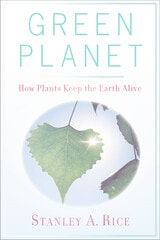
Green Planet
How Plants Keep the Earth AliveRice, Stanley A
Rutgers University Press, 2012
Beginning with an overview of how human civilization has altered the face of the Earth, particularly by the destruction of forests, the book details the startling consequences of these actions. Rice provides compelling reasons for government officials, economic leaders, and the public to support efforts to save threatened and endangered plants. Global campaigns to solve environmental problems with plants, such as the development of green roofs and the Green Belt Movement—a women's organization in Kenya that empowers communities worldwide to protect the environment—show readers that efforts to save wild plants can be successful and beneficial to the economic well-being of nations.
Through current scientific evidence, readers see that plants are vital to the ecological health of our planet and understand what can be done to lead to a better—and greener—future
Benefits of plants:
- Help modulate greenhouse gases
- Produce almost all oxygen in the air
- Create cool shade that reduces energy costs
- Prevent floods, droughts, and soil erosion
- Produce all of the food in the world
- Create and preserve soil
- Create natural habitats
- Heal the landscape after natural and human disasters

Green Travel Guide to Northern Wisconsin
Environmentally and Socially Responsible TravelPat Dillon
University of Wisconsin Press, 2011
Green Travel Guide to Northern Wisconsin showcases the best green restaurants, lodgings, shops, and activities in Wisconsin’s Northland. Learn about exploring the cliffs and caves of the Niagara Escarpment while biking the Door Peninsula. Carpool to the Midwest Renewable Energy Fair in Custer where you can stay at a nearby solar-powered inn. Take an all day eco-geo-history tour of the north woods near Hayward, explore the Chequamegon-Nicolet Forest, kayak the Mississippi River backwaters, and much more.
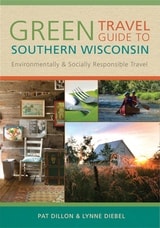
Green Travel Guide to Southern Wisconsin
Environmentally and Socially Responsible TravelPat Dillon
University of Wisconsin Press, 2010
Honorable Mention, Foreword Magazine’s Travel Guidebook of the Year
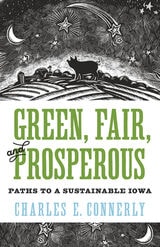
Green, Fair, and Prosperous
Paths to Sustainable IowaCharles Connerly
University of Iowa Press, 2020
At the center of what was once the tallgrass prairie, Iowa has stood out for clearing the land and becoming one of the most productive agricultural states in the nation. But its success is challenged by multiple issues including but not limited to a decline in union representation of meatpacking workers; lack of demographic diversity; the advent of job-replacing mechanization; growing income inequality; negative contributions to and effects of climate change and environmental hazards.
To become green, fair, and prosperous, Connerly argues that Iowa must reckon with its past and the fact that its farm economy continues to pollute waterways, while remaining utterly unprepared for climate change. Iowa must recognize ways in which it can bolster its residents’ standard of living and move away from its demographic tradition of whiteness. For development to be sustainable, society must balance it with environmental protection and social justice. Connerly provides a crucial roadmap for how Iowans can move forward and achieve this balance.
Greening Africana Studies
Linking Environmental Studies with Transforming Black ExperiencesRubin Patterson
Temple University Press, 2014
In his original work, Patterson demonstrates the ways in which black communities are harmed by local environmental degradation and global climate change. He shows that many local unwanted land use sites (LULUs), such as brownfields and toxic release inventory facilities, are disproportionately located in close proximity to neighborhoods of color, but also to colleges and universities with Africana studies programs. Arguing that such communities are not aggressively engaging in environmental issues, Greening Africana Studies also provides examples of how Africana studies students as well as members of black communities can prepare for green careers.
Greening The Lyre
Environmental Poetics And EthicsDavid W. Gilcrest
University of Nevada Press, 2002
This work covers important and neglected ground—environmental language theory. Gilcrest poses two overarching questions: To what extent does contemporary nature poetry represent a recapitulation of familiar poetics? And, to what extent does contemporary nature poetry engage a poetics that stakes out new territory? He addresses these questions with important thinkers, especially Kenneth Burke, and considers such poets as Frost, Kunitz, Heaney, Ammons, Cardenal, and Rich.
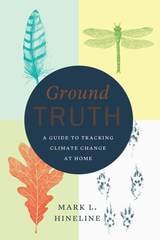
Ground Truth
A Guide to Tracking Climate Change at HomeMark L. Hineline
University of Chicago Press, 2018
We know that the Earth’s climate is changing, and that the magnitude of this change is colossal. At the same time, the world outside is still a natural world, and one we can experience on a granular level every day. Ground Truth is a guide to living in this condition of changing nature, to paying attention instead of turning away, and to gathering facts from which a fuller understanding of the natural world can emerge over time.
Featuring detailed guidance for keeping records of the plants, invertebrates, amphibians, birds, and mammals in your neighborhood, this book also ponders the value of everyday observations, probes the connections between seasons and climate change, and traces the history of phenology—the study and timing of natural events—and the uses to which it can be put. An expansive yet accessible book, Ground Truth invites readers to help lay the groundwork for a better understanding of the nature of change itself.
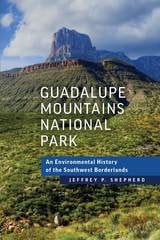
Guadalupe Mountains National Park
An Environmental History of the Southwest BorderlandsJeffrey P. Shepherd
University of Massachusetts Press, 2019
Drawing upon published sources, oral histories, and previously unused archival documents, Jeffrey P. Shepherd situates the Guadalupe Mountains and the national park in the context of epic tales of Spanish exploration, westward expansion, Native survival, immigrant settlement, the conservation movement, early tourism, and regional economic development. As Americans cope with climate change, polarized political rhetoric, and suburban sprawl, public spaces such as Guadalupe Mountains National Park remind us about our ties to nature and our historical relationships with the environment.

Guide To The Trees Of Utah
Michael Kuhns
Utah State University Press, 1998
For any tree enthusiast, be it homeowner, landscaper, recreationist, traveler, or student, who has needed a comprehensive, user-friendly guide to the trees of Utah and the Intermountain West, this new guide is the answer.
Tree specialist Michael Kuhns, through extensive research, has compiled a comprehensive list of virtually every native and introduced tree species from the eastern slope of the Rockies westward to the Sierra Nevada, and from north-central Oregon, the Salmon River region, and Yellowstone southward to the Grand Canyon and northern New Mexico. Included in the guide are simple and easy-to-use identification and classification keys, which are accompanied by hundreds of illustrations that introduce basic information on tree anatomy, climate/hardiness zones, and the individual species.
Accessible and informative, this book is a welcome addition to the library of any reader wanting basic information on the vast inventory of trees in this region.
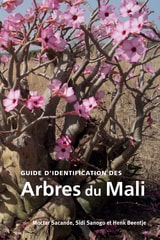
Guide d'identification des Arbres du Mali
Moctar Sacande, Sidi Sanogo, and Henk Beentje
Royal Botanic Gardens, Kew, 2016
(For English description see below) Le Guide d’identification des Arbres du Mali est la synthèse de plus de dix années de collecte de spécimens végétaux (graines et herbiers) et d’informations sur la flore locale dans le cadre des activités de conservation des ressources phytogénétiques au Mali, en collaboration avec le Royal Botanic Gardens Kew. Produit unique et dérivé du partenariat Millennium Seed Bank (MSB), le programme a aussi été mis à profit pour combler un manque d’institution nationale et de documentation, particulières a la flore du Mali. L’Unité de Semences Forestières et Herbier (USF-H) du Mali contient aujourd’hui environ 10,000 spécimens de près de 1,000 espèces de la flore nationale. Ce guide de terrain fournit de précieuses informations locales et un effort particulier a été déployé pour faciliter la reconnaissance de ces 300 espèces ligneuses à travers les descriptions botaniques, les noms locaux, les cartes de répartition géographique et les fascinantes photographies comme aide visuelle à leur identification. Les informations sur les graines aident à la régénération, la propagation, la domestication et les plantations pour une utilisation durable de ces espèces locales utiles.
Text in French.
Description in English:
Guide d’identification des arbres du Mali is the result of over ten years research in collaboration with Kew’s Millennium Seed Bank Project. Over 300 woody plant species are described in the book, with accompanying keys, colour photographs, distribution maps and local names and uses. This book is an essential reference for anyone required to know and recognize the woody flora of the forests of Mali, including forestry technicians, agriculturists, conservation workers, farmers, botanists, teachers and students.
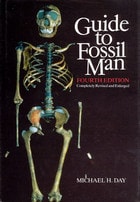
Guide to Fossil Man
Michael H. Day
University of Chicago Press, 1986
Day begins with an introduction to the anatomy of human fossils. He then describes the forty-nine sites in Europe, the Near East, Africa, the Middle East, Asia, and Oceania that have yielded the most significant information on the development of hominid species and the appearance of early man. Grouped geographically, each site description includes data on the hominid remains, other finds such as tools and animal bones, the local geology and contemporary geomorphology and ecology, and dating and other references. Sites featured for the first time in this edition include Kow Swamp and Mungo in Australia; Dali and Maba in China; and West Turkana in Kenya, which contained the almost complete skeleton of a boy determined to be 1,600,000 years old.
Short essays on problems associated with neandertal, australpithecine, and Homo erectus remains are included, as well as a glossary, a geological time scale, charts and comprehensive illustrations. Day's Guide to Fossil Man is invaluable not only for working palaeontologists, palaeolithic archaeologists, and physical anthropologists, but also for anyone interested in human evolution.

Guide to Sustainable Development and Environmental Policy
Natalia Mirovitskaya and William L. Ascher, eds.
Duke University Press, 2001
The guide combines formal, objective entries with critical commentaries that emphasize different opinions and controversies. With succinct explanations of more than a thousand terms, thoughtful interpretations by international experts, and helpful cross-referencing, this resource is designed to serve as a roadmap for understanding the issues and debates in the overlapping fields of environment and development. Intended for use by activists, journalists, policymakers, students, scholars, and interested citizens, the Guide to Sustainable Development and Environmental Policy will be a helpful tool for anyone trying to get a comprehensive look at the many environmental organizations, schools of thought, development programs, international environmental treaties, conventions, and strategies that have proliferated in the past few decades.

Guide to the Flowers of Western China
Christopher Grey-Wilson and Phillip Cribb
Royal Botanic Gardens, Kew, 2023
Since the publication of the first edition of Guide to the Flowers of Western China in 2011, there have been great strides in knowledge of the flora of China through international collaboration. Many plants included in the first edition have been revisited in the wild, while areas hitherto inaccessible have opened up, if sometimes only temporarily. Great advances in systematic botany have occurred since the publication of the first edition, particularly with the widespread availability of rapid DNA analysis. The result of this has been an influx of new photographs and data, and the need for a second edition of Guide to the Flowers of Western China.
Guide to the Liverworts of North Carolina
Marie L. Hicks
Duke University Press, 1992
North Carolina’s varied physiography creates a diversity of flora, ranging from boreal plants in the mountains to subtropical plants in the coastal plain. Collections of hepatics in North Carolina have been sporadic over the years, and knowledge of their distribution within the state has accumulated gradually. Guide to the Liverworts of North Carolina builds on earlier field studies, including those of Hugo L. Blomquist and R. M. Schuster, to provide keys and illustrations to aid identification. This important, comprehensive field guide will also be useful in states adjoining North Carolina and is designed for students, botanists, and all those interested in identifying local liverworts.
Gunflint Falling
Blowdown in the Boundary WatersCary J. Griffith
University of Minnesota Press, 2023
Stories from survivors of the Boundary Waters Canoe Area Wilderness’s epochal weather disaster
On July 4, 1999, in the Boundary Waters Canoe Area Wilderness (BWCAW), a bizarre confluence of meteorological events resulted in the most damaging blowdown in the region’s history. Originating over the Dakotas, the midsummer windstorm developed amid unusually high heat and water-saturated forests and moved steadily east, bearing down on Fargo, North Dakota, and damaging land as it crossed the Minnesota border. Gunflint Falling tells the story of this devastating storm from the perspectives of those who were on the ground before, during, and after the catastrophic event—from first-time visitors to the north woods to returning paddlers to Forest Service Rangers.
The pre-dawn forecasts from the National Weather Service in Duluth for that Sunday of the holiday weekend predicted the day would be “warm and humid. Partly sunny with a thirty percent chance of thunderstorms.” But as the afternoon and evening settled over the Boundary Waters, the first eyewitness accounts began to tell a dramatic and terrifying story. Five friends camping on Lake Polly watched in wonder as the sky turned green and the winds began to whip. They scrambled to pull canoes on shore and secure tarps when a tree snapped and struck one of them in the head, rendering her unconscious. Three women enjoying their last day of a camping trip near the end of the Gunflint Trail took shelter in their tent as winds increased. Water drenched the nylon walls as trees crashed around them, one flattening the tent and pinning a woman beneath its weight. A family vacationing at their cabin dodged falling trees and strained against straight-line winds as they sprinted from the cabin to the safest place they knew: a crawl space underneath it. They watched in awe as trees snapped and toppled, their twisted root balls torn out of the water-logged earth—as they prayed their cabin would hold.
By the time the storm began to subside, falling trees had injured approximately sixty people, and most needed to be medevacked to safety. Amazingly, no one died. The historic storm laid down timber that would later blaze in the Ham Lake fire of 2007, ultimately reshaping the region’s forests in ways we have yet to fully understand.

Gunflint
Reflections on the TrailJustine Kerfoot
University of Minnesota Press, 1991
“The best way to get to know Justine Kerfoot would be to explore a northern forest with her. The next best way to know ‘Just’ is on these pages. Here Justine is at her best, sharing with us her romantic and colorful, and sometimes a tad dangerous, life.” —Les Blacklock
Step off the Gunflint Trail, stride to a high point, and savor the view. Only the dark, cool waters and the rugged granite shores interrupt the panorama of the sweeping forest. In this engaging memoir, local pioneer Justine Kerfoot chronicled a year’s worth of experiences and insights while living on the legendary Gunflint Trail. The unique month-by-month chapters of Gunflint and Kerfoot’s rich memories provide a year-round view of a wilderness life that most of us glimpse only in all-too-short weekend interludes.
Justine Kerfoot (1906–2001) lived on Minnesota’s remote Gunflint Trail for more than six decades. She wrote of her adventures and travel in a weekly column for the Cook County News-Herald for forty-five years and is the author of Woman of the Boundary Waters (Minnesota, 1994).