Results by title
4917 books match the query 'Philosophy' and 86 start with g
Given Time II
Jacques Derrida
University of Chicago Press, 2026
The long-awaited conclusion to Derrida’s seminar on the gift and time.
In 1991, Jacques Derrida published the first half of a seminar delivered from 1978 to 1979 on gifts and time, but the second installment (though expected) was not completed in his lifetime. Given Time II completes the seminar with eight sessions that showcase Derrida’s most advanced work on the problematic of the gift in Heidegger, with deep dives into some of the most difficult texts in the Heideggerian corpus, including “The Origin of the Work of Art,” “The Thing,” and “On Time and Being.”
Beyond Heidegger, Derrida engages Claude Lévi-Strauss, Marcel Mauss, Maurice Blanchot, Jacques Lacan, and others on the act of giving and receiving, the sacrificial gift, and more. Throughout, Derrida identifies a paradox of gift giving: for the gift to be received as a gift, it must not appear as such, since gifts often involve a cycle of debt and repayment. Given Time II is a uniquely Derridean treatment of an important subject in the work of Heidegger and beyond.
Given Time
I. Counterfeit MoneyJacques Derrida
University of Chicago Press, 1992
Derrida reads the relation of time to gift through a number of texts: Heidegger's Time and Being, Mauss's The Gift, as well as essays by Benveniste and Levi-Strauss that assume Mauss's legacy. It is, however, a short tale by Baudelaire, "Counterfeit Money," that guides Derrida's analyses throughout. At stake in his reading of the tale, to which the second half of this book is devoted, are the conditions of gift and forgiveness as essentially bound up with the movement of dissemination, a concept that Derrida has been working out for many years.
For both readers of Baudelaire and students of literary theory, this work will prove indispensable.
Given Time
I. Counterfeit MoneyJacques Derrida
University of Chicago Press, 1992
Derrida reads the relation of time to gift through a number of texts: Heidegger's Time and Being, Mauss's The Gift, as well as essays by Benveniste and Levi-Strauss that assume Mauss's legacy. It is, however, a short tale by Baudelaire, "Counterfeit Money," that guides Derrida's analyses throughout. At stake in his reading of the tale, to which the second half of this book is devoted, are the conditions of gift and forgiveness as essentially bound up with the movement of dissemination, a concept that Derrida has been working out for many years.
For both readers of Baudelaire and students of literary theory, this work will prove indispensable.
Given World and Time
Temporalities in ContextTyrus Miller
Central European University Press, 2008
Giving Life, Giving Death
Psychoanalysis, Anthropology, PhilosophyLucien Scubla
Michigan State University Press, 2016
Glancing Visions
Surface and Depth in Nineteenth-Century American LiteratureZachary Tavlin
University of Alabama Press, 2023
How the “glance” rather than the “gaze” in nineteenth-century literature and art anticipates the turn to modernism
The sweeping vantages that typify American landscape painting from the nineteenth century by Thomas Cole and other members of the Hudson River School are often interpreted for their geopolitical connotations, as visual attempts to tame the wild, alleviating fears of a savage frontier through views that subdue the landscape to the eye. But many literary figures of the era display a purposeful disdain for the “possessive gaze,” signaling a preference for subtle glances, often informed by early photography, Impressionism, new techniques in portraiture, and, soon after, the dawn of cinema. The visual subjectivities and contingencies introduced by these media made room for a visual counternarrative, one informed by a mode of seeing that moves fast and lightly across the surface of things.
Tavlin probes Nathaniel Hawthorne’s theory of the imagination at a turning point in the history of photography, when momentary glances take on new narrative potentials. The poetry of Frances Ellen Watkins Harper toggles between gazes and glances, unsettling two competing forms of racialized seeing as they pertain to nineteenth-century Black life and racial hierarchies—the sentimental gaze and the slave trader’s glance—highlighting the life-and-death stakes of looking and looking away. Emily Dickinson’s syntactical oddities and her lifelong process of stitching and unstitching the poems that constitute her corpus all derive from a commitment to immanence associated with animal perception. Tavlin investigates, as well, Henry James’s vexed relationship to painterly Impressionism and William Carlos Williams’s imagist poetics as a response to early cinema’s use of the cut as the basis for a new visual grammar.
Each of these literary artists—via their own distinctive sensibilities and the artistic or technological counterparts that informed them—refuse the authoritative, all-possessive gaze in favor of the glance, a mode of seeing, thinking, and being that made way for the twentieth century’s twist on modernity. Glancing Visions will be of interest to scholars and teachers of American literature and literary history, visual culture, visual theory, aesthetic philosophy, and phenomenology.
Glissant and the Middle Passage
Philosophy, Beginning, AbyssJohn E. Drabinski
University of Minnesota Press, 2019
A reevaluation of Édouard Glissant that centers on the catastrophe of the Middle Passage and creates deep, original theories of trauma and Caribbeanness
While philosophy has undertaken the work of accounting for Europe’s traumatic history, the field has not shown the same attention to the catastrophe known as the Middle Passage. It is a history that requires its own ideas that emerge organically from the societies that experienced the Middle Passage and its consequences firsthand. Glissant and the Middle Passage offers a new, important approach to this neglected calamity by examining the thought of Édouard Glissant, particularly his development of Caribbeanness as a critical concept rooted in the experience of the slave trade and its aftermath in colonialism.
In dialogue with key theorists of catastrophe and trauma—including Aimé Césaire, Frantz Fanon, George Lamming, Gilles Deleuze, Félix Guattari, Derek Walcott, as well as key figures in Holocaust studies—Glissant and the Middle Passage hones a sharp sense of the specifically Caribbean varieties of loss, developing them into a transformative philosophical idea. Using the Plantation as a critical concept, John E. Drabinski creolizes notions of rhizome and nomad, examining what kinds of aesthetics grow from these roots and offering reconsiderations of what constitutes intellectual work and cultural production.
Glissant and the Middle Passage establishes Glissant’s proper place as a key theorist of ruin, catastrophe, abyss, and memory. Identifying his insistence on memories and histories tied to place as the crucial geography at the heart of his work, this book imparts an innovative new response to the specific historical experiences of the Middle Passage.
Global Bioethics
Building on the Leopold LegacyVan Rensselaer Potter
Michigan State University Press, 1988
Van Rensselaer Potter created and defined the term "bioethics" in 1970, to describe a new philosophy that sought to integrate biology, ecology, medicine, and human values. Bioethics is often linked to environmental ethics and stands in sharp contrast to biomedical ethics. Because of this confusion (and appropriation of the term in medicine), Potter chose to use the term "Global Bioethics" in 1988. Potter's definition of bioethics from Global Bioethics is, "Biology combined with diverse humanistic knowledge forging a science that sets a system of medical and environmental priorities for acceptable survival."

Global Technological Change
From Hard Technology to Soft Technology - Second EditionZhouying Jin
Intellect Books, 2011
This updated second edition of Global Technological Change reconsiders how we make and use technology in the twenty-first century. With human-centered "soft technology" driving machine-based "hard technology" in ever more complex ways, Zhouying Jin provides an understanding of the human dimension of technological advancement. Through a theoretical framework that incorporates elements of both Eastern and Western philosophy, she offers insight into the dynamic between the two as it relates to a variety of technological innovation. More relevant than ever, Global Technological Change continues to challenge assumptions about technology and the gap between the developed and developing countries in the twenty-first century.
Globalisation and Legal Theory
William Twining
Northwestern University Press, 2001
Globalizing American Studies
Edited by Brian T. Edwards and Dilip Parameshwar Gaonkar
University of Chicago Press, 2010
The discipline of American studies was established in the early days of World War II and drew on the myth of American exceptionalism. Now that the so-called American Century has come to an end, what would a truly globalized version of American studies look like? Brian T. Edwards and Dilip Parameshwar Gaonkar offer a new standard for the field’s transnational aspiration with Globalizing American Studies.
The essays here offer a comparative, multilingual, or multisited approach to ideas and representations of America. The contributors explore unexpected perspectives on the international circulation of American culture: the traffic of American movies within the British Empire, the reception of the film Gone with the Wind in the Arab world, the parallels between Japanese and American styles of nativism, and new incarnations of American studies itself in the Middle East and South Asia. The essays elicit a forgotten multilateralism long inherent in American history and provide vivid accounts of post–Revolutionary science communities, late-nineteenth century Mexican border crossings, African American internationalism, Cold War womanhood in the United States and Soviet Russia, and the neo-Orientalism of the new obsession with Iran, among others.
Bringing together established scholars already associated with the global turn in American studies with contributors who specialize in African studies, East Asian studies, Latin American studies, media studies, anthropology, and other areas, Globalizing American Studies is an original response to an important disciplinary shift in academia.
God Being Nothing
Toward a TheogonyRay L. Hart
University of Chicago Press, 2016
Drawing on a lifetime of reading in philosophy and religious thought, Hart unfolds a vision of God perpetually in process: an unfinished God being self-created from nothingness. Breaking away from the traditional focus on divine persons, Hart reimagines the Trinity in terms of theogony, cosmogony, and anthropogony in order to reveal an ever-emerging Godhead who encompasses all of temporal creation and, within it, human existence. The book’s ultimate implication is that Being and Nonbeing mutually participate in an ongoing process of divine coming-to-birth and dying that implicates all things, existent and nonexistent, temporal and eternal. God’s continual generation from nothing manifests the full actualization of freedom: the freedom to create ex nihilo.
God Owes Us Nothing
A Brief Remark on Pascal's Religion and on the Spirit of JansenismLeszek Kolakowski
University of Chicago Press, 1995
"Several books a year wrestle with that hoary conundrum, but few so dazzlingly as the Polish philosopher's latest."—Carlin Romano, Washington Post Book World
"Kolakowski's fascinating book and its debatable thesis raise intriguing historical and theological questions well worth pursuing."—Stephen J. Duffy, Theological Studies
"Kolakowski's elegant meditation is a masterpiece of cultural and religious criticism."—Henry Carrigan, Cleveland Plain Dealer
God Without Being
Hors-TexteJean-Luc Marion
University of Chicago Press, 1991
This volume, the first translation into English of the work of this leading Catholic philosopher, offers a contemporary perspective on the nature of God.
"An immensely thoughtful book. . . . It promises a rich harvest. Marion's highly original treatment of the idol and the icon, the Eucharist, boredom and vanity, conversion and prayer takes theological and philosophical discussions to a new level."—Norman Wirzba, Christian Century
God Without Being
Hors-Texte, Second EditionJean-Luc Marion
University of Chicago Press, 2012
Jean-Luc Marion is one of the world’s foremost philosophers of religion as well as one of the leading Catholic thinkers of modern times. In God Without Being, Marion challenges a fundamental premise of traditional philosophy, theology, and metaphysics: that God, before all else, must be. Taking a characteristically postmodern stance and engaging in passionate dialogue with Heidegger, he locates a “God without Being” in the realm of agape, or Christian charity and love. If God is love, Marion contends, then God loves before he actually is.
God and the City
D. C. Schindler
St. Augustine's Press, 2023
political theory or other, nor on the legitimacy of political action or the distinctiveness of particular regimes, but on the nature of political order as such, and how this order implicates the
fundamental questions of existence, those concerning man, being, and God.
Aristotle, and Aquinas after him, identified metaphysics and politics as “architectonic” sciences, since each concerns in some respect the whole of reality, of which the particular
sciences study a part. Chapter one of this book argues that, just as metaphysics, in studying being as a whole, cannot but address the question of God in some respect, so too does politics, the ordering of human life as a whole, necessarily implicate the existence of God. In this regard, the modern liberal project has deluded itself in attempting to render religion a private, rather than a genuinely political, matter. We cannot organize human existence without making some claim, whether implicitly or explicitly, about the nature of God and God’s relation to the world.
The second chapter approaches this theme from the anthropological dimension. As Plato affirmed, the “city is the soul writ large”: if man is religious by nature, he cannot be properly
understood, and the human good cannot be properly secured and fostered, if the “God question” is “bracketed out” of the properly political order. Moreover, if we fail to recognize the
essentially political dimension of relation to God, we will be unable properly to grasp the presence of God in the (ecclesial and sacramental) Body of Christ: God cannot be real in the
Church as Church unless he is also real in the city as city (and vice versa).
In his De regno, Aquinas famously affirms that “the king is to be in the kingdom what the soul is in the body and what God is in the world.” Chapter three offers a careful study of the
body-soul relationship in order to illuminate, on the one hand, the nature of political authority, and, on the other, the precise way that God is present in human community.
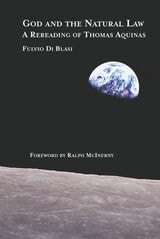
God and the Natural Law
Reading of Thomas AquinasFulvio Di Blasi
St. Augustine's Press, 2006
Blasi begins with an original analysis of the current debate in ethics, jurisprudence, and politics in order to set the stage for a sound understanding of the concept of natural law. This leads to the heart of the book: a recovery of the authentic meaning of the two main concepts of classical natural-law theory as synthesized by Thomas Aquinas – the will of God and the order of nature.
The wide revival of practical philosophy and ethics of objective-values in recent decades has involved a robust rediscovery of classical natural-law theory. This rediscovery is marked by two main traits: an emphasis on the autonomy of practical reason (as a reaction to modern voluntarism centered on the external will of the legislator); and an emphasis on the originality of practical reason (as a reaction to the idea of a rational deduction of
moral truths from the facts of nature). Without denying an autonomous character to ethics, or the need for a strong critique of moral rationalism, Di Blasi argues that Aquinas’s thought remains unintelligible if we remove from it either God or the metaphysical understanding of
nature.
God as Otherwise Than Being
Toward a Semantics of the GiftCalvin O. Schrag
Northwestern University Press, 2002
Schrag draws with grace, ease, and precision upon the history of Western metaphysics, from Plato and Aristotle through Nietzsche and Heidegger. Most important to his central question of God as "otherwise than Being," however, are such influential post-Heideggerian thinkers as Jean-Luc Marion, Jacques Derrida, and Emmanuel Levinas. Schrag's inquiry engages these thinkers at a serious level and also expands recent discussions by relating them to the work of figures hitherto overlooked or underplayed, most notably Paul Tillich.
God in the Machine
Video Games as Spiritual PursuitLiel Leibovitz
Templeton Press, 2014
Yet video games remain relatively unexplored by both scholars and pundits alike. Few have advanced beyond outmoded and futile attempts to tie gameplay to violent behavior. With this rumor now thoroughly and repeatedly disproven, it is time to delve deeper. Just as the Museum of Modern Art in Manhattan recently acquired fourteen games as part of its permanent collection, so too must we seek to add a serious consideration of virtual worlds to the pantheon of philosophical inquiry.
In God in the Machine, author Liel Leibovitz leads a fascinating tour of the emerging virtual landscape and its many dazzling vistas from which we are offered new vantage points on age-old theological and philosophical questions. Free will vs. determinism, the importance of ritual, transcendence through mastery, notions of the self, justice and sin, life, death, and resurrection all come into play in the video games that some critics so quickly write off as mind-numbing wastes of time. When one looks closely at how these games are designed, their inherent logic, and their cognitive effects on players, it becomes clear that playing these games creates a state of awareness vastly different from when we watch television or read a book. Indeed, the gameplay is a far more dynamic process that draws on various faculties of mind and body to evoke sensations that might more commonly be associated with religious experience. Getting swept away in an engaging game can be a profoundly spiritual activity. It is not to think, but rather to be, a logic that sustained our ancestors for millennia as they looked heavenward for answers.
As more and more of us look “screenward,” it is crucial to investigate these games for their vast potential as fine instruments of moral training. Anyone seeking a concise and well-reasoned introduction to the subject would do well to start with God in the Machine. By illuminating both where video game storytelling is now and where it currently butts up against certain inherent limitations, Liebovitz intriguingly implies how the field and, in turn, our experiences might continue to evolve and advance in the coming years.

God of Many Names
Play, Poetry and Power in Hellenic Thought, From Homer to AristotleMihai I. Spariosu
Duke University Press, 1991
Building upon the scholarship of an earlier volume, Dionysus Reborn, Spariosu her continues to draw on Dionysus—the “God of many names,” of both poetic play and sacred power—as a mythical embodiment of the two sides of the classical Greek mentality. Combining philosophical reflection with close textual analysis, the author examines the divided nature of the Hellenic mentality in such primary canonic texts as the Iliad, the Odyssey, the Theogony, Works and Days, the most well-known of the Presocratic fragments, Euripides’ Bacchae, Aristophanes’ The Frogs, Plato’s Republic and Laws, and Aristotle’s Poetics and Politics.
Spariosu’s model illuminates the many of the most enduring questions in contemporary humanistic study and addresses modern questions about the nature of the interrelation of poetry, ethics, and politics.
God's Knowledge of the World
Medieval Theories of Divine Ideas from Bonaventure to OckhamCarl A. Vater
Catholic University of America Press, 2022
God, the Flesh, and the Other
From Irenaeus to Duns ScotusEmmanuel Falque Translated from the French by William Christian Hackett
Northwestern University Press, 2015
In God, the Flesh, and the Other, the philosopher Emmanuel Falque joins the ongoing debate about the role of theology in phenomenology. An important voice in the second generation of French philosophy’s “theological turn,” Falque examines philosophically the fathers of the Church and the medieval theologians on the nature of theology and the objects comprising it. Falque works phenomenology itself into the corpus of theology. Theological concepts thus translate into philosophical terms that phenomenology should legitimately question: concepts from contemporary phenomenology such as onto-theology, appearance, reduction, body/flesh, inter-corporeity, the genesis of community, intersubjectivity, and the singularity of the other find penetrating analogues in patristic and medieval thought forged through millennia of Christological and Trinitarian debate, mystical discourses, and speculative reflection. Through Falque’s wide-ranging interpretive path, phenomenology finds itself interrogated—and renewed.
Good Music
What It Is and Who Gets to DecideJohn J. Sheinbaum
University of Chicago Press, 2018
In Good Music, John J. Sheinbaum explores these traditional models for valuing music. By engaging examples such as Handel oratorios, Beethoven and Mahler symphonies, jazz improvisations, Bruce Springsteen, and prog rock, he argues that metaphors of perfection do justice to neither the perceived strengths nor the assumed weaknesses of the music in question. Instead, he proposes an alternative model of appreciation where abstract notions of virtue need not dictate our understanding. Good music can, with pride, be playful rather than serious, diverse rather than unified, engaging to both body and mind, in dialogue with manifold styles and genres, and collaborative to the core. We can widen the scope of what music we value and reconsider the conventional rituals surrounding it, while retaining the joys of making music, listening closely, and caring passionately.
Good Vibes Only
Phenomenology and the Biopolitics of Algorithmic LegitimationRobin James
Duke University Press, 2026

Good and Evil Actions
A Journey through Saint Thomas AquinasSteven J. Jensen
Catholic University of America Press, 2010

Good-Bye Samizdat
Twenty Years of Czechoslovak Underground WritingMarketa Goetz-Stankiewicz
Northwestern University Press, 1992
Grafts
Michael Marder
University of Minnesota Press, 2016
Grafting: do we ever do anything other than that? And are we ever free from vegetal influences when we engage in its operations? For the philosopher Michael Marder, our reflections on vegetal life have a fundamental importance in how we can reflect on our own conceptions of ethics, politics, and philosophy in general. Taking as his starting point the simple vegetal conception of grafting, Marder guides the reader through his concise and numerous reflections on what could be described as a vegetal philosophy. Grafts are transplants either of a shoot inserted into the trunk of another tree or, surgically, of skin (among other living tissues). They are delicate operations intended to preserve, improve, and modify both the grafted materials and the body that receives them. To graft is to create unlikely encounters, hybrid mixes, and novel surfaces.
Moving across disciplinary lines, Grafts combines the lessons of plant science with the history of philosophy, semiotics, literary compositions, and political theory. Co-authoring some of the texts with other philosophers, plant scientists and artists, Marder allows their insights to be grafted onto his own, and vice versa. Weighing in on contemporary debates such as the ethics of biotechnology, dietary practices or political organization, Marder inserts an unmistakable vegetal perspective into topics of discussion where it normally wouldn’t be found. Transferring the living tissue of his own texts into another context, he helps them live better, more fully, than otherwise.
Gramsci at Sea
Sharad Chari
University of Minnesota Press, 2023
How might an oceanic Gramsci speak to Black aquafuturism and other forms of oceanic critique? This succinct work reads Antonio Gramsci’s writings on the sea, focused in his prison notes on waves of imperial power in the inter-war oceans of his time. Sharad Chari argues that the imprisoned militant’s method is oceanic in form, and that this oceanic Marxism can attend to the roil of sociocultural dynamics, to waves of imperial power, as well as to the capacity of Black, Drexciyan, and other forms of oceanic critique to “storm” us on different shores.
Gramsci in the World
Roberto M. Dainotto and Fredric Jameson, editors
Duke University Press, 2020
Contributors. Alberto Burgio, Cesare Casarino, Maria Elisa Cevasco, Kate Crehan, Roberto M. Dainotto, Michael Denning, Harry Harootunian, Fredric Jameson, R. A. Judy, Patrizia Manduchi, Andrea Scapolo, Peter D. Thomas, Catherine Walsh, Pu Wang, Cosimo Zene
Gratia non tollit naturam
Technologies of the Self and the Catholic Constitution of Time and SpacePhilipp W. Rosemann
St. Augustine's Press, 2025
In this short volume, Philipp Rosemann sets out to articulate the structures of Catholic existence in terms adapted from contemporary philosophy. Using a concept from the last works of Michel Foucault, Rosemann focuses on the liturgy as a "technology of the self." Through language, the liturgy "makes" the world in which the believer lives. But whereas modern philosophers hold that the human mind imposes its structures upon reality, the liturgical self exists in accordance with a cosmic order that stems from the Word.
If one dialogue partner is Michel Foucault, the other is Joseph Ratzinger, the late Pope Benedict XVI. Although this pairing may seem surprising, two facts suggest its fruitfulness. First, scholars now speak of a "Christian turn" in the late Foucault, a thinker often denounced—falsely—as the epitome of philosophical decadence. Second, as one of the leading liturgists of our time, Ratzinger incorporated crucial insights from modern philosophy into his liturgical theology. In relation to Ratzinger, too, some clichés need to be corrected.
In the resulting dialogue between Foucault and Ratzinger, the reader discovers what the specific mode of existence of the "liturgical subject" is, and how Catholic time and space are constituted liturgically. In the end, the Thomistic adage gratia non tollit naturam turns out to be an excellent way of summarizing how the liturgical subject relates to the cosmos: not by destroying it, but by listening to the words of creation and perfecting them.
The University of Dallas Aquinas Lecture for 2024, Gratia non tollit naturam is published here with an introduction by Fr. James Lehrberger, OCist.

Great Dialogue Nature Space
Yves R. Simon
St. Augustine's Press, 2000
In this work, Yves R. Simon discusses the basic insights of the creators of modern thought: Descartes, Newton, Galileo, Comte, Mach, Meyerson, Bergson, Planck, and the issues at stake in the development of modern science and in the rejection of the Aristotelian physics.
Simon distinguishes between a philosophy of nature and a science of nature - and grants a real value to both. A discussion of this vexing problem and its applications to the modern controversy over determinism and chance raised by modern physics rounds out this philosophical and historical highlighting of man's most important theories of nature.
Grievance
In FragmentsGrant Farred
Prickly Paradigm Press, 2024
Grievance is an American mode of being that can be traced back to the Declaration of Independence, that is at the root of the Civil War and accounts in large measure for the failure of Reconstruction, that runs through the Civil Rights moment, and that showed itself again in the events of January 6, 2021. Grievance, in America, always concatenates with racism and evinces itself most violently in those moments when white supremacy, fallaciously, presents itself as being under attack. This book explores this elemental yet destructive thread of the American character.
Groundless Noir
Ontology and Latin American Crime FictionErik Larson
Bucknell University Press, 2026
This philosophical study of Latin American noir fiction poses the question, What if precarity and uncertainty aren’t just themes of the genre but ways of being in the world? Emerging from a region immersed in violence, trauma, and political instability, the novela negra reveals not just disillusionment but a desire to adapt to, even dwell within, chaos. In the hands of writers like Ricardo Piglia, Roberto Bolaño, and Patricia Melo, savvy detectives and antiheroes navigate a world in which meaning constantly shifts and certainty is elusive. Blending literary analysis with philosophical inquiry, Larson draws on Heideggerian ontology to demonstrate how the noir novel becomes a mode of existence—grounded in its very groundlessness. Rather than offering resolution, these novels embody a paradoxical desire: to engage crisis while also adapting to it. In doing so, they become both ideological and pedagogical—existential fiction for an uncertain world.
Published by Bucknell University Press. Distributed worldwide by Rutgers University Press.
Growing Explanations
Historical Perspectives on Recent ScienceM. Norton Wise, ed.
Duke University Press, 2004
Written by leading historians and philosophers of science, these essays examine the range of subjects, people, and goals involved in changing the character of scientific analysis over the last several decades. They highlight the alternatives that fields as diverse as string theory, fuzzy logic, artificial life, and immunology bring to the forms of explanation that have traditionally defined scientific modernity. A number of the essays deal with the mathematical and physical sciences, addressing concerns with hybridity and the materials of the everyday world. Other essays focus on the life sciences, where questions such as “What is life?” and “What is an organism?” are undergoing radical re-evaluation. Together these essays mark the contours of an ongoing revolution in scientific explanation.
Contributors. David Aubin, Amy Dahan Dalmedico, Richard Doyle, Claus Emmeche, Peter Galison, Stefan Helmreich, Ann Johnson, Evelyn Fox Keller, Ilana Löwy, Claude Rosental, Alfred Tauber
Guy Debord
Revolution in the Service of PoetryVincent Kaufmann
University of Minnesota Press, 2010
Instead of providing a conventional day-to-day account of Debord's life, Kaufmann deftly locates his subject within the historical and intellectual context of the radical social, political, and artistic movements in which he participated. He traces Debord's development as an intellectual: his involvement with the lettrist movement in the early 1950s, his central role in the Situationist International from 1957 to 1971 and in the events of May 1968, and the productive and frequently misunderstood period between the dissolution of the situationists and his suicide, during which time Debord clarified the rules of his war against inauthenticity.
As Kaufmann makes clear, for Debord political thought and action were inseparable from aesthetics and poetic expression. Whether envisioning the recovery of a lost, protocommunist age of authenticity and transparency in The Society of the Spectacle or critically assessing the possibility of revolution against postmodern capitalism two decades later, Debord advocated and practiced an art of defiance, a concurrently martial and melancholic poetics. Avoiding the mythologies about Debord that both admirers and critics have cultivated, Kaufmann provides a groundbreaking and generous assessment of Debord and his uncompromising struggle against a corrupt civilization.

Guy Hocquenghem
Beyond Gay IdentityBill Marshall
Duke University Press, 1997
Marshall explores all aspects of Hocquenghem’s writing—journalistic, theoretical, and fictional—much of this work still untranslated. His consideration reaches beyond the aftermath of the events of May 1968 and points toward the ways in which Hocquenghem’s work might invigorate contemporary debates on a range of issues in Marxist and queer theory and in gay, lesbian, and cultural studies. These include the construction of homosexuality in social discourse, the status of "identity politics," and the role of the state and civil society in the determination of each. Demonstrating Hocquenghem’s importance within the framework of French leftist thought, Marshall links him to his contemporaries Foucault, Deleuze, and Guattari. Tracing his connections to the intellectual traditions of Benjamin, Diderot, Fourier, Lucretius, and Gnosticism, he also illustrates Hocquenghem’s place within the European intellectual tradition.Guy Hocquenghem brings an important, challenging, and overly neglected French theorist back to the main stage.