Results by title
2916 books match the query 'Politics and government' and 61 start with g
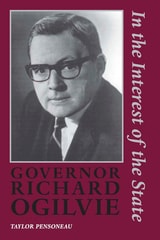
Governor Richard Ogilvie
In the Interest of the StateTaylor Pensoneau
Southern Illinois University Press, 2009
Although serious scandal erupted in Illinois Governor Richard Ogilvie’s administration— eight hundred thousand dollars mysteriously appearing in Secretary of State Paul Powell’s shoe boxes and other hiding places, the downfall of two Supreme Court justices for questionable stock dealings, corruption surrounding the Illinois State Fair— Ogilvie’s accomplishments, as Taylor Pensoneau demonstrates, rank him among the best governors in Illinois history.
Perhaps the most important of Ogilvie’s accomplishments during his single term in office (1969–1973) was the passage of the state’s first income tax in 1969. Supporting the income tax took political courage on the part of the new governor, but in doing so he saved the financially crippled state from economic disaster. He also looked far into the future; at a time when few politicians expressed concern with the environment, Ogilvie created an exemplary and hard-hitting antipollution program. He was in office during the Illinois Constitutional Convention in 1970 and was instrumental in the widespread restructuring of Illinois government.
Viewing Ogilvie as a pivotal figure in Illinois politics during a time of great social and political turmoil, Pensoneau provides a complete political biography. He sheds light on Ogilvie’s military heroics, his political career, and the Illinois elections of 1968, 1970, and 1972.
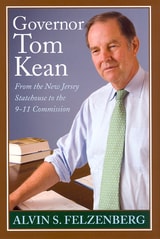
Governor Tom Kean
From the New Jersey Statehouse to the 911 CommissionFelzenberg, Alvin S
Rutgers University Press, 2006
In this first political biography of one of the nation's most popular and successful governors, Alvin S. Felzenberg tells the story of a remarkable career that culminated in an unexpected and crucial contribution to the country-chairmanship of the 9/11 Commission. Felzenberg describes how, early in his political career, Kean worked to transform New Jersey's legislature in the aftermath of court rulings that mandated redistricting in accordance with the "one man, one vote" principle. He discusses Kean's efforts to relieve the urban crisis that followed in the wake of the 1967 Newark riots. He relates how Kean was able to use the New Jersey governorship-purportedly the strongest in the country-to transform a so-called "rust belt" state into a leader in education, environmental responsibility, and economic growth.
Kean's successes in these and other areas caused leaders outside New Jersey to follow in his path. Together with his fellow governors, Kean forged a national consensus on domestic policy between Democratic congresses and Republican presidents, in the process winning for himself a leadership role in his own party. Kean's story serves as an uncommon case of how a Republican loyal to the historic roots and principles of his party can not only win election in a "blue state" but effectively govern it.
Starting from the example the governor set on the state level, Felzenberg's account traces Kean's career to positions of trusted authority on the national stage. After several years of advising presidents, Kean was appointed chairman of the 9/11 Commission. In this role, he made the bipartisan, Congressionally mandated commission one of the most successful in American history.
Drawing on interviews with Kean as well as with state and national leaders, including former presidents Gerald Ford and Bill Clinton and former New York City mayor Ed Koch, Felzenberg not only provides a marvelous biography, but also offers a unique look at American politics during the last four decades of the twentieth century.
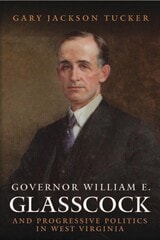
Governor William Glasscock and Progressive Politics in West Virginia
Gary Jackson Tucker
West Virginia University Press, 2008
From 1909 to 1913, Governor William Glasscock served the state of West Virginia as an ardent progressive and reformer. In his inaugural address he proclaimed government "the machinery invoked and devised by man for his benefit and protection” and good government the guarantor of the happiness, prosperity, success, and welfare of the people. Governor William Glasscock and Progressive Politics in West Virginia recounts the life and work of West Virginia’s thirteenth governor. Born during the Civil War, Glasscock witnessed a country torn by sectional, fratricidal war become a powerful industrial nation by the turn of the twentieth century. Author Gary Jackson Tucker demonstrates how Glasscock, along with others during the Progressive Era, railed against large and powerful political and economic machines to enact legislation protecting free and fair elections, just taxation, regulation of public utilities, and workmen’s compensation laws. Never hesitating to use the power of the state to stand firm against racism and mob rule, and placing his own personal safety in jeopardy, Glasscock won the praise and admiration of average people. Glasscock’s four years in office took his own health and financial security from him, but left behind a better government—a good government—for the people of West Virginia.
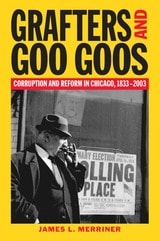
Grafters and Goo Goos
Corruption and Reform in ChicagoJames L. Merriner
Southern Illinois University Press, 2008
Chicago’s reputation for corruption is the basis of local and national folklore and humor. Grafters and Goo Goos: Corruption and Reform in Chicago, 1833–2003 unfolds the city’s notorious history of corruption and the countervailing reform struggles that largely failed to clean it up. More than a regional history of crime in politics, this wide-ranging account of governmental malfeasances traces ongoing public corruption and reform to its nineteenth-century democratic roots. Former Chicago journalist James L. Merriner reveals the battles between corrupt politicos and ardent reformers to be expressions of conflicting class, ethnic, and religious values.
From Chicago’s earliest years in the 1830s, the city welcomed dollar-chasing businessmen and politicians, swiftly followed by reformers who strived to clean up the attendant corruption. Reformers in Chicago were called “goo goos,” a derisive epithet short for “good-government types.” Grafters and Goo Goos contends a certain synergy defined the relationship between corruption and reform. Politicians and reformers often behaved similarly, their separate ambitions merging into a conjoined politics of interdependency wherein the line between heroes and villains grew increasingly faint. The real story, asserts Merriner, has less to do with right against wrong than it does with the ways the cultural backgrounds of politicians and reformers steered their own agendas, animating and defining each other by their opposition.
Drawing on original and archival research, Merriner identifies constants in the struggle between corruption and reform amid a welter of changing social circumstances and customs—decades of alternating war and peace, hardships and prosperity. Three areas of reform and resistance are identified: structural reform of the political system to promote honesty and efficiency, social reform to provide justice to the lower classes, and moral reform to combat vice. “In the matter of corruption and reform, the constants might be stronger than the variables,” writes Merriner in the Preface. “The players, rules, and scorekeepers change, but not the essential game.”
Complemented by eighteen illustrations, Grafters and Goo Goos is rife with shocking and amusing anecdotes and peppered with the personalities of famous muckrakers, bootleggers, mayors, and mobsters. While other studies have profiled infamous Chicago corruption cases and figures such as Al Capone and Richard J. Daley, this is the first to provide an overview appropriate for historians and general readers alike. In examining Chicago’s notorious saga of corruption and reform against a backdrop of social history, Merriner calls attention to our constant problems of both civic and national corruption and contributes to larger discussions about the American experiment of democratic self-government.
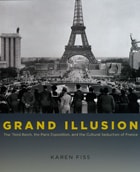
Grand Illusion
The Third Reich, the Paris Exposition, and the Cultural Seduction of FranceKaren Fiss
University of Chicago Press, 2009
Franco-German cultural exchange reached its height at the 1937 Paris World’s Fair, where the Third Reich worked to promote an illusion of friendship between the two countries. Through the prism of this decisive event, Grand Illusion examines the overlooked relationships among Nazi elites and French intellectuals. Their interaction, Karen Fiss argues, profoundly influenced cultural production and normalized aspects of fascist ideology in 1930s France, laying the groundwork for the country’s eventual collaboration with its German occupiers.
Tracing related developments across fine arts, film, architecture, and mass pageantry, Fiss illuminates the role of National Socialist propaganda in the French decision to ignore Hitler’s war preparations and pursue an untenable policy of appeasement. France’s receptiveness toward Nazi culture, Fiss contends, was rooted in its troubled identity and deep-seated insecurities. With their government in crisis, French intellectuals from both the left and the right demanded a new national culture that could rival those of the totalitarian states. By examining how this cultural exchange shifted toward political collaboration, Grand Illusion casts new light on the power of art to influence history.

Great Expectations and Interwar Realities
Cultural Diplomacy in Horthy's HungaryZsolt Nagy
Central European University Press, 2017

Greenlanders, Whales, and Whaling
Sustainability and Self-Determination in the ArcticRichard A. Caulfield
Dartmouth College Press, 2000
Gringolandia
Lyn Miller-Lachmann
Northwestern University Press, 2009
After papá’s arrest in 1980, Daniel’s family fled to the United States. Now Daniel has a new life, playing guitar in a rock band and dating Courtney, a minister’s daughter. He hopes to become a US citizen as soon as he turns eighteen.
When Daniel’s father is released and rejoins his family, they see what five years of prison and torture have done to him. Marcelo is partially paralyzed, haunted by nightmares, and bitter about being exiled to “Gringolandia.” Daniel worries that Courtney’s scheme to start a bilingual human rights newspaper will rake up papá’s past and drive him further into alcohol abuse and self-destruction. Daniel dreams of a real father-son relationship, but he may have to give up everything simply to save his papá’s life.
This powerful coming-of-age story portrays an immigrant teen’s struggle to reach his tortured father and find his place in the world.
Guerrilla Auditors
The Politics of Transparency in Neoliberal ParaguayKregg Hetherington
Duke University Press, 2011
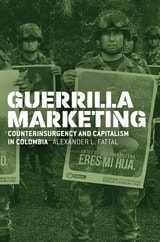
Guerrilla Marketing
Counterinsurgency and Capitalism in ColombiaAlexander L. Fattal
University of Chicago Press, 2018
Full of rich, unforgettable ethnographic stories, Guerrilla Marketing is a stunning and troubling analysis of the mediation of global conflict.
Guerrillas, Unionists, and Violence on the Confederate Home Front
Daniel E. Sutherland
University of Arkansas Press, 1999