Results by title
2194 books match the query 'Women's Studies' and 61 start with g

Gone to Another Meeting
The National Council of Jewish Women, 1893-1993Faith Rogow
University of Alabama Press, 1993
The first comprehensive history of the oldest national religious Jewish women's organization in the United States
Gone to Another Meeting charts the development of the National Council of Jewish Women (NCJW) and its impact on both the Jewish Community in the United States and American Society in general.
Founded in 1893 by Hannah Greenebaum Solomon, NCJW provided a conduit through which Jewish women’s voices could be heard and brought a Jewish voice to America’s women’s rights movement. NCJW would come to represent both the modernization and renewal of traditional Jewish womanhood. Through its emphasis on motherhood, its adoption of domestic feminism, and its efforts to carve a distinct Jewish niche in the late 19th-century Progressive social reform movement in the largely Christian world of women’s clubs, NCJW was instrumental in defining a uniquely American version of Jewish womanhood.
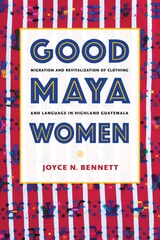
Good Maya Women
Migration and Revitalization of Clothing and Language in Highland Guatemalaby Joyce N. Bennett
University of Alabama Press, 2022
Good Maya Women: Migration and Revitalization of Clothing and Language in Highland Guatemala analyzes how Indigenous women’s migration contributes to women’s empowerment in their home communities in Guatemala. This decolonial ethnographic analysis of Kaqchikel Maya women’s linguistic and cultural activism demonstrates that marginalized people can and do experience empowerment and hope for the future of their communities, even while living under oppressive neoliberal regimes. Joyce N. Bennett contests dominant frameworks of affect theory holding that marginalized peoples never truly experience unrestricted hope or empowerment, and she contributes new understandings of the intimate connections between Indigenous women, migration, and language and clothing revitalization.
Based on more than twenty months of fieldwork, the study begins with an ethnographic investigation of how economic policies force Indigenous women into migration for wage work. To survive, many, like the three young women profiled in this ethnography, are forced to leave their schooling, families, and highland homes to work in cities or other countries. They might work, for example, as vendors, selling crafts to tourists, or as housekeepers or waitresses. Their work exposes them to structural violence, including anti-Indigenous slurs, sexual harassment and violence, and robbery.
Furthermore, the women are pressured to wear Western clothing and to speak Spanish, which endangers Indigenous culture and language in Guatemala. Yet the Indigenous migrant women profiled do not abandon their Indigenous clothing and language, in this case Kaqchikel Maya. Instead, they find inspiration and pride in revitalizing Kaqchikel traditions in their hometowns post-migration. As women attempt to revitalize Kaqchikel Maya language and clothing, they seek to earn the title of “good” women in their home communities.
Unpacking women’s daily activisms reveals that women attempt to retain their language and clothing and also collectively seek to make space for Indigenous people in the modern world. Bennett reveals that women find their attempts at revitalization to be personally empowering, even when their communities do not support them.
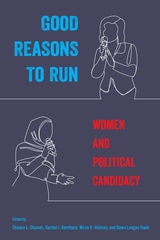
Good Reasons to Run
Women and Political CandidacyEdited by Shauna L. Shames, Rachel I. Bernhard, Mirya R. Holman, and Dawn Langan Teele
Temple University Press, 2020
After the 2016 U.S. Presidential election, a large cohort of women emerged to run for office. Their efforts changed the landscape of candidates and representation. However, women are still far less likely than men to seek elective office, and face biases and obstacles in campaigns. (Women running for Congress make twice as many phone calls as men to raise the same contributions.)
The editors and contributors to Good Reasons to Run, a mix of scholars and practitioners, examine the reasons why women run—and do not run—for political office. They focus on the opportunities, policies, and structures that promote women’s candidacies. How do nonprofits help recruit and finance women as candidates? And what role does money play in women’s campaigns?
The essays in Good Reasons to Run ask not just who wants to run, but how to activate and encourage such ambition among a larger population of potential female candidates while also increasing the diversity of women running for office.
Good-Natured Feminist
Ecofeminism And The Quest For DemocracyCatriona Sandilands
University of Minnesota Press, 1999
A foundational statement of the democratic promise of ecofeminism.
Heroic mothers defending home and hearth against a nature deformed by multinationalist corporate practice: this may be a compelling story, but it is not necessarily the source of valid feminist or ecological critique. What’s missing is the democratic element, an insistence on bringing to public debate all the relations of gender and nature that such a view takes for granted. This book aims to situate a commitment to theory and politics—that is, to democratic practice—at the center of ecofeminism and, thus, to move toward an ecofeminism that is truly both feminist and ecological.
The Good-Natured Feminist inaugurates a sustained conversation between ecofeminism and recent writings in feminist postmodernism and radical democracy. Starting with the assumption that ecofeminism is a body of democratic theory, the book tells how the movement originated in debates about “nature” in North American radical feminisms, how it then became entangled with identity politics, and how it now seeks to include nature in democratic conversation and, especially, to politicize relations between gender and nature in both theoretical and activist milieus.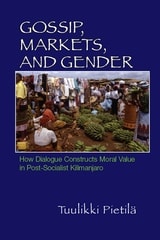
Gossip, Markets, and Gender
How Dialogue Constructs Moral Value in Post-Socialist KilimanjaroTuulikki Pietilä
University of Wisconsin Press, 2007
"All traders are thieves, especially women traders," people often assured social anthropologist Tuulikki Pietilä during her field work in Kilimanjaro, Tanzania, in the mid-1990s. Equally common were stories about businessmen who had "bought a spirit" for their enrichment. Pietilä places these and similar comments in the context of the liberalization of the Tanzanian economy that began in the 1980s, when many men and women found themselves newly enmeshed in the burgeoning market economy. Even as emerging private markets strengthened the position of enterprising people, economic resources did not automatically lead to heightened social position. Instead, social recognition remained tied to a complex cultural negotiation through stories and gossip in markets, bars, and neighborhoods.
With its rich ethnographic detail, Gossip, Markets, and Gender shows how gossip and the responses to it form an ongoing dialogue through which the moral reputations of trading women and businessmen, and cultural ideas about moral value and gender, are constructed and rethought. By combining a sociolinguistic study of talk, storytelling, and conversation with analysis of gender, the political economy of trading, and the moral economy of personhood, Pietilä reveals a new perspective on the globalization of the market economy and its meaning and impact on the local level.
Winner, Aidoo-Snyder Prize, African Studies Association Women’s Caucus
Greek Prostitutes in the Ancient Mediterranean, 800 BCE–200 CE
Allison Glazebrook
University of Wisconsin Press, 2011
Greek Prostitutes in the Ancient Mediterranean, 800 BCE–200 CE challenges the often-romanticized view of the prostitute as an urbane and liberated courtesan by examining the social and economic realities of the sex industry in Greco-Roman culture. Departing from the conventional focus on elite society, these essays consider the Greek prostitute as displaced foreigner, slave, and member of an urban underclass.
The contributors draw on a wide range of material and textual evidence to discuss portrayals of prostitutes on painted vases and in the literary tradition, their roles at symposia (Greek drinking parties), and their place in the everyday life of the polis. Reassessing many assumptions about the people who provided and purchased sexual services, this volume yields a new look at gender, sexuality, urbanism, and economy in the ancient Mediterranean world.

Green Cane and Juicy Flotsam
Short Stories by Caribbean WomenEsteves, Carmen C
Rutgers University Press, 1991

Gross Misbehavior and Wickedness
A Notorious Divorce in Early Twentieth-Century AmericaJean Elson
Temple University Press, 2017
Gross Misbehavior and Wickedness—the charges Nina levied at James for his adultery (with the family governess) and extreme cruelty—recounts the protracted legal proceedings in juicy detail.
Jean Elson uses court documents, correspondence, journals, and interviews with descendants to recount the salacious case. In the process, she underscores how divorce—in an era when women needed husbands for economic support—was associated with women’s aspirations for independence and rights. The Walkers’ dispute, replete with plot twists and memorable characters, sheds light on a critical period in the evolution of American culture.
Growing Girls
The Natural Origins of Girls' Organizations in AmericaMiller, Susan A
Rutgers University Press, 2007
Surprisingly, the "girl problem"?a crisis caused by the transition from a sheltered, family-centered Victorian childhood to modern adolescence where self-control and a strong democratic spirit were required of reliable citizens?was also solved by way of traditionally masculine, adventurous, outdoor activities, as practiced by the Girl Scouts, the Camp Fire Girls, and many other similar organizations.
Susan A. Miller explores these girls' organizations that sprung up in the first half of the twentieth century from a socio-historical perspective, showing how the notions of uniform identity, civic duty, "primitive domesticity," and fitness shaped the formation of the modern girl.

Growing Up Female in Nazi Germany
Dagmar Reese, Translated by William Templer
University of Michigan Press, 2010
Dagmar Reese, however, depicts another picture of life in the BDM. She explores how and in what way the National Socialists were successful in linking up with the interests of contemporary girls and young women and providing them a social life of their own. The girls in the BDM found latitude for their own development while taking on responsibilities that integrated them within the folds of the National Socialist state.
"At last available in English, this pioneering study provides fresh insights into the ways in which the Nazi regime changed young 'Aryan' women's lives through appeals to female self-esteem that were not obviously defined by Nazi ideology, but drove a wedge between parents and children. Thoughtful analysis of detailed interviews reveals the day-to-day functioning of the Third Reich in different social milieus and its impact on women's lives beyond 1945. A must-read for anyone interested in the gendered dynamics of Nazi modernity and the lack of sustained opposition to National Socialism."
--Uta Poiger, University of Washington
"In this highly readable translation, Reese provocatively identifies Nazi girls league members' surprisingly positive memories and reveals significant implications for the functioning of Nazi society. Reaching across disciplines, this work is for experts and for the classroom alike."
--Belinda Davis, Rutgers University
Dagmar Reese is The Moses Mendelssohn Zentrum Potsdam researcher on the DFG-project "Georg Simmels Geschlechtertheorien im ‚fin de siecle' Berlin", 2004
William Templer is a widely published translator from German and Hebrew and is on the staff of Rajamangala University of Technology Srivijaya.

Guilty Pleasures
Feminist Camp from Mae West to MadonnaPamela Robertson
Duke University Press, 1996
Robertson grounds her theoretical discussion of female performance and spectatorship in detailed studies of figures such as Mae West, Joan Crawford, and Madonna. She locates these figures in turn within a tradition of feminist camp—a female form of aestheticism related to masquerade and rooted in burlesque, parallel to but different from gay male camp. Through analyses of films from Gold Diggers of 1933 to Johnny Guitar, as well as video and television, Robertson shows how the gold digger is to feminist camp what the dandy is to gay male camp—its original personification and defining voice. Set against a backdrop of social history, her analysis demonstrates that feminist camp flourishes during periods of antifeminist backlash in America, and that it reflects a working-class sensibility particularly attuned to changing attitudes toward women’s work and sexuality.
Appealing to a wide range of scholars spanning the fields of film and mass culture, feminism, gay/lesbian/queer studies, and cultural studies, Guilty Pleasures will also attract an audience of general readers interested in camp and popular culture.