Results by title
5550 books match the query 'Biography & Autobiography' and 159 start with g

Guitars, Bars, and Motown Superstars
Dennis Coffey
University of Michigan Press, 2009
"Guitarist Dennis Coffey was in that elite band of musicians who helped to create the Motown Sound."
---Edwin Starr
"There can never be enough stories told from the vantage point of Motown's fabled Snake Pit, from one of the journeyman musicians working behind the scenes. Guitars, Bars, and Motown Superstars also shows just how frenetic and creative the Detroit music scene was in the '60s and '70s. But it's Dennis Coffey's personal story that's most gripping: the journey from Motown, to Billboard's Top Ten, to working the line at Chevrolet."
---Susan Whitall, Detroit News; author of Women of Motown
Under Berry Gordy, Motown was a place where studio musicians usually stood in the shadows, unlike the solo stars whose names appeared on the albums. Gordy held a tight rein on his musicians, forbidding them from playing for other record companies and denying them credit on his records.
In Guitars, Bars, and Motown Superstars, author and guitarist Dennis Coffey tells how he slipped Gordy's draconian rules and went on to success as both a Motown musician and a million-selling solo artist. He offers a fascinating backstage look at the Detroit, L.A., and New York music scenes in the '60s and '70s, with side trips to the smoky clubs and funky studios where the Motown sound was born.
Coffey is credited with creating a lot of that sound, including the famous guitar intro to the Temptations' classic "Cloud Nine." He played on hundreds of Motown albums, and introduced such innovations as the Wah Wah pedal into the Motown recording studio.
Guitars, Bars, and Motown Superstars is an entertaining and amusing memoir of one of the most dynamic and influential periods in contemporary pop culture, and a unique insight into the ups and downs of the studio guitar-for-hire. It's also a look at the dizzying rags-to-riches-and-back-again career of a rock musician who went from million-seller with a house in the Hollywood Hills, and ultimately back to his roots in the Detroit area. A must for fans of Motown, rock, and you-are-there pop-culture history.
From "rock & roll kid" to honorary member of Motown's elite rhythm section the Funk Brothers, Dennis Coffey was one of Detroit's most in-demand session guitarists. After leaving Motown, Coffey became a regular at Hitsville USA, playing on records for Marvin Gaye, the Supremes, Stevie Wonder, Gladys Knight, and Junior Walker. Most recently he appeared in the documentary Standing in the Shadows of Motown.
[more]

Guns of February
Ordinary Japanese Soldiers' Views of the Malayan Campaign and the Fall of Singapore, 1941-42Henry Frei
National University of Singapore Press, 1990
Guns of February shows the Fall of Singapore and Japan's 1941 military campaign in Malaya through the eyes of Japanese soldiers who took part, based on interviews, memoirs, war diaries, and other Japanese-language sources. Although an enormous number of books have been published on Japan's wartime advance into Southeast Asia, few books in English make much use of Japanese sources, and they reveal little of what happened on the Japanese side. In the words of the author, the Japanese"'advance by brigade groups', 'outflank the defence', 'sustain many casualties', and remain altogether a largely faceless mass bicycling their way down to Singapore." In Guns of February some of the voices of these soldiers are finally heard, and they tell a fascinating story. A few of them were professional soldiers who served their country with commitment and dedication, but many were conscripts hoping to stay alive, curious and apprehensive about the countries they entered, and moved by the plight of the people whose cities and towns they sometimes destroyed. Many were young men, interested in girls and in the sights and sounds of Southeast Asia, but also missing their families and the familiar world of Japan. It is a picture far removed from the staple view of the remorseless and fanatic Japanese soldier totally devoted to his Emperor and determined to die for his country. In writing this account of the Japanese advance on Singapore, the author attempted to show the universal humanity of the actors concerned.
[more]
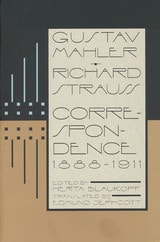
Gustav Mahler--Richard Strauss
Correspondence 1888-1911Gustav Mahler and Richard Strauss
University of Chicago Press, 1984
Gustav Mahler and Richard Strauss came to know one another as young conductors in Leipzig in 1887. From then until Mahler's death in 1911—the year of the first performance of Der Rosenkavalier—they kept in touch. Mahler himself described their relationship as that of two miners tunneling from opposite directions with the hope of eventually meeting.
This first publication of their correspondence, which includes twenty-five previously unknown Strauss letters, offers a portrait of two men who were as antithetical in their musical means and goals as in their temperaments and personalities, but who exercised a strong fascination for one another. These sixty-three letters show both composers advancing in their careers as they battled against adverse conditions in the musical world at the turn of the century. They present Mahler's energetic support of Strauss's Symphonia Domestica, which Mahler conducted in 1904 and, in turn, Strauss's championing of Mahler's music, especially the Second and Third Symphonies.
The correspondence is fully annotated and is supplemented with a major essay by Herta Blaukopf.
"Unfailingly absorbing. . . . An indispensable addition to the literature on these composers."—Norman Del Mar, Times Literary Supplement
[more]
Gut Feelings
A Writer'S Truths And Minute InventionsMerrill Joan Gerber
University of Wisconsin Press, 2003
In these highly personal essays and powerful tales that verge on memoir, Merrill Joan Gerber opens to us her life and work as a writer. She is candid and unflinching in revealing the truths and inventions of a writer’s vision and the use of life as the raw material of art. Her personal essays range widely, from the mysteries of love and marriage to painful encounters with suicides and family deaths.
Gerber writes of her apprenticeships with celebrated writing teachers Andrew Lytle and Wallace Stegner and recounts her ghostly (and ghastly) experiences during a month at Yaddo, the famous retreat for artists. Gerber includes three pieces in the book—originally published as stories—but which blur the line between fiction and memoir, demonstrating Gerber’s contention that the deepest secrets in life beget the most passionate fictions.
Gerber writes of her apprenticeships with celebrated writing teachers Andrew Lytle and Wallace Stegner and recounts her ghostly (and ghastly) experiences during a month at Yaddo, the famous retreat for artists. Gerber includes three pieces in the book—originally published as stories—but which blur the line between fiction and memoir, demonstrating Gerber’s contention that the deepest secrets in life beget the most passionate fictions.
[more]

Gutenberg
Stephan Füssel
Haus Publishing, 2019
Named “Man of the Millennium” in 1999, Johannes Gutenberg was the creator of one of the most influential and revolutionary inventions in Europe’s history: a printing press with mechanical movable type. This development sparked the printing revolution, which is regarded as the milestone of the second millennium and represents one of the central contributions in the turn to modernity. His printing press came to play a key role in the development of the Renaissance, the Reformation, and the Age of Enlightenment, providing the material foundation for the modern knowledge-based economy and the spread of learning to the masses. His invention revolutionized the way that information is shared and broadened the boundaries of who has access to written knowledge. Paving the way for bibliophiles of today, the Gutenberg Bible of 1454 remains one of the most famous books in history.
Gutenberg’s technical innovations remained unrivalled for almost 350 years, until industrialization of the printing industry and the digital revolution built on the advances that he began, increasing the rate at which information is spread. Despite his significance in forming the world as we know it, there has not yet been a rigorous and accessible biography of Gutenberg published in English. Written by the leading expert on Gutenberg, Füssel’s biography brings together high academic standards and thorough historical details in a highly readable text that conveys everything you need to know about the man who changed printing forever.
Gutenberg’s technical innovations remained unrivalled for almost 350 years, until industrialization of the printing industry and the digital revolution built on the advances that he began, increasing the rate at which information is spread. Despite his significance in forming the world as we know it, there has not yet been a rigorous and accessible biography of Gutenberg published in English. Written by the leading expert on Gutenberg, Füssel’s biography brings together high academic standards and thorough historical details in a highly readable text that conveys everything you need to know about the man who changed printing forever.
[more]
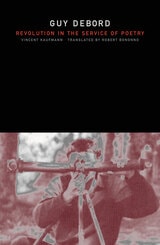
Guy Debord
Revolution in the Service of PoetryVincent Kaufmann
University of Minnesota Press, 2010
Writer, artist, filmmaker, provocateur, revolutionary, and impresario of the Situationist International, Guy Debord shunned the apparatus of publicity he dissected so brilliantly in his most influential work, The Society of the Spectacle. In this ambitious and innovative biography, Vincent Kaufmann places Debord's very hostility toward the inquisitive, biographical gaze at the center of an investigation into his subject's diverse output-from his earliest films to his landmark works of social theory and political provocation-and the poetic sensibility that informed both his work and his life.
Instead of providing a conventional day-to-day account of Debord's life, Kaufmann deftly locates his subject within the historical and intellectual context of the radical social, political, and artistic movements in which he participated. He traces Debord's development as an intellectual: his involvement with the lettrist movement in the early 1950s, his central role in the Situationist International from 1957 to 1971 and in the events of May 1968, and the productive and frequently misunderstood period between the dissolution of the situationists and his suicide, during which time Debord clarified the rules of his war against inauthenticity.
As Kaufmann makes clear, for Debord political thought and action were inseparable from aesthetics and poetic expression. Whether envisioning the recovery of a lost, protocommunist age of authenticity and transparency in The Society of the Spectacle or critically assessing the possibility of revolution against postmodern capitalism two decades later, Debord advocated and practiced an art of defiance, a concurrently martial and melancholic poetics. Avoiding the mythologies about Debord that both admirers and critics have cultivated, Kaufmann provides a groundbreaking and generous assessment of Debord and his uncompromising struggle against a corrupt civilization.
[more]

Guy Wolff
Master Potter in the GardenSuzanne Staubach
University Press of New England, 2013
If you mention Guy Wolff to a serious gardener, that gardener will almost certainly admit to either owning a Guy Wolff flowerpot or coveting one. Wolff’s pots—some small and perfect for a sunny windowsill, others massive and just right for a favorite outdoor spot—are widely considered to be the epitome of gardenware. Their classical proportions, simple decoration, and the marks of Wolff’s hands all combine to make plants look their best. His pots possess an honesty and liveliness that machine-made flowerpots lack. Wolff is probably the best-known potter working in the United States today. In gardening circles, he is a highly revered horticultural icon; gardeners flock to his lectures and demonstrations. His work also appeals to lovers of design and fine arts: visit the personal gardens of landscape designers, and you will see Guy Wolff pots. Step inside the gates of estate gardens, and you will see Guy Wolff pots. Yet he is a potter’s potter. He’s a big ware thrower, a skill few have today. He thinks deeply about what he calls the architecture of pots and the importance of handmade objects in our lives. Whether you are a longtime collector of Wolff’s pots, anxious to buy your first one, or simply intrigued by the beauty and practicality of hand-crafted goods in our fast-paced era, you’ll want to add this richly illustrated book to your library.
[more]
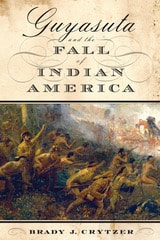
Guyasuta and the Fall of Indian America
Brady J. Crytzer
Westholme Publishing, 2013
A History of the Influential Seneca Leader Who Fought to Maintain Indian Sovereignty During the Bitter Wars for North America
Nearly a century before the United States declared the end of the Indian Wars, the fate of Native Americans was revealed in the battle of Fallen Timbers. In 1794, General Anthony Wayne led the first American army— the Legion of the United States—against a unified Indian force in the Ohio country. The Indians were routed and forced to vacate their lands. It was the last of a series of Indian attempts in the East to retain their sovereignty and foreshadowed what would occur across the rest of the continent. In Guyasuta and the Fall of Indian America, historian Brady J. Crytzer traces how American Indians were affected by the wars leading to American Independence through the life of one of the period’s most influential figures. Born in 1724, Guyasuta is perfectly positioned to understand the emerging political landscape of America in the tumultuous eighteenth century. As a sachem of the vaunted Iroquois Confederacy, for nearly fifty years Guyasuta dedicated his life to the preservation and survival of Indian order in a rapidly changing world, whether it was on the battlefield, in the face of powerful imperial armies, or around a campfire negotiating with his French, British, and American counterparts. Guyasuta was present at many significant events in the century, including George Washington’s expedition to Fort Le Boeuf, the Braddock disaster of 1755, Pontiac’s Rebellion and the Battle of Bushy Run in 1763, and the Battle of Oriskany during the American Revolution. Guyasuta’s involvement in the French and British wars and the American War for Independence were all motivated by a desire to retain relevance for Indian society. It was only upon the birth of the United States of America that Guyasuta finally laid his rifle down and watched as his Indian world crumbled beneath his feet. A broken man, debilitated by alcoholism, he died near Pittsburgh in 1794.
Supported by extensive research and full of compelling drama, Guyasuta and the Fall of Indian America unravels the tangled web of alliances, both white and native, and explains how the world of the American Indians could not survive alongside the emergent United States.
[more]

Guys Like Me
Five Wars, Five Veterans for PeaceMessner, Michael A
Rutgers University Press, 2019
Over the last few decades, as the United States has become embroiled in foreign war after foreign war, some of the most vocal activists for peace have been veterans. These veterans for peace come from all different races, classes, regions, and generations. What common motivations unite them and fuel their activism?
Guys Like Me introduces us to five ordinary men who have done extraordinary work as peace activists: World War II veteran Ernie Sanchez, Korean War veteran Woody Powell, Vietnam veteran Gregory Ross, Gulf War veteran Daniel Craig, and Operation Iraqi Freedom veteran Jonathan Hutto. Acclaimed sociologist Michael Messner offers rich profiles of each man, recounting what led him to join the armed forces, what he experienced when fighting overseas, and the guilt and trauma he experienced upon returning home. He reveals how the pain and horror of the battlefront motivated these onetime warriors to reconcile with former enemies, get involved as political activists, and help younger generations of soldiers.
Guys Like Me is an inspiring multigenerational saga of men who were physically or psychically wounded by war, but are committed to healing themselves and others, forging a path to justice, and replacing endless war with lasting peace
[more]