Results by title
8113 books match the query 'Literary Criticism' and 159 start with g
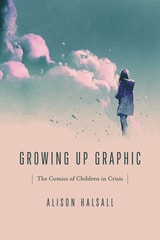
Growing Up Graphic
The Comics of Children in CrisisAlison Halsall
The Ohio State University Press, 2023
In Growing Up Graphic, Alison Halsall considers graphic texts for young readers to interrogate how they help children develop new ideas about social justice and become potential agents of change. With a focus on comics that depict difficult experiences affecting young people, Halsall explores the complexities of queer graphic memoirs, narratives of belonging, depictions of illness and disability, and explorations of Indigenous experiences. She discusses, among others, Child Soldier by Jessica Dee Humphreys and Michel Chikwanine, War Brothers by Sharon E. McKay, Baddawi by Leila Abdelrazaq, Matt Huynh’s interactive adaptation of Nam Le’s The Boat, and David Alexander Robertson’s 7 Generations. These examples contest images of childhood victimization, passivity, and helplessness, instead presenting young people as social actors who attempt to make sense of the challenges that affect them. In considering comics for children and about children, Growing Up Graphic centers a previously underexplored vein of graphic narratives and argues that these texts offer important insights into the interests and capabilities of children as readers.
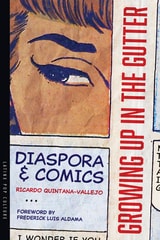
Growing Up in the Gutter
Diaspora and ComicsRicardo Quintana-Vallejo; Foreword by Frederick Luis Aldama
University of Arizona Press, 2024
While the most traditional iteration of the bildungsroman—the coming-of-age story—follows middle-class male heroes who forge their identities in a process of complex introspection, contemporary graphic coming-of-age narratives represent formative processes that fit into, resist, or even disregard narratives of socialization under capitalism, of citizenship, and of nationhood.
Quintana-Vallejo delves into several important themes: how the coming-of-age genre can be used to study adulthood, how displacement and international or global heritage are fundamental experiences, how multidiasporic approaches foreground lived experiences, and how queerness opens narratives of development to the study of adulthood as fundamentally diverse and nonconforming to social norms. Quintana-Vallejo shows how openness enables belonging among chosen families and, perhaps most importantly, freedom to disidentify. And, finally, how contemporary authors writing for the instruction of BIPOC children (and children otherwise affected by diaspora and displacement) use the didactic power of the coming-of-age genre, combined with the hybrid language of graphic narratives, to teach difficult topics in accessible ways.
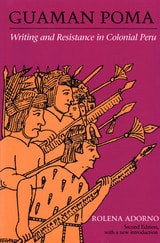
Guaman Poma
Writing and Resistance in Colonial PeruBy Rolena Adorno
University of Texas Press, 2000
In the midst of native people's discontent following Spanish conquest, a native Andean born after the fall of the Incas took up the pen to protest Spanish rule. Felipe Guaman Poma de Ayala wrote his Nueva corónica y buen gobierno to inform Philip III of Spain about the evils of colonialism and the need for governmental and societal reform. By examining Guaman Poma's verbal and visual engagement with the institutions of Western art and culture, Rolena Adorno shows how he performed a comprehensive critique of the colonialist discourse of religion, political theory, and history. She argues that Guaman Poma's work chronicles the emergence of a uniquely Latin American voice, characterized by the articulation of literary art and politics.
Following the initial appearance of Guaman Poma: Writing and Resistance in Colonial Peru, the 1990s witnessed the creation of a range of new studies that underscore the key role of the Nueva corónica y buen gobierno in facilitating our understanding of the Andean and Spanish colonial pasts. At the same time, the documentary record testifying to Guaman Poma's life and work has expanded dramatically, thanks to the publication of long-known but previously inaccessible drawings and documents. In a new, lengthy introduction to this second edition, Adorno shows how recent scholarship from a variety of disciplinary perspectives sheds new light on Guaman Poma and his work, and she offers an important new assessment of his biography in relation to the creation of the Nueva corónica y buen gobierno.
Guerrilla Theory
Political Concepts, Critical Digital HumanitiesMatthew Applegate
Northwestern University Press, 2019
In this penetrating study, Matthew Applegate uses the guerrilla to connect popular iterations of digital humanities’ practice to its political rhetoric and infrastructure. By doing so, he reorients DH’s conceptual lexicon around practices of collective becoming, mediated by claims to conflict, antagonism, and democratic will.
Applegate traces Michael Hardt and Antonio Negri’s radical democratic ingresses into network theory, the guerrilla’s role in its discourse, and concerns for the digital humanities’ own invocation of the figure. The book also connects post- and decolonial, feminist, and Marxist iterations of DH praxis to the aesthetic histories of movements such as Latin American Third Cinema and the documentary cinema of the Black Panther Party. Concluding with a meditation on contemporary political modalities inherent in DH’s disciplinary expansion, Guerrilla Theory challenges the current political scope of the digital humanities and thus its future institutional impact.
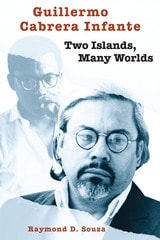
Guillermo Cabrera Infante
Two Islands, Many WorldsBy Raymond D. Souza
University of Texas Press, 1996
A native Cuban who has lived in London since 1966, Guillermo Cabrera Infante is, in every sense, a multilingual and multicultural author. Equally at ease in both Spanish and English, he has distinguished himself with daring and innovative novels, essays, short stories, and film scripts written in both languages. His work has won major literary awards in France, Italy, and Spain, as well as a Guggenheim fellowship in the United States.
This biography is the first comprehensive exploration of the life and works of Guillermo Cabrera Infante. Drawing on wide-ranging interviews with the author and his family and friends, as well as extensive study of both published and unpublished works, Raymond D. Souza creates an intimate portrait of Cabrera Infante and the cultural and political milieus that shaped his writing, including Three Trapped Tigers (Tres tristes tigres), View of Dawn in the Tropics (Vista del amanecer en el trópico), Infante's Inferno (La Habana para un Infante difunto), Holy Smoke, A Twentieth Century Job (Un oficio del siglo XX), Writes of Passage (Así en la paz como en la guerra), and Mea Cuba.
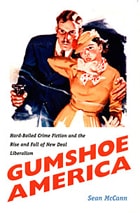
Gumshoe America
Hard-Boiled Crime Fiction and the Rise and Fall of New Deal LiberalismSean McCann
Duke University Press, 2000
Gumshoe America traces the way those problems surfaced in hard-boiled crime fiction from the1920s through the 1960s. Beginning by using a forum on the KKK in the pulp magazine Black Mask to describe both the economic and political culture of pulp fiction in the early twenties, McCann locates the origins of the hard-boiled crime story in the genre’s conflict with the racist antiliberalism prominent at the time. Turning his focus to Dashiell Hammett’s career, McCann shows how Hammett’s writings in the late 1920s and early 1930s moved detective fiction away from its founding fables of social compact to the cultural alienation triggered by a burgeoning administrative state. He then examines how Raymond Chandler’s fiction, unlike Hammett’s, idealized sentimental fraternity, echoing the communitarian appeals of the late New Deal. Two of the first crime writers to publish original fiction in paperback—Jim Thompson and Charles Willeford—are examined next in juxtaposition to the popularity enjoyed by their contemporaries Mickey Spillane and Ross Macdonald. The stories of the former two, claims McCann, portray the decline of the New Deal and the emergence of the rights-based liberalism of the postwar years and reveal new attitudes toward government: individual alienation, frustration with bureaucratic institutions, and dissatisfaction with the growing vision of America as a meritocracy. Before concluding, McCann turns to the work of Chester Himes, who, in producing revolutionary hard-boiled novels, used the genre to explore the changing political significance of race that accompanied the rise of the Civil Rights movement in the late 1950s and the 1960s.
Combining a striking reinterpretation of the hard-boiled crime story with a fresh view of the political complications and cultural legacies of the New Deal, Gumshoe America will interest students and fans of the genre, and scholars of American history, culture, and government.
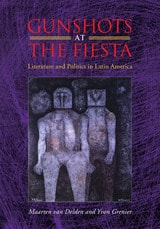
Gunshots at the Fiesta
Literature and Politics in Latin AmericaMaarten van Delden
Vanderbilt University Press, 2009
Yet the authors of this book argue that the relationship between the two realms is much more complex and fraught with tension than is nowadays recognized. In examining these tensions, and in revealing the diverse ways in which literature and politics intersect in the Latin American cultural tradition, Gunshots at the Fiesta offers a lively challenge to the current tendency--especially strong in the U.S. academy--to read Latin American literature through a narrowly political prism.
The authors argue that one can only understand the nature of the dialogue between literature and politics if one begins by recognizing the different logics that operate in these different domains. Using this idea of the different logics of politics and literature as a guiding thread, Van Delden and Grenier offer bold new readings of major authors such as José Martí, Octavio Paz, Carlos Fuentes, Gabriel García Márquez, and Mario Vargas Llosa, as well as compelling interpretations of works by less-frequently-discussed figures such as Claribel Alegría, Marisol Martín del Campo and Víctor Hugo Rascón Banda.
Guy Davenport
Postmodern and AfterAndre Furlani
Northwestern University Press, 2007
Guy Davenport (1927–2005), an American writer of fiction, poetry, criticism, and essays, a translator, painter, intellectual, and teacher, brought a breadth and depth of knowledge to his pursuits that few other writers could approach, let alone appraise. In Andre Furlani, this twentieth-century American master has finally found an apt critical reader. In this first sustained critical study of Davenport, Furlani elucidates the depths of Davenport's fiction and its poetic precedents, brings a rare understanding to the author's reworking of twentieth-century literature and intellectual history, and offers unusual insight into his compositional technique.
Furlani explores key themes across the spectrum of Davenport's fiction: pastoral utopia; twentieth-century dystopia; sexual ethics; the mythologizing of childhood; the inseparability of the archaic and the modern; and a celebration of the union of sophia, eros, and poesia. Whether Davenport's view of art and the cosmos should be called "postmodern" is a question that Furlani considers closely--offering, finally, a new aesthetic for this American original who, in these pages, at last receives the thorough and meticulous attention he has long merited.
Guys Like Us
Citing Masculinity in Cold War PoeticsMichael Davidson
University of Chicago Press, 2003