482 books match the query '17th Century' and 13 start with h
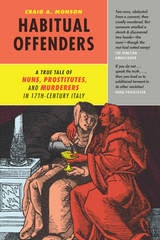
cover of Habitual Offenders: A True Tale of Nuns, Prostitutes, and Murderers in Seventeenth-Century Italy

Habitual Offenders

A True Tale of Nuns, Prostitutes, and Murderers in Seventeenth-Century Italy

Craig A. Monson

University of Chicago Press, 2016

In April 1644, two nuns fled Bologna’s convent for reformed prostitutes. A perfunctory archiepiscopal investigation went nowhere, and the nuns were quickly forgotten. By June of the next year, however, an overwhelming stench drew a woman to the wine cellar of her Bolognese townhouse, reopened after a two-year absence—where to her horror she discovered the eerily intact, garroted corpses of the two missing women.
           
Drawing on over four thousand pages of primary sources, the intrepid Craig A. Monson reconstructs this fascinating history of crime and punishment in seventeenth-century Italy. Along the way, he explores Italy’s back streets and back stairs, giving us access to voices we rarely encounter in conventional histories: prostitutes and maidservants, mercenaries and bandits, along with other “dubious” figures negotiating the boundaries of polite society. Painstakingly researched and breathlessly told, Habitual Offenders will delight historians and true-crime fans alike.
[more]
cover of Half Humankind: Contexts and Texts of the Controversy about Women in England, 1540-1640

Half Humankind

Contexts and Texts of the Controversy about Women in England, 1540-1640

Katherine Usher Henderson and Barbara F. McManus

University of Illinois Press, 1985
Half Humankind is the first study to provide modernized and annotated editions of the key documents from the controversy about women in Renaissance England. The selections -- ten treatises debating the merits of womankind and six eulogies and condemnations depicting actual women -- range in style from careful logic and studied eloquence to ribald humor and witty parody. Illuminated by an extensive discussion tying the selections to Renaissance society and traditional literature, this volume is an invaluable resource for scholars and students of literature, history, and women's studies.
 
[more]
cover of Harmony and the Balance: An Intellectual History of Seventeenth-Century English Economic Thought

Harmony and the Balance

An Intellectual History of Seventeenth-Century English Economic Thought

Andrea Finkelstein

University of Michigan Press, 2000

Frequently the achievements of pioneering economic writers are assessed by imposing contemporary theories of markets, economics, politics, and history. At last, here is a book that appraises the work of the leading English economic writers of the seventeenth century using intellectual concepts of the time, rather than present-day analytical models, in order to place their economic theories in context. In an analysis that tracks the Stuart century, Andrea Finkelstein traces the progress of such figures as Gerard de Malynes, William Petty, John Locke, and Charles Davenant by inviting us into the great trading companies and halls of parliament where we relive the debates over the coinage, the interest rate, and the nature of money. Furthermore, we see them model their works on the latest developments in physiology, borrow ideas from bookkeeping, and argue over the nature of numbers in an effort to construct a market theory grounded in objective moral value. This comprehensive approach clarifies the relationship between the century's economic ideas and its intellectual thought so that, in the end, readers will be able to judge for themselves whether this really was the age of the Capitalist Geist.
 
Finkelstein has crafted her book to be both inclusive and interdisciplinary by skillfully integrating biography, political history, economic history, and intellectual theory as well as the economic heritage of its subjects. While the concepts are far from simple, Finkelstein's adroit style presents her analysis in an extremely accessible manner.

Andrea Finkelstein is Assistant Professor of History, City University of New York.
[more]
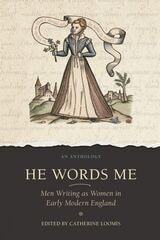
cover of He Words Me: Men Writing as Women in Early Modern England

He Words Me

Men Writing as Women in Early Modern England

Catherine Loomis

Arizona Center for Medieval and Renaissance Studies, 2026

A collection of works by early modern men writing in women’s voices.

This anthology gives students and scholars access to a body of texts that provide a clearer understanding of what life was like for early modern women by presenting hundreds of little-known primary texts that contain details about early modern women’s work, relationships, emotional and intellectual development, friendships, and daily struggles. He Words Me brings together work from a variety of genres in which male authors adopt the voice of a female narrator and use that voice to provide intimate details about the lives of women. 

These works introduce modern readers to less familiar genres, complement or contradict portrayals of women in canonical texts, and raise compelling questions about who speaks for women and when women can speak for themselves. Through these women’s voices, readers can encounter characters and experiences that will broaden their understanding of early modern English literature and culture, and of the history of women in the late sixteenth and early seventeenth centuries.
[more]
cover of Healing Like Our Ancestors: The Nahua Tiçitl, Gender, and Settler Colonialism in Central Mexico, 1535–1660

Healing Like Our Ancestors

The Nahua Tiçitl, Gender, and Settler Colonialism in Central Mexico, 1535–1660

Edward Anthony Polanco

University of Arizona Press, 2024

Offering a provocative new perspective, Healing Like Our Ancestors examines sixteenth- and seventeenth-century Nahua healers in central Mexico and how their practices have been misconstrued and misunderstood in colonial records.

Early colonial Spanish settlers defined, assessed, and admonished Nahua titiçih (healing specialists) and tiçiyotl (healing knowledge) in the process of building a society in Mexico that mirrored Iberia. Nevertheless, Nahua survivance (intergenerational knowledge transfer) has allowed communities to heal like their ancestors through changes and adaptations. Edward Anthony Polanco draws from diverse colonial primary sources, largely in Spanish and Nahuatl (the Nahua ancestral language), to explore how Spanish settlers framed titiçih, their knowledge, and their practices within a Western complex. Polanco argues for the usage of Indigenous terms when discussing Indigenous concepts and arms the reader with the Nahuatl words to discuss central Mexican Nahua healing. In particular, this book emphasizes the importance of women as titiçih and highlights their work as creators and keepers of knowledge. These vital Nahua perspectives of healing—and how they differed from the settler narrative—will guide community members as well as scholars and students of the history of science, Latin America, and Indigenous studies.
[more]
cover of Historical Milton: Manuscript, Print, and Political Culture in Revolutionary England

Historical Milton

Manuscript, Print, and Political Culture in Revolutionary England

Thomas Fulton

University of Massachusetts Press, 2010
John Milton's Commonplace Book is the only known political notebook of a radical polemicist writing during the English civil war, and the most extensive manuscript record of reading we have from any major English poet from this period. In this rethinking of a surprisingly neglected body of evidence, Thomas Fulton explores Milton's reading practices and the ways he used this reading in his writing. Fulton's close study of the Commonplace Book suggests that this reading record is far from the haphazard collection of notes that it first appears but is instead a program of research which had its own ideology that responded to the reading habits and practices of Milton's contemporaries. Created mostly in the late 1630s and during the overthrow of the Stuart government in the 1640s, Milton's reading notes yield a number of surprises, the most fundamental being a highly structured commitment to political history. Fulton explores the relationship between the manuscript author and his polemical persona, placing the Commonplace Book, the manuscript "Digression" to the History of Britain, and some wartime poems in revealing contrast to the printed political texts of this period.
[more]
cover of History of the Triumphs of Our Holy Faith amongst the Most Barbarous and Fierce Peoples of the New World

History of the Triumphs of Our Holy Faith amongst the Most Barbarous and Fierce Peoples of the New World

Andrés Pérez de Ribas; Translated by Daniel T. Reff, Maureen Ahern, and Richard K. Danford; Annotated and with a Critical Introduction by Daniel T. Reff

University of Arizona Press, 1999

Considered by historian Herbert E. Bolton to be one of the greatest books ever written in the West, Andrés Pérez de Ribas's history of the Jesuit missions provides unusual insight into Spanish and Indian relations during the colonial period in Northern New Spain. First published in Madrid in 1645, it traces the history of the missions from 1591 to 1643 and includes letters from Jesuit annual reports and other correspondence, much of which has never been found or cataloged in historical archives. Daniel T. Reff, Maureen Ahern, and Richard K. Danford have now prepared the first complete, scholarly, and fully annotated edition of this important work in English.

Pérez de Ribas was the first permanent missionary to the Ahome, Zuaque, and Yaqui Indians. After fifteen years on the mission frontier he was recalled to Mexico City, where he held various posts, including Jesuit Provincial. Addressed to novitiates ignorant of the challenges they would face in the field, his Historia was a virtual textbook on missionary work in the New World. Also written to encourage ongoing support of the Jesuit missions, it reflected the author's deep grasp of what rhetorically soothed and moved Church and Crown officials.

Perhaps of greatest interest to the modern reader are Pérez de Ribas's often detailed comments on indigenous beliefs and practices. These firsthand observations provide a rich resource of ethnographic and historical data concerning everything from native subsistence, settlement patterns, and myths to the dynamics of Jesuit-Indian relations. The many cases of conversion that Pérez de Ribas describes are especially rich in ethnographic data, clarifying the values and beliefs from which the Indians were "rescued."

History of the Triumphs is a primary document of great importance, made more valuable here by an exceptionally fluid translation and painstaking annotations. It will be a standard reference for all engaged in research on New Spain and a captivating read for anyone interested in this chapter of American history.
[more]
cover of Hobbes's Kingdom of Light: A Study of the Foundations of Modern Political Philosophy

Hobbes's Kingdom of Light

A Study of the Foundations of Modern Political Philosophy

Devin Stauffer

University of Chicago Press, 2018

Was Hobbes the first great architect of modern political philosophy? Highly critical of the classical tradition in philosophy, particularly Aristotle, Hobbes thought that he had established a new science of morality and politics. Devin Stauffer here delves into Hobbes’s critique of the classical tradition, making this oft-neglected aspect of the philosopher’s thought the basis of a new, comprehensive interpretation of his political philosophy.

In Hobbes’s Kingdom of Light, Stauffer argues that Hobbes was engaged in a struggle on multiple fronts against forces, both philosophic and religious, that he thought had long distorted philosophy and destroyed the prospects of a lasting peace in politics. By exploring the twists and turns of Hobbes’s arguments, not only in his famous Leviathan but throughout his corpus, Stauffer uncovers the details of Hobbes’s critique of an older outlook, rooted in classical philosophy and Christian theology, and reveals the complexity of Hobbes’s war against the “Kingdom of Darkness.” He also describes the key features of the new outlook—the “Kingdom of Light”—that Hobbes sought to put in its place. Hobbes’s venture helped to prepare the way for the later emergence of modern liberalism and modern secularism. Hobbes’s Kingdom of Light is a wide-ranging and ambitious exploration of Hobbes’s thought.
 
[more]
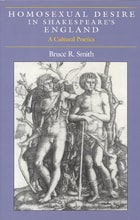
cover of Homosexual Desire in Shakespeare's England: A Cultural Poetics

Homosexual Desire in Shakespeare's England

A Cultural Poetics

Bruce R. Smith

University of Chicago Press, 1994

In the most comprehensive study yet of homosexuality in the English Renaissance, Bruce R. Smith examines and rejects the assessments of homosexual acts in moral philosophy, laws, and medical books in favor of a poetics of homosexual desire. Smith isolates six different "myths" from classical literature and discusses each in relation to a particular Renaissance literary genre and to a particular part of the social structure of early modern England. Smith's new Preface places his work in the context of the continuing controversies in gay, lesbian, and bisexual studies.

"The best single analysis of the homoerotic element in Renaissance English literature."—Keith Thomas, New York Review of Books

"Smith's lucid and subtle book offer[s] a poetics of homosexual desire. . . . Its scholarship, impressively broad and deftly deployed, aims to further a serious social purpose: the redemptive location of homosexual desire in history and the recuperation for our own time, through an understanding of its discursive embodiments, of that desire's changing imperatives and parameters."—Terence Hawkes, Times Literary Supplement

"The great strength of Bruce Smith's book is that it does not sidestep the complex challenge of engaging in the sexual politics of the present while attending to the resistant discourses and practices of Renaissance England. Homosexual Desire in Shakespeare's England demonstrates how a commitment to the present opens up our understanding of the past."—Peter Stallybrass, Shakespeare Quarterly

"A major contribution to the understanding of homosexuality in Renaissance England and by far the best and most comprehensive account yet offered of the homoeroticism that suffuses Renaissance literature."—Claude J. Summers, Journal of Homosexuality
[more]
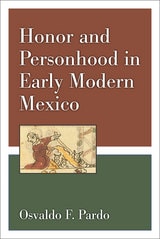
cover of Honor and Personhood in Early Modern Mexico

Honor and Personhood in Early Modern Mexico

Osvaldo F. Pardo

University of Michigan Press, 2015
Osvaldo F. Pardo examines the early dissemination of European views on law and justice among Mexico’s native peoples. Newly arrived from Spain in the sixteenth and seventeenth centuries, mendicant friars brought not only their faith in the authority of the Catholic Church but also their reverence of the monarchy. Drawing on a rich range of documents dating from this era—including secular and ecclesiastical legislation, legal and religious treatises, bilingual catechisms, grammars on indigenous languages, historical accounts, and official reports and correspondence—Pardo finds that honor, as well as related notions such as reputation, came to play a central role in shaping the lives and social relations of colonists and indigenous Mexicans alike. Following the application and adaptation of European ideas of justice and royal and religious power as they took hold in the New World, Pardo sheds light on the formation of colonial legalities and long-lasting views, both secular and sacred, that still inform attitudes toward authority in contemporary Mexican society.
[more]
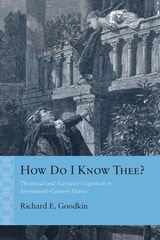
cover of How Do I Know Thee?: Theatrical and Narrative Cognition in Seventeenth-Century France

How Do I Know Thee?

Theatrical and Narrative Cognition in Seventeenth-Century France

Richard E. Goodkin

Northwestern University Press, 2015

The classical period in France presents a particularly lively battleground for the transition between oral-visual culture, on the one hand, and print culture on the other. The former depended on learning from sources of knowledge directly, in their presence, in a manner analogous to theatrical experience. The latter became characterized by the distance and abstraction of reading. How Do I Know Thee? explores the ways in which literature, philosophy, and psychology approach social cognition, or how we come to know others. Richard E. Goodkin describes a central opposition between what he calls “theatrical cognition” and “narrative cognition,” drawing both on scholarship on literary genre and mode, and also on the work of a number of philosophers and psychologists, in particular Descartes’s theory of cognition, Freudian psychoanalysis, mid‑twentieth‑century behaviorism, and the field of cognitive science. The result is a study that will be of interest not only to students of the classical period but also to those in the corresponding disciplines.
 

[more]
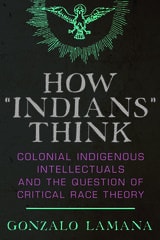
cover of How “Indians” Think: Colonial Indigenous Intellectuals and the Question of Critical Race Theory

How “Indians” Think

Colonial Indigenous Intellectuals and the Question of Critical Race Theory

Gonzalo Lamana

University of Arizona Press, 2019
The conquest and colonization of the Americas marked the beginning of a social, economic, and cultural change of global scale. Most of what we know about how colonial actors understood and theorized this complex historical transformation comes from Spanish sources. This makes the few texts penned by Indigenous intellectuals in colonial times so important: they allow us to see how some of those who inhabited the colonial world in a disadvantaged position thought and felt about it.
 
This book shines light on Indigenous perspectives through a novel interpretation of the works of the two most important Amerindian intellectuals in the Andes, Felipe Guaman Poma de Ayala and Garcilaso de la Vega, el Inca. Building on but also departing from the predominant scholarly position that views Indigenous-Spanish relations as the clash of two distinct cultures, Gonzalo Lamana argues that Guaman Poma and Garcilaso were the first Indigenous activist intellectuals and that they developed post-racial imaginaries four hundred years ago. Their texts not only highlighted Native peoples’ achievements, denounced injustice, and demanded colonial reform, but they also exposed the emerging Spanish thinking and feeling on race that was at the core of colonial forms of discrimination. These authors aimed to alter the way colonial actors saw each other and, as a result, to change the world in which they lived.
[more]
cover of Humanism and Classical Crisis: Anxiety, Intertexts, and the Miltonic Memory

Humanism and Classical Crisis

Anxiety, Intertexts, and the Miltonic Memory

Jacob Blevins

The Ohio State University Press, 2014

While earlier critics have demonstrated significant insight into the relationship between the classical world and the early modern period, Humanism and Classical Crisis: Anxiety, Intertexts, and the Miltonic Memory, by Jacob Blevins, offers a new psychoanalytic approach to understanding classical reception, specifically during the early modern period. Blevins asserts that influence and imitation are primarily driven by anxious desires to identify the poetic self with the past while simultaneously affirming the autonomy and individuality of the self within its own cultural, ideological, and poetic moment. Since the poet cannot hold positions simultaneously in both past and present, anxiety irrupts as the poet fails to understand the fissures in his sense of identity and how that identity is articulated in poetic expression.
 
Blevins grounds his approach in the theories of Jacques Lacan, whose work challenges the very notions of what identity is and, as a result, exposes the complexities of identity formation. Areas and authors covered include imitations and translations of classical works of the sixteenth and seventeenth centuries in England and France by Andrew Marvell, Edmund Spencer, Pierre Ronsard, Joachim Du Bellay, Ben Jonson, Sir Thomas Wyatt, and John Milton.
 
This book not only provides a new perspective on early modern poetic imitation, but also offers a foundational methodology for examining the classical presence within the modern self.
 
[more]