Results by title
805 books match the query '18th century' and 18 start with h
Handwriting in Early America
A Media HistoryEdited by Mark Alan Mattes, Foreword by Karen Sánchez-Eppler, Afterword by Christopher Hager
University of Massachusetts Press, 2023
As digital communication has become dominant, commentators have declared that handwriting is a thing of the past, a relic of an earlier age. This volume of original essays makes it clear that anxiety around handwriting has existed for centuries and explores writing practices from a variety of interdisciplinary fields, including manuscript studies, Native American studies, media history, African American studies, book history, bibliography, textual studies, and archive theory.
By examining how a culturally diverse set of people grappled with handwriting in their own time and weathered shifting relationships to it, Handwriting in Early America uncovers perspectives that are multiethnic and multiracial, transatlantic and hemispheric, colonial and Indigenous, multilingual and illiterate. Essays describe a future of handwriting as envisioned by practitioners, teachers, and even government officials of this time, revealing the tension between the anxiety of loss and the need to allow for variations going forward.
Contributors include James Berkey, Blake Bronson-Bartlett, John J. Garcia, Christopher Hager, Desirée Henderson, Frank Kelderman, Michelle Levy, Lisa Maruca, Christen Mucher, Alan Niles, Seth Perlow, Carla L. Peterson, Sarah Robbins, Patricia Jane Roylance, Karen Sánchez-Eppler, and Danielle Skeehan.

Harlots, Hussies, and Poor Unfortunate Women
Crime, Transportation, and the Servitude of Female Convicts, 1718-1783Edith M. Ziegler
University of Alabama Press, 2014
In Harlots, Hussies, and Poor Unfortunate Women, Edith M. Ziegler recounts the history of British convict women involuntarily transported to Maryland in the eighteenth century.
Great Britain’s forced transportation of convicts to colonial Australia is well known. Less widely known is Britain’s earlier program of sending convicts—including women—to North America. Many of these women were assigned as servants in Maryland. Titled using epithets that their colonial masters applied to the convicts, Edith M. Ziegler’s Harlots, Hussies, and Poor Unfortunate Women examines the lives of this intriguing subset of American immigrants.
Basing much of her powerful narrative on the experiences of actual women, Ziegler restores individual faces to women stripped of their basic freedoms. She begins by vividly invoking the social conditions of eighteenth-century Britain, which suffered high levels of criminal activity, frequently petty thievery. Contemporary readers and scholars will be fascinated by Ziegler’s explanation of how gender-influenced punishments were meted out to women and often ensnared them in Britain’s system of convict labor.
Ziegler depicts the methods and operation of the convict trade and sale procedures in colonial markets. She describes the places where convict servants were deployed and highlights the roles these women played in colonial Maryland and their contributions to the region’s society and economy. Ziegler’s research also sheds light on escape attempts and the lives that awaited those who survived servitude.
Mostly illiterate, convict women left few primary sources such as diaries or letters in their own words. Ziegler has masterfully researched the penumbra of associated documents and accounts to reconstruct the worlds of eighteenth-century Britain and colonial Maryland and the lives of these unwilling American settlers. In illuminating this little-known episode in American history, Ziegler also discusses not just the fact that these women have been largely forgotten, but why. Harlots, Hussies, and Poor Unfortunate Women makes a valuable contribution to American history, women’s studies, and labor history.

Haskalah
The Romantic Movement in JudaismLitvak, Olga
Rutgers University Press, 2012
Commonly translated as the “Jewish Enlightenment,” the Haskalah propelled Jews into modern life. Olga Litvak argues that the idea of a Jewish modernity, championed by adherents of this movement, did not originate in Western Europe’s age of reason. Litvak contends that the Haskalah spearheaded a Jewish religious revival, better understood against the background of Eastern European Romanticism.
Based on imaginative and historically grounded readings of primary sources, Litvak presents a compelling case for rethinking the relationship between the Haskalah and the experience of political and social emancipation. Most importantly, she challenges the prevailing view that the Haskalah provided the philosophical mainspring for Jewish liberalism.
In Litvak’s ambitious interpretation, nineteenth-century Eastern European intellectuals emerge as the authors of a Jewish Romantic revolution. Fueled by contradictory longings both for community and for personal freedom, the poets and scholars associated with the Haskalah questioned the moral costs of civic equality and the achievement of middle-class status. In the nineteenth century, their conservative approach to culture as the cure for the spiritual ills of the modern individual provided a powerful argument for the development of Jewish nationalism. Today, their ideas are equally resonant in contemporary debates about the ramifications of secularization for the future of Judaism.
Haydn and the Performance of Rhetoric
Edited by Tom Beghin and Sander M. Goldberg
University of Chicago Press, 2007
In this volume, a distinguished group of contributors in fields from classics to literature to musicology restores the rhetorical model to prominence and shows what can be achieved by returning to the idea of music as a rhetorical process. An accompanying DVD, specially designed for this project, presents performances and illustrations keyed to its chapters, making musicological arguments accessible to nonspecialists and advancing additional arguments of its own through the medium of performance. The volume thus reaches beyond musicology to enrich and complicate the larger debate over rhetoric's role in eighteenth-century culture.
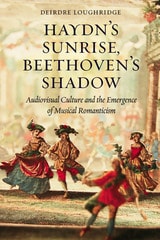
Haydn’s Sunrise, Beethoven’s Shadow
Audiovisual Culture and the Emergence of Musical RomanticismDeirdre Loughridge
University of Chicago Press, 2016
Deirdre Loughridge reveals that allusions in musical writings to optical technologies reflect their spread from fairgrounds and laboratories into public consciousness and a range of discourses, including that of music. She demonstrates how concrete points of intersection—composers’ treatments of telescopes and peepshows in opera, for instance, or a shadow-play performance of a ballad—could then fuel new modes of listening that aimed to extend the senses. An illuminating look at romantic musical practices and aesthetics, this book yields surprising relations between the past and present and offers insight into our own contemporary audiovisual culture.

Hegel on Hamann
G. W. F. Hegel
Northwestern University Press, 2008
In 1828, G. W. F. Hegel published a critical review of Johann George Hamann, a retrospective of the life and works of one of Germany's most enigmatic and challenging thinkers and writers. While Hegel's review had enjoyed a central place in Hamann studies since its appearance, Hegel on Hamann is the first English translation of the important work. Philosophers, theologians, and literary critics welcome Anderson's stunning translation since Hamann is gaining renewed attention, not only as a key figure of German intellectual history, but also as an early forerunner of postmodern thought. Relationships between Enlightenment, Counter Enlightenment, and Idealism come to the fore as Hegel reflects on Hamann's critiques of his contemporaries Immanuel Kant, Moses Mendelssohn, J. G. Herder, and F. H. Jacobi. Hegel on Hamann also includes an introduction to Hegel's review, as well as an essay on the role of friendship in Hamann's life, in Hegel's thought, and in German intellectual culture more broadly. Rounding out the volume are its extensive annotations and bibliography, which facilitate further study of eighteenth- and nineteenth-century philosophy in English and German. This book is essential both for readers of Hegel or Hamann and for those interested in the history of German thought, the philosophy of religion, language and hermeneutics, or friendship as a philosophical category.

Hemispheres and Stratospheres
The Idea and Experience of Distance in the International EnlightenmentKevin L. Cope
Bucknell University Press, 2021
Published by Bucknell University Press. Distributed worldwide by Rutgers University Press.
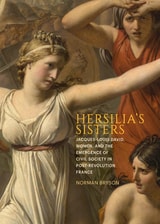
Hersilia's Sisters
Jacques-Louis David, Women, and the Emergence of Civil Society in Post-Revolution FranceNorman Bryson
J. Paul Getty Trust, The, 0
In 1799, when the French artist Jacques-Louis David (1748–1825) exhibited his Intervention of the Sabines, a history painting featuring the ancient heroine Hersilia, he added portraits of two contemporary women on either side of her—Henriette de Verninac, daughter of Charles-François Delacroix, minister of foreign affairs, and Juliette Récamier, a well-known and admired socialite. Drawing on many disciplines, Norman Bryson explains how such a combination of paintings could reveal the underlying nature of the Directoire, the period between the vicious and near-dictatorial Reign of Terror (1793–94) and the coup in 1799 that brought Napoleon to power.
Hersilia’s Sisters illuminates ways that cultural life and civil society were rebuilt during these years through an extraordinary efflorescence of women pioneers in every cultural domain—literature, the stage, opera, moral philosophy, political theory, painting, popular journalism, and fashion. Through a close examination of David’s work between The Intervention of the Sabines (begun in 1796) and Bonaparte Crossing the Alps (begun in 1800), Bryson explores how the flowering of women’s culture under the Directoire became a decisive influence on David’s art. With more than 150 illustrations, this book provides new and brilliant insight into this period that will captivate readers.
Hey Presto!
Swift and the QuacksHugh Ormsby-Lennon
University of Delaware Press, 2011
Published by University of Delaware Press. Distributed worldwide by Rutgers University Press.

Hierarchy, Commerce, and Fraud in Bourbon Spanish America
A Postal Inspector's ExposeRuth Hill
Vanderbilt University Press, 2021
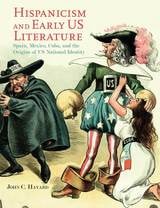
Hispanicism and Early US Literature
Spain, Mexico, Cuba, and the Origins of US National IdentityJohn C. Havard
University of Alabama Press, 2018
Revealing how Spain, Mexico, and Cuba helped shape the literary origins of American national identity.
In Hispanicism and Early US Literature, author John C. Havard posits that representations of Spain, Spanish America, Spanishness, and Spanish Americanness are integral elements in the evolution of early national and antebellum US literature. He argues that Spanish-speaking countries have long held a broad fascination for Americans and that stock narratives regarding these peoples were central to the period’s US literature.
Beginning with the work of eighteenth-century literary nationalists such as Joel Barlow, US literature has been drawn to reflect on Spain and Spanish America. Such reflection was often inspired by geopolitical conflicts such as US expansion into Spanish Louisiana and the US-Mexican War. Havard terms the discourse emerging from these reflections “Hispanicism.” This discourse was used to portray the dominant viewpoint of classical liberalism that propounded an American exceptionalism premised on the idea that Hispanophone peoples were comparatively lacking the capacity for self-determination, hence rationalizing imperialism. On the conservative side were warnings against progress through conquest.
Havard delves into selected works of early national and antebellum literature on Spain and Spanish America to illuminate US national identity. Poetry and novels by Joel Barlow, James Fenimore Cooper, and Herman Melville are mined to further his arguments regarding identity, liberalism, and conservatism. Understudied authors Mary Peabody Mann and José Antonio Saco are held up to contrast American and Cuban views on Hispanicism and Cuban annexation as well as to develop the focus on nationality and ideology via differences in views on liberalism.
More than just a work of literary criticism, there is a substantial amount of cultural and political history discussed. Havard’s use of archival sources such as political articles and personal correspondence elucidates not just literary genres and movements such as early national epic poetry, abolitionist fiction, and the American Renaissance, but also US prominent culture.

Historicizing the Enlightenment, Volume 1
Politics, Religion, Economy, and Society in BritainMichael McKeon
Bucknell University Press, 2023
Published by Bucknell University Press. Distributed worldwide by Rutgers University Press.
Historicizing the Enlightenment, Volume 2
Literature, the Arts, and the Aesthetic in BritainMichael McKeon
Bucknell University Press, 2023
Published by Bucknell University Press. Distributed worldwide by Rutgers University Press.
Homo Aestheticus
The Invention of Taste in the Democratic AgeLuc Ferry
University of Chicago Press, 1993
Ferry's treatise begins in the mid-1600s with the simultaneous invention of the notions of taste (the essence of art as subjective pleasure) and modern democracy (the idea of the State as a consensus among individuals). He explores the differences between subjectivity and individuality by examining aesthetic theory as developed first by Kant's predecessors and then by Kant, Hegel, Nietzsche, and proponents of the avant-garde. Ferry discerns two "moments" of the avant-garde aesthetic: the hyperindividualistic iconoclasm of creating something entirely new, and the hyperrealistic striving to achieve an extraordinary truth. The tension between these two, Ferry argues, preserves an essential element of the Enlightenment concern for reconciling the subjective and the objective—a problem that is at once aesthetic, ethical, and political.
Rejecting postmodern proposals for either a radical break with or return to tradition, Ferry embraces a postmodernism that recasts Enlightenment notions of value as a new intersubjectivity. His original analysis of the growth and decline of the twentieth-century avant-garde movement sheds new light on the connections between aesthetics, ethics, and political theory.
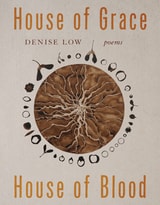
House of Grace, House of Blood
PoemsDenise Low
University of Arizona Press, 2024
In a personal poetic treatment of documents, oral tradition, and images, the author embodies the contradictions she unravels. From a haunting first-person perspective, Low’s formally inventive archival poetry combines prose and lyric, interweaving verse with historical voices in a dialogue with the source material. Each poem builds into a larger narrative on American genocide, the ways in which human loss corresponds to ecological destruction, and how intimate knowledge of the past can enact healing.
Ultimately, these poems not only reconstruct an important historical event, but they also put pressure on the gaps, silences, and violence of the archive. Low asks readers to question not only what is remembered, but how history is remembered—and who is forgotten from it. Reflecting on the injustice of the massacre, the Shawnee leader Tecumseh lamented that though “the Americans murdered all the men, women, and children, even as they prayed to Jesus . . . no American ever was punished, not one.” These poems challenge this attempted erasure.
How Russia Learned to Write
Literature and the Imperial Table of RanksIrina Reyfman
University of Wisconsin Press, 2021
Irina Reyfman illuminates the surprisingly diverse effects of the Table of Ranks on writers, their work, and literary culture in Russia. From Sumarokov and Derzhavin in the eighteenth century through Pushkin, Gogol, Dostoevsky, and poets serving in the military in the nineteenth, state service affected the self-images of writers and the themes of their creative output. Reyfman also notes its effects on Russia’s atypical course in the professionalization and social status of literary work.
Hungarian Culture and Politics in the Habsburg Monarchy 1711-1848
Gábor Vermes
Central European University Press, 2014

Hungary and the Habsburgs, 1765-1800
An Experiment in Enlightened AbsolutismÉva H. Balázs
Central European University Press, 1997