101 books match the query '1933-1945' and 5 start with h

cover of Hard Luck Blues: Roots Music Photographs from the Great Depression

Hard Luck Blues

Roots Music Photographs from the Great Depression

Rich Remsberg

University of Illinois Press, 2010

Showcasing American music and music making during the Great Depression, Hard Luck Blues presents more than two hundred photographs created by the New Deal's Farm Security Administration photography program. With an appreciation for the amateur and the local, FSA photographers depicted a range of musicians sharing the regular music of everyday life, from informal songs in migrant work camps, farmers' homes, barn dances, and on street corners to organized performances at church revivals, dance halls, and community festivals. Captured across the nation from the northeast to the southwest, the images document the last generation of musicians who learned to play without the influence of recorded sound, as well as some of the pioneers of Chicago's R & B scene and the first years of amplified instruments. The best visual representation of American roots music performance during the Depression era, Hard Luck Blues features photographs by Jack Delano, Dorothea Lange, Russell Lee, Arthur Rothstein, Ben Shahn, Marion Post Wolcott, and others.

Photographer and image researcher Rich Remsberg breathes life into the images by providing contextual details about the persons and events captured, in some cases drawing on interviews with the photographers' subjects. Also included are a foreword by author Nicholas Dawidoff and an afterword by music historian Henry Sapoznik.

Published in association with the Library of Congress.

[more]
cover of Hitler in History

Hitler in History

Eberhard Jäckel

Brandeis University Press, 2000
A leading interpreter of the Nazi period addresses crucial issues in modern European and contemporary history.
[more]
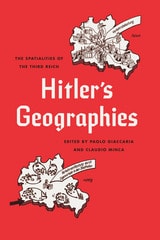
cover of Hitler's Geographies: The Spatialities of the Third Reich

Hitler's Geographies

The Spatialities of the Third Reich

Edited by Paolo Giaccaria and Claudio Minca

University of Chicago Press, 2016

Lebensraum: the entitlement of “legitimate” Germans to living space. Entfernung: the expulsion of “undesirables” to create empty space for German resettlement. During his thirteen years leading Germany, Hitler developed and made use of a number of powerful geostrategical concepts such as these in order to justify his imperialist expansion, exploitation, and genocide. As his twisted manifestation of spatial theory grew in Nazi ideology, it created a new and violent relationship between people and space in Germany and beyond.
 
With Hitler’s Geographies, editors Paolo Giaccaria and Claudio Minca examine the variety of ways in which spatial theory evolved and was translated into real-world action under the Third Reich. They have gathered an outstanding collection by leading scholars, presenting key concepts and figures as well exploring the undeniable link between biopolitical power and spatial expansion and exclusion.

[more]
cover of Hitler's Library

Hitler's Library

Ambrus Miskolczy

Central European University Press, 2003
The first book to present the so-called Hitler Library. It sheds new light on the readings of Hitler and on his techniques how to read a book. Hitler presented himself as an ideal reader of Schopenhauer, nevertheless his remarks destroy that image, particularly if we see how he read Ernst Jünger, Richard Wagner, or Paul de Lagarde, and how he reread Mein Kampf.The book describes the gnostic character of the phenomenon as an explication of the success of nazism and that of the Hitler myth and challenges the static views of traditional historiography.
[more]
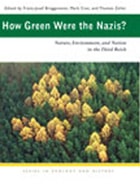
cover of How Green Were the Nazis?: Nature, Environment, and Nation in the Third Reich

How Green Were the Nazis?

Nature, Environment, and Nation in the Third Reich

Franz-Josef Brüggemeier

Ohio University Press, 2005

The Nazis created nature preserves, championed sustainable forestry, curbed air pollution, and designed the autobahn highway network as a way of bringing Germans closer to nature. How Green Were the Nazis?:Nature, Environment, and Nation in the Third Reich is the first book to examine the Third Reich’s environmental policies and to offer an in-depth exploration of the intersections between brown ideologies and green practices. Environmentalists and conservationists in Germany welcomed the rise of the Nazi regime with open arms and hoped that it would bring about legal and institutional changes. However, environmentalists soon realized that the rhetorical attention they received from the regime did not always translate into action. By the late 1930s, nature and the environment had become less pressing concerns as Nazi Germany prepared for and executed a global conflagration. Based on prodigious archival research, and written by some of the most important scholars in the field of twentieth-century German history, How Green Were the Nazis? examines the overlap between Nazi ideology and conservationist agendas. This landmark book underscores the fact that the “green” policies of the Nazis were more than a mere episode or aberration in environmental history. Contributors: Franz-Josef Brüggemeier, Mark Cioc, Thomas Zeller, Charles Closmann, Michael Imort, Thomas Lekan, Frank Uekötter, Gesine Gerhard, Thomas Rohkrämer, Mark Bassin, and Joachim Wolschke-Bulmahn.
[more]