Results by title
53 books match the query '1970-' and 3 start with h
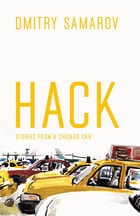
Hack
Stories from a Chicago CabDmitry Samarov
University of Chicago Press, 2011
An artist and painter trained at the School of the Art Institute of Chicago, Samarov began driving a cab in 1993 to make ends meet, and he’s been working as a taxi driver ever since. In Hack: Stories from a Chicago Cab, he recounts tales that will delight, surprise, and sometimes shock the most seasoned urbanite. We follow Samarov through the rhythms of a typical week, as he waits hours at the garage to pick up a shift, ferries comically drunken passengers between bars, delivers prostitutes to their johns, and inadvertently observes drug deals. There are long waits with other cabbies at O’Hare, vivid portraits of street corners and their regular denizens, amorous Cubs fans celebrating after a game at Wrigley Field, and customers who are pleasantly surprised that Samarov is white—and tell him so. Throughout, Samarov’s own drawings—of his fares, of the taxi garage, and of a variety of Chicago street scenes—accompany his stories. In the grand tradition of Nelson Algren, Saul Bellow, Mike Royko, and Studs Terkel, Dmitry Samarov has rendered an entertaining, poignant, and unforgettable vision of Chicago and its people.
Happy Days
Images of the Pre-Sixties Past in Seventies AmericaBenjamin L. Alpers
Rutgers University Press, 2024
Happy Days investigates how 1970s popular culture was obsessed with America’s past but often offered radically different interpretations of the same historical events and icons. Even the figure of the greaser, once an icon of juvenile delinquency, was made family-friendly by Henry Winkler’s Fonzie at the same time that he was being appropriated in more threatening ways by punk and gay subcultures. The cultural historian Benjamin Alpers discovers similar levels of ambivalence toward the past in 1970s neo-noir films, representations of America’s founding, and neo-slave narratives by Alex Haley and Octavia Butler. By exploring how Americans used the 1970s to construct divergent representations of their shared history, he identifies it as a pivotal moment in the nation’s ideological fracturing.
Hop on Pop
The Politics and Pleasures of Popular CultureHenry Jenkins, Tara McPherson and Jane Shattuc, eds.
Duke University Press, 2003
The essays cover a wide and colorful array of subjects including pro wrestling, the computer games Myst and Doom, soap operas, baseball card collecting, the Tour de France, karaoke, lesbian desire in the Wizard of Oz, Internet fandom for the series Babylon 5, and the stress-management industry. Broader themes examined include the origins of popular culture, the aesthetics and politics of performance, and the social and cultural processes by which objects and practices are deemed tasteful or tasteless. The commitment that binds the contributors is to an emergent perspective in cultural studies, one that engages with popular culture as the culture that "sticks to the skin," that becomes so much a part of us that it becomes increasingly difficult to examine it from a distance. By refusing to deny or rationalize their own often contradictory identifications with popular culture, the contributors ensure that the volume as a whole reflects the immediacy and vibrancy of its objects of study.
Hop on Pop will appeal to those engaged in the study of popular culture, American studies, cultural studies, cinema and visual studies, as well as to the general educated reader.
Contributors. John Bloom, Gerry Bloustein, Aniko Bodroghkozy, Diane Brooks, Peter Chvany, Elana Crane, Alexander Doty, Rob Drew, Stephen Duncombe, Nick Evans, Eric Freedman, Joy Fuqua, Tony Grajeda, Katherine Green, John Hartley, Heather Hendershot, Henry Jenkins, Eithne Johnson, Louis Kaplan, Maria Koundoura, Sharon Mazer, Anna McCarthy, Tara McPherson, Angela Ndalianis, Edward O’Neill, Catherine Palmer, Roberta Pearson, Elayne Rapping, Eric Schaefer, Jane Shattuc, Greg Smith, Ellen Strain, Matthew Tinkhom, William Uricchio, Amy Villarego, Robyn Warhol, Charles Weigl, Alan Wexelblat, Pamela Robertson Wojcik, Nabeel Zuberi