Results by title
81 books match the query '1980-' and 4 start with h
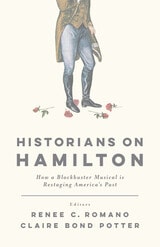
Historians on Hamilton
How a Blockbuster Musical Is Restaging America's PastRomano, Renee C
Rutgers University Press, 2018
Historians on Hamilton brings together a collection of top scholars to explain the Hamilton phenomenon and explore what it might mean for our understanding of America’s history. The contributors examine what the musical got right, what it got wrong, and why it matters. Does Hamilton’s hip-hop take on the Founding Fathers misrepresent our nation’s past, or does it offer a bold positive vision for our nation’s future? Can a musical so unabashedly contemporary and deliberately anachronistic still communicate historical truths about American culture and politics? And is Hamilton as revolutionary as its creators and many commentators claim?
Perfect for students, teachers, theatre fans, hip-hop heads, and history buffs alike, these short and lively essays examine why Hamilton became an Obama-era sensation and consider its continued relevance in the age of Trump. Whether you are a fan or a skeptic, you will come away from this collection with a new appreciation for the meaning and importance of the Hamilton phenomenon.
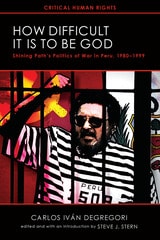
How Difficult It Is to Be God
Shining Path’s Politics of War in Peru, 1980–1999Carlos Iván Degregori; Edited and with an introduction by Steve J. Stern; Translated by Nancy Appelbaum, Joanna Drzewieniecki, Héctor Flores, Eric Hershberg, Judy Rein, Steve J. Stern, and Kimberly Theidon
University of Wisconsin Press, 2012
In How Difficult It Is to Be God, Carlos Iván Degregori—the world’s leading expert on Shining Path and the intellectual architect for Peru’s highly regarded Truth and Reconciliation Commission—elucidates the movement’s dynamics. An anthropologist who witnessed Shining Path’s recruitment of militants in the 1970s, Degregori grounds his findings in deep research and fieldwork. He explains not only the ideology and culture of revolution among the insurgents, but also their capacity to extend their influence to university youths, Indian communities, and competing social and political movements.
Making Degregori’s most important work available to English-language readers for the first time, this translation includes a new introduction by historian Steve J. Stern, who analyzes the author’s achievement, why it matters, and the debates it sparked. For anyone interested in Peru and Latin America’s age of “dirty war,” or in the comparative study of revolutions, Maoism, and human rights, this book will provide arresting new insights.

How We Write Now
Living with Black Feminist TheoryJennifer C. Nash
Duke University Press, 2024
How Women Win Presidential Elections in Latin America
Catherine Reyes-Housholder
Temple University Press, 2026
Between 1990 and 2020, women candidates won only 6% of the world’s presidential races. How Women Win Presidential Elections in Latin America explains the factors, strategies, and perceptions that help (or hinder) women to democratically access their country’s highest political office. Catherine Reyes-Housholder introduces a theory of gendered incentives and perceived potential to reveal why a political party would break with tradition and nominate a woman. She also shows how citizens respond when women candidates are running in incumbent parties or competing to displace those in power.
Drawing on comparative research on the presidency and gender, How Women Win Presidential Elections in Latin America examines the successful campaigns of Michelle Bachelet in Chile and Dilma Rousseff in Brazil, as well as why Blanca Ovelar lost her presidential race in Paraguay. Reyes-Housholder’s findings indicate that voter sexism is not a major factor; however, women do not triumph in these elections in the same ways that men do. Rather, the central unknown factor behind women’s victories is how they become candidates of major parties—and gender profoundly influences who parties nominate.
How Women Win Presidential Elections in Latin America is a valuable investigation of women and executive politics.