Results by title
313 books match the query 'Administration' and 6 start with h
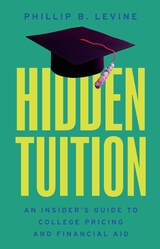
Hidden Tuition
An Insider's Guide to College Pricing and Financial AidPhillip B. Levine
University of Chicago Press, 2026
The secret economics of maximizing college financial aid (and why it’s not as miserable as you think).
In the college admissions process, a terrifying unknown looms large: How much is this really going to cost? For prospective students and their families, there’s no easy answer. While college prices continue to rise, so do their promises of financial aid for qualified students. But who qualifies? And for how much? How can this monumental life decision be so utterly impossible to understand?
Hidden Tuition is an insider’s guide for navigating college financial aid to maximum effect and with (relatively) minimal pain. Economist and financial-aid expert Phillip B. Levine draws on his unique experience—including years of research in higher-education finance and work alongside admissions and financial-aid departments—to help readers first identify, then minimize, what they’ll actually pay for different types of colleges based on their circumstances. With expertise, clarity, and the warmth of someone who’s been through it, Levine details how students can find the hidden tuition costs in the opaque landscape of college pricing and financial aid. He explores topics that include:
- Why college’s “sticker prices” are rarely what students pay—and how some actual prices are even going down
- The best, worst, and most surprising deals for students with different financial resources
- How to navigate financial aid for divorced and multi-residence households
- Who really benefits from early decision
- How the nature of scholarships and merit-based aid is often framed in misleading ways
- The pros and cons of college savings accounts
- When and how to get started on college financing
- Why all student loans aren't the same (or aren't all that bad)
Debunking common myths and offering practical guidance for both families and individual students, Hidden Tuition makes a maddeningly imperfect process more manageable—and gives students a clearer path through one of life’s biggest financial decisions towards collegiate success.
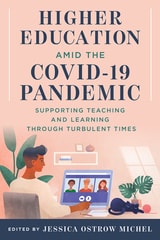
Higher Education amid the COVID-19 Pandemic
Supporting Teaching and Learning through Turbulent TimesJessica Ostrow Michel
Rutgers University Press, 2024

Higher Education and the State in Latin America
Private Challenges to Public DominanceDaniel C. Levy
University of Chicago Press, 1986
Levy shows how specific national circumstances cause variations and identifies three basic private-public patterns: one in which the private and public sectors are relatively similar and those in which one sector or the other is dominant. These patterns are analyzed in depth in case studies of Chile, Mexico, and Brazil. For each sector, Levy investigates origins and growth, and then who pays, who rules, and whose interests are served.
In addition to providing a wealth of information, Levy offers incisive analyses of the nature of public and private institutions. Finally, he explores the implications of his findings for concepts such as autonomy, corporatism, and privatization. His multifaceted study is a major contribution to the literature on Latin American studies, comparative politics, and higher education.
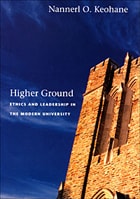
Higher Ground
Ethics and Leadership in the Modern UniversityNannerl O. Keohane
Duke University Press, 2006
Keohane regards colleges and universities as intergenerational partnerships in learning and discovery, whose compelling purposes include not only teaching and research but also service to society. Their mission is to equip students with a moral education, not simply preparation for a career or professional school.
But the modern era has presented universities and their leadership with unprecedented new challenges. Keohane worries about access to education in a world of rising costs and increasing economic inequality, and about threats to academic freedom and expressions of opinion on campus. She considers diversity as a key educational tool in our increasingly pluralistic campuses, ponders the impact of information technologies on the university’s core mission, and explores the challenges facing universities as they become more “global” institutions, serving far-flung constituencies while at the same time contributing to the cities and towns that are their institutional homes.
Reflecting on the role of contemporary university leaders, Keohane asserts that while they have many problems to grapple with, they will find creative ways of dealing with them, just as their predecessors have done.
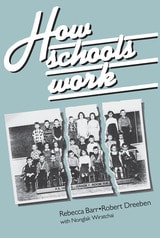
How Schools Work
Rebecca Barr and Robert Dreeben
University of Chicago Press, 1988
Viewing schools as part of a social organization with a hierarchy of levels—district, school, classroom, instructional group, and students—avoids the common pitfalls of lumping together any and all possible influences on student learning without regard to the actual processes of the classroom. Barr and Dreeben systematically explain how instructional groups originate, form, and change over time. Focusing on first grade reading instruction, their study shows that individual reading aptitude actually has little direct relation to group reading achievement and virtually none to the coverage of reading materials once the mean aptitude of groups is taken into consideration. Individual aptitude, they argue, is rather the basis on which teachers form reading groups that are given different instructional treatment. It is these differences in group treatment, they contend, that explain substantial differences in learning curricular material.
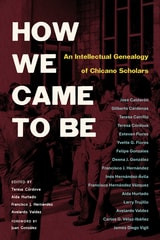
How We Came to Be
An Intellectual Genealogy of Chicano ScholarsEdited by Teresa Córdova, Aída Hurtado, Francisco J. Hernández, Avelardo Valdez; Foreword by Juan González
University of Arizona Press, 2026
This work chronicles the lives and legacies of Chicana and Chicano scholars whose formative experiences in the Chicano Movement shaped the development of Chicano studies and transformed higher education. Originating from the Reuniónes de Colegas—gatherings of veteran scholars reflecting on their shared histories—the volume features sixteen essays organized into five thematic sections that explore the intersections of activism, scholarship, and institutional change.
The contributors document how grassroots organizing evolved into academic inquiry, leading to the creation of departments, student support systems, and policy reforms that advanced equity and representation in universities. Essays address how community-engaged research influenced urban planning, health advocacy, and cultural production, while also highlighting Indigenous and transnational epistemologies that redefined theoretical frameworks in Chicano studies. The volume concludes with reflections on academic leadership and the breaking of barriers by Chicana scholars in higher education administration.
Together, these essays offer a powerful intellectual history and a testament to a generation’s enduring commitment to social justice. How We Came to Be is both a scholarly archive and a call to action, preserving the legacy of those who built Chicano studies and inspiring future generations to continue the work of transformation within and beyond the academy.
Contributors
José Calderón
Gilberto Cárdenas
Teresa Carrillo
Teresa Córdova
Estevan Flores
Yvette G. Flores
Felipe Gonzales
Deena J. González
Francisco J. Hernández
Inés Hernández-Ávila
Francisco Hernández Vázquez
Aída Hurtado
Larry Trujillo
Avelardo Valdez
Carlos G. Vélez-Ibáñez
James Diego Vigil